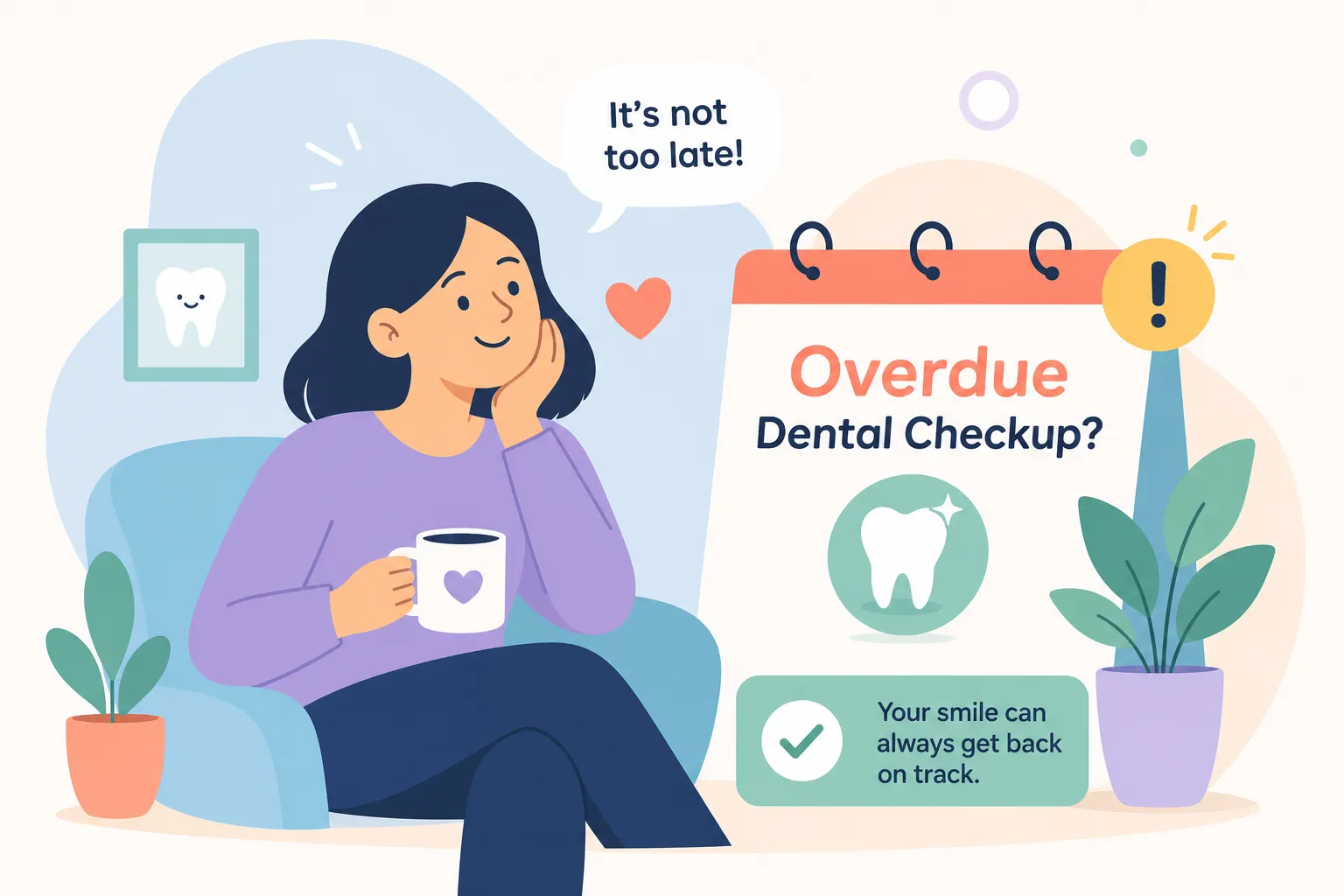



This article walks you through exactly what to expect when you come back: how long is actually too long, which symptoms mean you shouldn’t wait even a few more days, what happens during a catch-up dental visit step by step, what the dentist is likely to find, and what it will cost. Read on, and you’ll have everything you need to book with confidence.
Overdue dental exam: how long is too long between visits?
What Australian dental guidelines recommend
There is no single national rule that applies to every Australian adult. The Australian Dental Association takes a risk-based approach to recall intervals. Most adults benefit from a routine dental check-up every 6 to 12 months. Low-risk individuals with excellent oral health can sometimes stretch to 24 months with their dentist’s approval. Higher-risk groups, such as smokers, people with diabetes, or those already managing gum disease, should attend every 3 to 6 months. Children and adolescents under 18 should be seen at least once a year.
The key word is “individualised.” Your dentist is the right person to tell you how often you specifically need to come in. What dental research consistently shows is that going beyond 12 months without a check-up raises the risk of tooth decay and gum disease developing silently, without any symptoms you’d notice at home.
When an overdue dental check-up becomes higher risk
Being 6 to 12 months overdue is common and almost always very manageable. A delayed dental exam of 1 to 2 years is still in the territory where most people walk in and walk out with a clean, a small filling at most, and a straightforward plan. The picture shifts noticeably once the gap reaches 2 to 5 years. Problems that were small enough to treat simply at the 12-month mark have had time to grow quietly, and what would have been a filling may now be heading toward a crown.
A gap of 5 years or more increases the chance of finding heavier tartar buildup, gum disease that has progressed beyond gingivitis, and multiple cavities at different stages. This isn’t said to alarm you, it’s an honest reason to book now rather than next month.
Symptoms that mean you should not wait for a routine booking
Pain and swelling that need urgent attention
Some symptoms require same-day dental care rather than a routine recall appointment. Seek urgent help if you have severe or throbbing tooth pain that wakes you at night or doesn’t ease with over-the-counter medication, facial or jaw swelling (especially if it feels warm and is spreading), a foul taste in your mouth suggesting pus, or a fever paired with tooth pain. These are signs of a possible abscess or spreading infection that can worsen rapidly within hours.
If swelling is affecting your ability to breathe or swallow, or if it is spreading toward your neck or eye, do not wait for a dental appointment. Go directly to the emergency department or call 000 (Triple Zero). This is the one situation that genuinely warrants bypassing the dentist entirely.
Signs that are concerning but not an emergency
There is a middle ground of symptoms that aren’t emergencies but should prompt you to book within days rather than weeks. Sensitivity that lingers for more than a few seconds after hot or cold food, a chipped or cracked tooth with mild discomfort, a lost filling or crown, and gums that bleed consistently when you brush all fall into this category. They won’t resolve on their own, and leaving them simply allows a smaller problem to become a larger one. Sunbury Dental Group accommodates urgent dental situations in the Sunbury area, so if something changes suddenly, there is a clear path forward, contact the practice directly to discuss your options.
What to expect at an overdue dental exam, step by step
Your history review and the initial conversation
When you arrive, you’ll update your medical and dental history. This covers your current medications, any health changes, how long it’s been since your last visit, and any symptoms you’ve noticed. It sounds administrative, but this information shapes everything that follows. The conversation with your dentist or hygienist is genuinely two-way: they want to understand your concerns, your comfort level, and what you’re hoping to get out of the appointment. Nobody is keeping score on how long it’s been.
The comprehensive examination
The clinical exam covers every tooth visually and with a small probe, checking for decay, cracks, worn enamel, and the condition of any existing fillings or crowns. Your gums are assessed using a fine probe that measures pocket depth, which is how the dentist identifies early or established gum disease. Your bite and jaw are evaluated, and a soft-tissue screening checks your cheeks, tongue, and palate for any unusual spots.
Digital X-rays are standard at a catch-up visit, particularly if it has been more than a year since your last set. X-rays reveal decay between teeth, bone changes below the gumline, and hidden infections that a visual exam simply cannot detect. They use a very low dose of radiation and are completed in minutes.
Scale and polish, and when deeper cleaning is needed
The hygienist removes hardened tartar and plaque from all tooth surfaces, polishes away surface stains, and goes through your home-care routine with you. For most people at a standard overdue dental exam, this is a thorough clean that leaves your teeth feeling noticeably smoother. If there is significant buildup or evidence of early gum disease, the hygienist may recommend scaling and root planing, a deeper clean that works below the gumline to remove bacteria from within the gum pockets. This is different from a routine dental scale and polish: it targets active periodontal disease, sometimes requires a second appointment, and is usually done with numbing gel or local anaesthetic to keep things comfortable.

What a dentist is likely to find (and how serious it usually is)
Common findings after 1 to 2 years away
For most people who are overdue by a year or two, the findings are manageable: perhaps one or two small cavities and some tartar buildup that a thorough clean will address. A couple of fillings, a good clean, and a treatment plan that wraps up in one or two short follow-up appointments. Costs stay reasonable, recovery time is typically minimal, and the whole process is far less daunting than most people expect before they arrive.
How findings change the longer the gap
A five-year gap shifts the picture meaningfully. Tartar buildup is heavier, gingivitis has often progressed to periodontitis, and small cavities that were once a one-appointment fix may now need a crown or root canal treatment. Periodontitis, unlike gingivitis, involves actual bone loss around the teeth and cannot be reversed, only managed with deeper ongoing treatment. A gap of ten years or more raises the likelihood of finding multiple issues at different stages, requiring staged treatment over several visits.
The message here isn’t to catastrophise. It’s simply this: the earlier you come in, the simpler and more cost-effective treatment almost always is. Catching a problem at the two-year mark rather than the seven-year mark makes a genuine difference to both your wallet and your experience in the chair.
What it costs and what financial support is available
Typical out-of-pocket costs in Australia
A full catch-up appointment at a private clinic, including an examination, two bitewing X-rays, and a scale and polish, typically costs between $200 and $350, based on published dental fee surveys and ADA schedule data. As a general guide, an examination runs around $75 to $95, a scale and polish around $120 to $135, and two bitewing X-rays around $80 to $140. These are estimates and vary by practice and location. Some clinics offer new-patient packages that bundle these items at a reduced combined rate, which can make the first appointment more accessible than a line-by-line breakdown might suggest.
Ways to reduce what you pay
There are several straightforward options worth knowing about before you book. Private health insurance often covers one check-up and clean per year, sometimes at no gap or very low out-of-pocket cost. The Child Dental Benefits Schedule provides up to $1,132 over two consecutive calendar years for eligible children aged 0 to 17, covering examinations, X-rays, cleans, fillings, and extractions through Medicare. Concession card holders can access reduced-cost or free care through community health centres and public dental services. University dental clinics are also worth considering, as they typically charge substantially less than a private practice, often well below standard private fees.
At Sunbury Dental Group, transparent pricing means you’ll understand exactly what your appointment involves and what it costs before any treatment begins. Flexible payment options are available so that cost doesn’t become the reason you delay any further.
Why coming back is always the right move
What judgement-free dental care actually looks like
Experienced dentists have genuinely seen every situation. They are not surprised by long gaps, and their job is not to lecture you but to figure out where things stand and build a plan that works for you. A well-run clinic welcomes a returning patient with a calm conversation, clear explanations, and options presented without pressure, you control the pace entirely. If you want to address the most urgent items first and schedule the rest over time, that is a completely normal way to approach it.
How to book and what to do beforehand
Before you call, jot down any symptoms you’ve noticed, any changes in your health or medications, and roughly how long it has been since your last visit. Sharing this information upfront lets the team allocate the right amount of time for your appointment and prepare accordingly. There is no need to pre-explain or apologise for the gap.
Sunbury Dental Group is a locally owned practice at 5/92 Evans Street, Sunbury, led by AHPRA-registered dentist Dr Nita Kumari. The practice is equipped with digital X-rays and modern diagnostic technology to make catch-up visits as efficient and comfortable as possible. Serving families and adults across Sunbury and surrounding suburbs, including Diggers Rest, Riddells Creek, and Gisborne, the team welcomes new and returning patients without judgement. If you’re ready to come back, booking online is the first and most important step.
The bottom line
An overdue dental exam is not a moral failing. Missed dental appointments and delayed check-ups are an extremely common situation, and returning now will always be better than waiting longer. For most people, a catch-up appointment means a clean, a small filling if needed, and a clear plan going forward. Costs are manageable, particularly with private health cover or concession support, and the process is far more straightforward than most people anticipate while they’re putting it off.
If you have any of the urgent symptoms described above, severe pain, facial swelling, or fever, seek care today rather than scheduling a routine visit. For everyone else, every day you wait is simply more time for small issues to grow. Contact Sunbury Dental Group to arrange your overdue dental exam and start the conversation in a calm, welcoming environment where the only goal is to help you get back on track.
FAQ – Overdue Dental Exam
What counts as an overdue dental exam?
An overdue dental exam is any check-up that falls outside the recommended 6 to 12 month window most adults are advised to follow, with the risk generally increasing the longer the gap extends beyond 12 months.
Is it bad to have an overdue dental exam for years?
Going several years without an overdue dental exam raises the chance of finding heavier tartar buildup, advanced gum disease, and multiple cavities, but it is still very manageable and does not mean you’ve done permanent damage.
What happens during an overdue dental exam appointment?
An overdue dental exam typically includes a health history review, a full visual and probe examination of teeth and gums, digital X-rays, and a professional scale and polish to remove built-up plaque and tartar.
Will the dentist judge me for an overdue dental exam?
No, experienced dental teams treat an overdue dental exam as a routine situation they encounter every week, with the focus placed on building a comfortable plan forward rather than commenting on the delay.
How much does an overdue dental exam cost in Australia?
A typical overdue dental exam including examination, two bitewing X-rays, and a scale and polish costs between 200 and 350 dollars, with individual items ranging from around 75 to 95 dollars for the exam alone.
What symptoms mean I shouldn’t wait for an overdue dental exam?
Severe throbbing pain, facial or jaw swelling, a foul taste suggesting pus, or fever alongside tooth pain are signs that require urgent same-day care rather than waiting to book a routine overdue dental exam.
Does health insurance cover an overdue dental exam?
Most private health insurance plans cover one check-up and clean per year, often at no gap or low out-of-pocket cost, making an overdue dental exam more affordable than expected.
Can an overdue dental exam find serious problems after 5 years?
Yes, a five-year gap often reveals progressed gum disease, heavier tartar, and cavities that may now require a crown or root canal rather than a simple filling, so booking an overdue dental exam sooner keeps treatment simpler.
Do children need an overdue dental exam too?
Yes, children and adolescents under 18 should be seen at least once a year, and an overdue dental exam for a child may be partly covered under the Child Dental Benefits Schedule for eligible families.
How do I book an overdue dental exam at Sunbury Dental Group?
You can book an overdue dental exam online or by calling the practice directly at (03) 9717 7311, with no need to explain or apologise for the gap since the team simply builds a plan based on where things currently stand