
Dentist Visit Frequency: What’s Right for You and Your Family
Dentist visit frequency is one of those topics where common knowledge and clinical evidence don’t quite line up. Ask most people how often they visit the dentist and they’ll say “every six months.” Ask them why, and you’ll usually get a shrug. The twice-yearly rule has been part of Australian dental culture for so long that most patients accept it without question. But here’s the thing: it was never a clinical standard. It was a marketing convention, and the research has since moved well beyond it.
Your dentist visit frequency should be tailored to your individual needs and risk factors.
Understanding dentist visit frequency is essential for maintaining optimal oral health.
The latest systematic reviews, including a 2023 updated Cochrane analysis, are clear that for low-to-moderate risk adults, there is little or no measurable difference in decay, gum disease, or quality of life between visits at six, twelve, or even twenty-four months. For high-risk patients managing gum disease, diabetes, or active decay, however, research indicates six months is often not enough, with many requiring three- to four-monthly recalls, and sometimes more frequent visits depending on clinical stability. Your actual risk profile is what determines the right schedule, not the calendar.
In determining your dentist visit frequency, it’s crucial to consider various health indicators.
At Sunbury Dental Group, recall intervals are set by clinical assessment, not a reception desk default. This article walks you through what the evidence says, how your own risk factors change the equation, and how to work with your dentist to set a schedule that genuinely reflects your oral health needs.
Every patient’s dentist visit frequency can differ based on their oral health conditions.
What the evidence says about dentist visit frequency
Research on dentist visit frequency indicates that personal health factors play a vital role.
Where the six-month habit came from
The twice-yearly dental visit was popularised in the United States during the early twentieth century through a toothpaste advertising campaign, not a clinical trial. It became a cultural norm before evidence-based dentistry existed in its modern form. By the time researchers began formally studying recall intervals, the six-month rule was already deeply embedded in public expectation and practice management systems.
What systematic reviews found about fixed intervals
The 2023 updated Cochrane review found that for adults without severe periodontitis, visits at six, twelve, and twenty-four months produced little or no difference in caries, gingivitis, probing depths, and quality of life. For low-risk adults specifically, roughly thirty per cent of the general population, extending intervals to twenty-four months carries no detectable detriment. The review concluded that no specific fixed frequency can be universally advocated, and that providing six-monthly check-ups regardless of risk does not improve oral health outcomes.
Why regular attendance still matters more than exact timing
This does not mean skipping dental care altogether. The same Cochrane and supporting reviews consistently show that regular attendance, even at extended intervals, is associated with less tooth loss, fewer missing teeth, and better quality of life compared to sporadic or problem-driven visits. Oral cancer is a particularly clear example: people who never had routine check-ups showed roughly twelve times higher oral cancer risk than those who attended at least yearly. The message is not “go less often” but rather “go at the right interval for you.”
Finding the right dentist visit frequency ensures better preventive care.
What Australian dental guidelines recommend for adults
The ADA Australia’s position on dentist visit frequency
The Australian Dental Association explicitly rejects the one-size-fits-all six-month rule in favour of risk-based recall. The ADA’s position is that visit frequency should be determined by assessing each patient’s individual risk for dental disease, taking into account gum health, caries history, medical conditions, lifestyle, and oral hygiene habits. This aligns Australian guidance with updated international best practice from both the NHS and the American Dental Association.
Dental professionals recommend adjusting your dentist visit frequency based on specific needs.
Recommended intervals by risk level
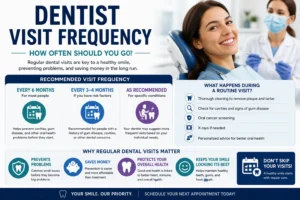
Dentist visit frequency recommendations vary considerably depending on individual risk. The table below summarises the typical intervals used in Australian clinical practice:
Factors influencing dentist visit frequency include age, health status, and history of oral disease.
| Risk Level | Profile | Recommended Interval |
|---|---|---|
| Low risk | Healthy gums, no active decay, good oral hygiene, no significant medical conditions | Every 12 months or longer |
| Moderate risk | Occasional calculus, mild gingivitis, or a history of one or two fillings per year | Every 6 months |
| High risk | Active gum disease, diabetes, smoking, dry mouth, or frequent decay history | Every 3, 4 months |
| Active disease management | Unstable or Grade C periodontitis requiring close monitoring | Every 2, 3 months or as directed |
Recall intervals generally should not exceed twenty-four months for adults or twelve months for patients under eighteen.
Regular assessment of your dentist visit frequency can lead to improved dental health.
How Australian guidance compares internationally
By comparison, international bodies take varying positions on recall intervals. The CDC sets a minimum of once per year for adults and acknowledges that twice-yearly visits are better for most, making it the only major body with a stated minimum. The NHS takes a fully individualised approach with no fixed rule, extending low-risk patients to twelve to twenty-four months without concern. Australian guidance sits between the two: six months remains a common default, but personalised, risk-based intervals are increasingly recognised as best practice.
Experts emphasize understanding your dentist visit frequency for better long-term outcomes.
Risk factors that shorten your dental recall interval
Gum disease and periodontal maintenance
Adjusting your dentist visit frequency based on your risk factors is critical for effective care.
Active periodontitis typically requires recall every three to four months. Biofilm re-establishes itself quickly in periodontal pockets, and without professional removal on a regular cycle, disease progression can be rapid and difficult to reverse. For patients with unstable or Grade C periodontitis, visits every two months may be necessary until clinical stability is achieved. Once a patient reaches a stable state with reduced probing depths and minimal bleeding, the interval can be gradually extended based on clinical findings.
Diabetes, smoking, and high caries risk
Diabetes alters the tissue response to plaque and significantly increases susceptibility to destructive periodontal disease, placing most diabetic patients on a three- to six-monthly schedule. Smoking shifts a patient toward higher periodontal risk grades and may require bimonthly visits until the risk is reduced. Patients with a history of frequent decay are also typically started on a three-month recall, as rapid caries progression makes longer intervals a genuine clinical risk rather than just a precaution.
Other factors that affect how often you should visit
Dry mouth caused by medications reduces the protective buffering capacity of saliva, significantly elevating caries risk and warranting closer monitoring. Dental implants require three- to six-monthly review to screen for peri-implant disease, which can progress without obvious symptoms. Pregnancy, immunocompromised states, and conditions like acid reflux or haematological disorders also influence the appropriate interval. Your dentist assesses all of these factors together, not in isolation, to arrive at a recommendation that fits your whole clinical picture.
Consulting your dentist about your dentist visit frequency can clarify your oral health needs.
How often children should visit the dentist
Establishing a suitable dentist visit frequency is vital for children’s dental health.
When to schedule a child’s first dental visit
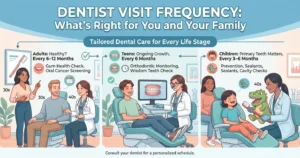
Australian paediatric dental guidelines recommend the first visit by twelve months of age, or within six months of the first tooth appearing. Early visits serve multiple purposes: the dentist can monitor tooth eruption patterns, identify early signs of decay, and coach parents on appropriate diet and cleaning techniques before habits become entrenched. Evidence from paediatric dentistry research suggests that children who attend from an early age may be less likely to develop dental anxiety compared to those who only visit when a problem arises.
Typical recall intervals for children and teenagers
Most children are seen every six months as a standard schedule. Healthy, low-risk children may safely extend to annual visits, but patients under eighteen are not extended beyond twelve months regardless of risk level. High-risk children with poor diet, developing decay, or inadequate oral hygiene are kept to three- to six-monthly intervals until their risk status stabilises. The goal with children is always to stay ahead of problems, because primary teeth matter for speech, chewing, and the proper development of adult teeth.
Preventive milestones worth planning for
Childhood recall visits are not just for checking for cavities. Fissure sealants, which protect the grooves of permanent molars from decay, are typically applied during recall appointments when the relevant teeth erupt, in line with Australian Dental Association and paediatric dentistry guidance on preventive timing. Fluoride applications, diet counselling, and mouthguard fitting for sports all occur within the recall visit schedule. Maintaining consistent attendance means these preventive steps happen at the right time rather than being missed.
Regular reviews of your dentist visit frequency can enhance preventive care for your family.
The long-term value of keeping up with preventive visits
What a routine check-up and clean costs in Australia
A standard exam and scale and clean bundle in Victoria typically falls between $150 and $350. A full check-up package including X-rays and fluoride generally ranges from $280 to $480 in 2026. Private health insurance often reduces this significantly, with average rebates around $124, and many funds offer no-gap preventive cover for eligible members. Public dental options are also available for concession card holders, with fees capped at significantly lower amounts.
Preventive care versus the cost of delaying treatment
The financial case for regular visits becomes clear when you compare a routine clean to the cost of what develops without one. Deep periodontal cleaning for established gum disease can reach $800 to $1,600 for a full mouth. Crowns, bridges, and implants carry far higher costs again. Catching a small cavity at a routine visit is always cheaper than treating an abscess or a fractured tooth. Longitudinal research into preventive dental care also supports the view that regular attendance reduces overall long-term dental spending, not just the immediate bill, by intercepting problems before they escalate.
What regular visits catch beyond your teeth
Oral cancer screening, early identification of jaw issues, detection of bite changes, and assessment of wear patterns from grinding are all part of what a routine recall appointment involves. These are things patients cannot self-diagnose and that a dentist can only find by seeing you regularly. A clean and check-up is not just maintenance, it is a clinical review of your oral health by an expert who knows what to look for.
Setting a personalised recall schedule that works for you
Your dentist visit frequency should reflect your overall health and dental status.
What a proper risk assessment involves
A recall interval discussion is a clinical decision, not a quick conversation at the front desk. Your dentist reviews your periodontal charts, caries history, medical history, lifestyle factors such as smoking and diet, and current X-ray findings before recommending a frequency that reflects the full picture. Your recommended interval is reviewed at each visit and adjusted as your circumstances change, which means it evolves alongside your oral health, rather than sitting fixed from the first appointment.
Questions to ask at your next appointment
Going in with the right questions helps you get the most from the conversation. Consider asking your dentist:
- What recall interval do you recommend for me, and why?
- Am I currently low, moderate, or high risk for gum disease and decay?
- Are there specific factors in my health or habits that are shortening my interval, and could addressing them extend it?
These questions shift the appointment from a passive check-in to an informed conversation about your oral health strategy.
How Sunbury Dental Group approaches recall planning
At Sunbury Dental Group, recall intervals are built around each patient’s individual oral health status, not a calendar default. Dr Nita Kumari and the team assess gum health, caries risk, medical history, and dental history before recommending a frequency that makes genuine clinical sense. Whether that means three-monthly periodontal maintenance for a patient managing active gum disease or a straightforward annual check-up for a low-risk adult, the goal is a schedule that protects your oral health without unnecessary visits. Patients across Sunbury, Diggers Rest, Riddells Creek, and surrounding areas are welcome to book a check-up and have that personalised discussion.
The bottom line on dentist visit frequency
Ultimately, understanding your dentist visit frequency leads to a healthier smile.
Your ideal dentist visit frequency is not a single number that applies to everyone. The research is clear: low-risk adults can safely extend beyond six months, while patients managing gum disease, diabetes, or active decay genuinely need to be seen more often. For children, regular attendance from an early age builds the foundation for lifelong oral health and reduces the chance that a visit only happens when something hurts.
The most important factor is not whether you visit every six or twelve months, but that you visit regularly and that your dentist visit frequency reflects your actual clinical needs. A schedule based on your own risk profile is more effective, more efficient, and more sustainable than one borrowed from a decades-old advertising convention.
Consider the dentist visit frequency that best suits your needs for optimal health.
If you are unsure what the right dentist visit frequency looks like for you or your family, the best starting point is a straightforward conversation with your dentist. Book a check-up at Sunbury Dental Group in Sunbury VIC and get a clear, personalised recall recommendation based on your oral health, not a calendar convention.
Understanding the appropriate dentist visit frequency is key for maintaining great oral health.
The Six-Month Rule
Is the six-month dental check-up rule actually based on science?
No, the twice-yearly rule originated from an early twentieth-century US toothpaste advertising campaign, not a clinical trial. It became embedded in public expectation before evidence-based dentistry existed, and modern research has since moved well beyond a fixed one-size-fits-all interval.
What did the 2023 Cochrane review find about dental recall intervals?
The 2023 updated Cochrane review found that for adults without severe periodontitis, visits at six, twelve, and twenty-four months produced little or no difference in decay, gum disease, or quality of life. It concluded that no single fixed frequency can be universally recommended, and that six-monthly check-ups regardless of individual risk do not improve outcomes.
Does this mean I can just skip dental visits altogether?
No, regular attendance at the right interval for your risk level is still strongly linked to less tooth loss and better long-term oral health outcomes. People who never attend routine check-ups show roughly twelve times higher oral cancer risk than those who attend at least yearly, so the message is “go at the right interval,” not “go less”.
Risk-Based Recall Intervals
How often should a low-risk adult visit the dentist?
Low-risk adults, with healthy gums, no active decay, and good oral hygiene, can safely extend recall intervals to every 12 months or longer. This group represents roughly 30 percent of the general population and shows no detectable detriment from extending beyond six months.
How often should someone with gum disease or diabetes see a dentist?
High-risk patients with active gum disease, diabetes, smoking history, dry mouth, or frequent decay typically need recall visits every three to four months. Patients with unstable or Grade C periodontitis requiring close monitoring may need visits every two to three months, or as directed by their dentist.
What is the standard interval for moderate-risk patients?
Moderate-risk patients, those with occasional calculus, mild gingivitis, or a history of one or two fillings per year, are typically recommended a six-month recall interval. This remains the most common default schedule in Australian clinical practice for patients who aren’t clearly low or high risk.
What is the maximum recommended gap between dental visits?
Recall intervals generally should not exceed 24 months for adults or 12 months for patients under 18, regardless of how low-risk they appear. This ceiling exists because dental risk status can change between visits in ways that aren’t always obvious to the patient.
Australian Guidelines vs International Practice
What does the Australian Dental Association recommend?
The ADA explicitly rejects the one-size-fits-all six-month rule in favour of risk-based recall, assessing gum health, caries history, medical conditions, lifestyle, and hygiene habits for each patient. This aligns Australian guidance with updated NHS and American Dental Association best practice.
How does Australian guidance compare to the US and UK?
The CDC sets a minimum of once yearly for US adults while suggesting twice-yearly is better for most, making it the only major body with a stated minimum. The NHS takes a fully individualised approach with no fixed rule, extending low-risk patients to 12–24 months, while Australia sits between the two approaches.
Specific Risk Factors
Why does diabetes affect how often I need to see a dentist?
Diabetes alters tissue response to plaque and significantly increases susceptibility to destructive periodontal disease, placing most diabetic patients on a three- to six-monthly schedule. This is a clinical necessity rather than a precaution, since diabetic patients face genuinely faster disease progression.
Do dental implants need more frequent check-ups?
Yes, dental implants require three- to six-monthly review to screen for peri-implant disease, which can progress without obvious symptoms. Regular monitoring is important because implant complications often aren’t self-detectable until they’ve advanced.
Does smoking change my recommended dental visit schedule?
Yes, smoking shifts a patient toward higher periodontal risk grades and may require bimonthly visits until that risk is reduced. Smokers are typically moved to more frequent recall schedules alongside other high-risk groups like diabetics and those with active decay.
Children’s Dental Visits
When should a child have their first dental visit?
Australian paediatric guidelines recommend a child’s first dental visit by 12 months of age, or within six months of their first tooth appearing. Early visits let the dentist monitor tooth eruption, spot early decay signs, and coach parents on diet and cleaning before habits become entrenched.
How often should children and teens see the dentist?
Most children are seen every six months as a standard schedule, though healthy, low-risk children may safely extend to annual visits. Patients under 18 are never extended beyond 12 months regardless of risk level, and high-risk children are kept to three- to six-monthly intervals.
Cost and Value
How much does a routine dental check-up and clean cost in Victoria?
A standard exam and scale-and-clean bundle in Victoria typically costs between $150 and $350, while a full check-up package with X-rays and fluoride ranges from $280 to $480 in 2026. Private health insurance often reduces this significantly, with average rebates around $124, and some funds offer no-gap preventive cover.
Is it cheaper to visit regularly than to delay treatment?
Yes, catching a small cavity at a routine visit is always cheaper than treating an abscess or fractured tooth later. Deep periodontal cleaning for established gum disease can reach $800 to $1,600 for a full mouth, far exceeding the cost of preventive visits that could have avoided it.
Working With Your Dentist
What questions should I ask my dentist about my recall schedule?
Ask what recall interval your dentist recommends and why, whether you’re currently low, moderate, or high risk for gum disease and decay, and whether specific habits are shortening your interval. These questions turn a passive check-in into an informed conversation about your personal oral health strategy.
Sunbury Dental Group sets recall intervals through clinical assessment of gum health, caries risk, medical history, and dental history rather than a reception desk default. This might mean three-monthly periodontal maintenance for active gum disease or a straightforward annual check-up for a low-risk adult, tailored to patients across Sunbury, Diggers Rest, and Riddells Creek