
Dental Implant Failure Rate Statistics: What the Research Actually Says
If you’ve been scrolling forums at midnight searching “dental implant failure rate statistics,” we get it. Missing a tooth is stressful enough without wondering if the fix is going to fail on you too. So let’s cut through the noise and look at what the actual peer-reviewed research says, because it’s a lot more reassuring than the scary stories floating around online.
We’re Sunbury Dental Group, and we talk through implant options with families across Sunbury, Diggers Rest, Bulla, and the surrounding Hume region pretty regularly. This article pulls together what long-term studies actually show about implant success rate long term, what makes implants fail when they do, and how you can stack the odds in your favour.
Overview: What We’re Covering
Short version, before we dig in properly. We’ll look at what the biggest, longest-running studies say about how often implants actually fail, both in the short term and over 10 to 20 years. We’ll unpack the real implant failure causes, from smoking to gum disease to poor bone quality, and separate the controllable risks from the ones you can’t do much about. Then we’ll bring it back local, because your own risk profile matters more than any average.
In This Article, You’ll Discover…
What the actual dental implant failure rate statistics show across major long-term studies
Why “success” and “survival” aren’t quite the same thing in implant research
The biggest controllable and uncontrollable implant failure causes
How smoking dramatically changes your personal risk profile
What implant longevity research tells us about the 10-year and 20-year mark
Why early failure and late failure happen for completely different reasons
What you can realistically do to improve your own odds of long-term success
The Headline Numbers: What Studies Actually Show
Let’s just get straight into it, because we know that’s what you’re here for. Across dozens of long-term studies, dental implants consistently come out as one of the most reliable procedures in modern dentistry.
A major systematic review pooling data from 18 prospective studies found a 10-year implant survival rate of 96.4 percent. Other large cohort studies land in a similar range — one review of over 158,000 implants found an overall failure rate of just 2.21 percent, and another study of 10,871 implants reported similarly strong long-term outcomes. Put simply, the vast majority of implants placed today are still doing their job a decade later.
What Happens Beyond 10 Years?
This is where implant longevity research gets genuinely interesting. Survival does decline gradually the further out you go — from around 99.3 percent at one year down to roughly 92 percent at the 20-year mark, based on pooled data from more than 40 clinical studies. That’s not a sudden drop-off. It’s a slow, steady decline, and most of it happens for identifiable reasons rather than random bad luck.
Interestingly, failures don’t spread evenly across those 20 years. Most happen either very early (in the first year, usually due to failed osseointegration) or much later (after year 10, often linked to peri-implantitis or mechanical wear). The years in between tend to be remarkably stable.
Success Rate vs Survival Rate: Why the Difference Matters
Here’s something that trips a lot of people up when they’re reading implant research online. “Survival” just means the implant is still sitting in your jaw and hasn’t been removed. “Success” is a stricter measure — it accounts for bone loss, gum health around the implant, and whether it’s functioning properly, not just whether it’s technically still there.
That distinction matters because a study might report a 97 percent survival rate but a noticeably lower success rate once stricter clinical criteria are applied. One well-known 10-year study, for instance, found survival rates of over 90 percent in most patients, but success rates dropped depending on whether someone had a history of gum disease. So when you’re comparing statistics from different sources, it genuinely helps to check which measure they’re actually using.
Implant Success Rate Long Term: What the Big Reviews Found
To give you a clearer picture, here’s how implant success rate long term tends to break down across the research, roughly averaged from multiple systematic reviews:
1 year: Around 99 percent survival — this is when early failures from poor healing tend to show up.
5 years: Typically 95 to 98 percent survival across most studies.
10 years: Around 96.4 percent survival based on pooled meta-analysis data.
20 years: Roughly 88 to 92 percent survival, reflecting slow, cumulative wear and occasional late-stage complications.
Individual results vary a fair bit depending on implant brand, placement location, and patient health — some brand-specific studies report figures as high as 98.8 percent at 10 years. No study can promise you a specific outcome, and any clinic that does probably isn’t being straight with you.
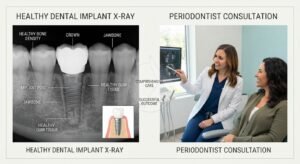
Long-term studies consistently show implants holding up well over 10 to 20 years.
Implant Failure Causes: What Actually Goes Wrong
This is probably the part you actually clicked on. What causes implants to fail, and how much of it is within your control?
The Big Controllable Risk Factors
Smoking: This is by far the most significant modifiable risk factor. Smokers face failure rates roughly 2.2 times higher than non-smokers, with some studies reporting failure rates between 6.5 and 20 percent in smokers compared to much lower rates in non-smokers.
Poor oral hygiene: Plaque buildup around an implant can trigger peri-implantitis, a gum infection specific to implants that mirrors periodontitis around natural teeth.
Untreated gum disease history: Patients with a past history of periodontitis show noticeably lower survival and success rates than those without.
Uncontrolled health conditions: Poorly managed diabetes and certain immune conditions can slow healing and reduce osseointegration success.
Excessive grinding or bite overload: Mechanical stress on an implant that isn’t properly load-balanced can contribute to later-stage failure.
The Less Controllable Factors
Bone quality and quantity: Some jaw sites naturally have denser, more supportive bone than others.
Age-related risk: Some sensitivity analyses suggest a possibly doubled risk of implant loss in older age groups.
Implant location: Studies show survival differences between single crowns and implant-supported dentures, with some reporting notably lower long-term survival for overdentures.
Individual healing response: Just like any surgical site, everyone heals a little differently.
Why Smoking Deserves Its Own Section
We’re not going to lecture anyone here — plenty of our patients smoke, and it’s a genuinely difficult habit to shake. But the research is stark enough that it’s worth being upfront about it. Nicotine causes vasoconstriction, which reduces blood flow and oxygen to the healing bone site, and it directly interferes with the cells responsible for bone formation. If you’re a smoker considering implants, this is exactly the kind of thing worth discussing openly with your dentist, because there may be strategies to reduce your personal risk.
[EXTERNAL LINK: suggest linking to the Australian Dental Association’s patient information on dental implants for further reading — ada.org.au]
Early Failure vs Late Failure: Two Very Different Stories
Something that doesn’t get explained often enough — early and late implant failure aren’t really the same problem wearing different disguises.
Early Failure (Within the First Year)
Early failure usually comes down to the implant simply not fusing properly with the bone, a process called osseointegration. One large dataset found the early failure rate during this osseointegration phase sat at around 1.56 percent, compared to an overall failure rate of 2.21 percent. This tends to be influenced by bone quality, surgical technique, and infection risk immediately after placement.
Late Failure (After Year 5 to 10)
Late failure tells a different story. It’s more commonly linked to peri-implantitis — that gum inflammation we mentioned earlier — or mechanical issues like a loosening crown or fractured component. This is where ongoing maintenance, regular checkups, and good home hygiene genuinely earn their keep.

Good hygiene habits play a real role in long-term implant success.
What Sunbury Patients Should Actually Take From This
We know statistics can feel a bit abstract when it’s your own mouth on the line. So here’s the practical version: implants remain one of the most predictable, well-researched treatments in dentistry, with failure being the exception rather than the rule. Your personal risk depends far more on your smoking status, gum health, and how well you look after the implant afterwards than on chance.
For Sunbury families weighing up an implant, that means a proper initial assessment matters enormously. Bone density, gum health, and your general medical history all factor into an honest, individualised estimate — not a generic percentage pulled from a study that may not reflect your situation at all.
A Few Questions Worth Asking Before You Proceed
What does my bone density and gum health look like specifically?
Are there any factors in my history that might raise my personal risk?
What does the maintenance schedule look like after placement?
How will we monitor for early signs of peri-implantitis?
What’s the realistic timeline for healing in my specific case?
Bringing these questions to your consult tends to lead to a much clearer, more personal conversation than any generic statistic ever could.
Frequently Asked Questions
What is the average failure rate of dental implants?
Across major long-term studies, the overall failure rate tends to sit somewhere between 2 and 5 percent, with survival rates around 95 to 98 percent at the 10-year mark. Individual risk varies depending on personal health factors like smoking and gum disease history.
How long do dental implants typically last?
Many implants last well beyond 20 years, with pooled research showing survival rates around 88 to 92 percent at that point. Longevity depends heavily on oral hygiene, regular checkups, and lifestyle factors like smoking.
What is the most common cause of dental implant failure?
Peri-implantitis, a gum infection around the implant similar to periodontal disease, is one of the leading causes of later-stage failure. Early failure, on the other hand, is more often linked to the implant not properly fusing with the jawbone.
Does smoking really affect dental implant success that much?
Yes, research consistently shows smokers face significantly higher failure rates, sometimes more than double that of non-smokers. Nicotine restricts blood flow and interferes with the bone healing process needed for the implant to integrate properly.
In many cases, yes, though it depends on the cause of the original failure and the current condition of the jawbone. A proper assessment is needed to determine whether the site can support another implant or whether an alternative approach makes more sense.
Are implant failure rates the same for everyone?
No, failure rates vary considerably based on individual risk factors like smoking, gum disease history, bone quality, and how well the implant site is maintained afterwards. That’s why a personalised assessment matters more than any general statistic.
Bringing It All Together
The research is genuinely reassuring here — dental implants show 10-year survival rates around 96 percent and remain reliable well into the 20-year mark for most patients. Where things go wrong, it’s usually down to identifiable, often manageable factors like smoking, gum disease, or inconsistent maintenance rather than the treatment itself being unreliable.
If you’re weighing up implants and want an honest, personalised look at your own risk profile rather than a generic percentage, that’s exactly the kind of conversation worth having face-to-face. Book your appointment at Sunbury Dental Group today for a proper implant assessment: