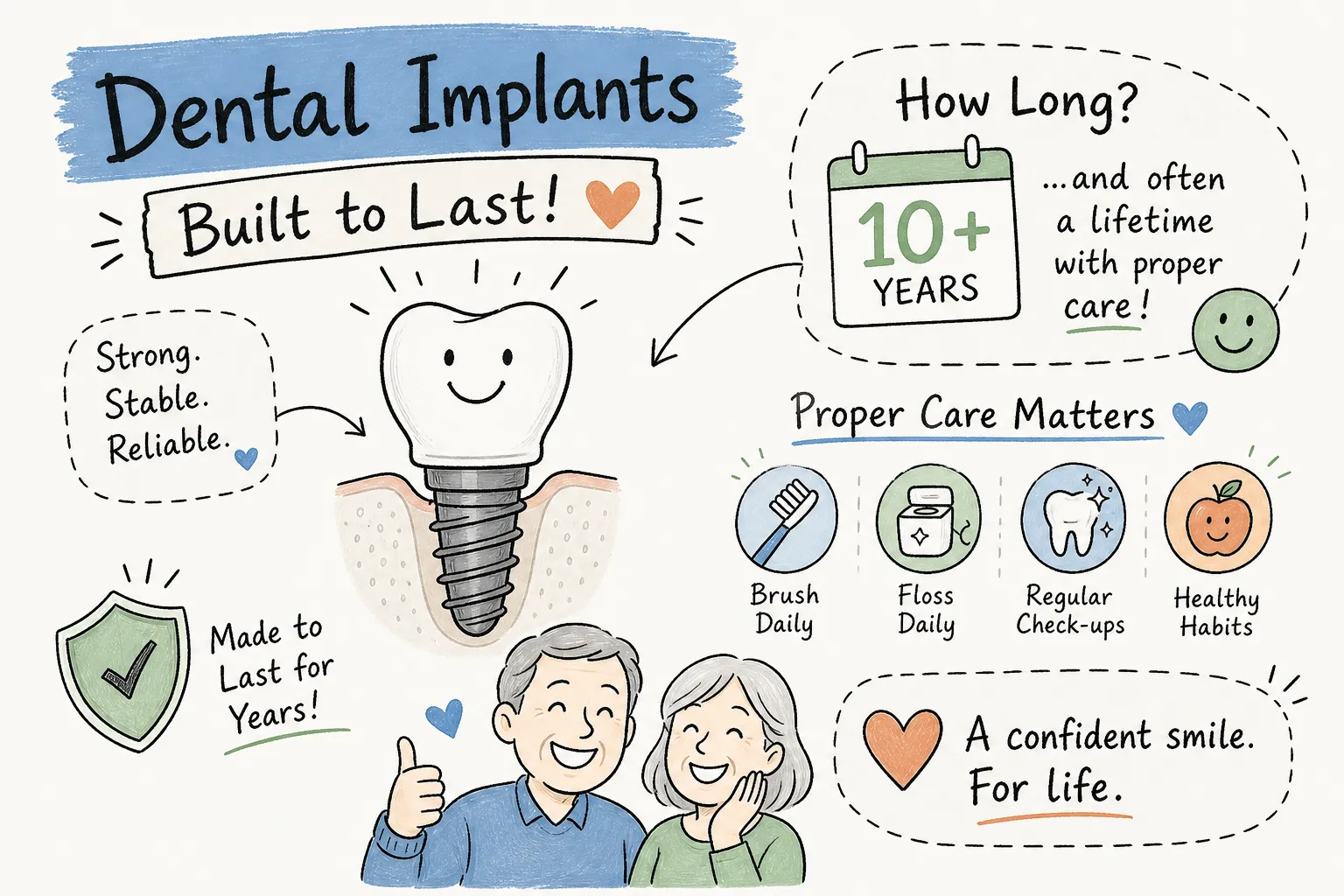
How Long Do Dental Implants Last With Proper Care?
How long do dental implants last with proper care? It’s one of the first questions patients ask at an implant consultation, and it deserves a straight answer.
Understanding how long do dental implants last with proper care is crucial for making informed decisions about your oral health.
The honest answer starts with understanding that a dental implant is not a single object with a single lifespan.
Patients often inquire about how long do dental implants last with proper care when discussing their options.
What the research actually tells us about implant lifespan
The titanium post vs the crown: two different timelines
A dental implant system has three components, each with its own lifespan.
Knowing how long do dental implants last with proper care can significantly influence patients’ expectations.
This distinction matters for how you budget and plan.
How long do dental implants last with proper care: survival rates at 5, 10, and 20 years
Clinical data on implant survival is genuinely reassuring when you look at the numbers across time. At the five-year mark, large-scale studies, including systematic reviews published in Clinical Oral Implants Research, consistently place survival rates between 95% and 98%. At ten years, those rates remain strong at 93% to 96%. By the twenty-year point, the range shifts to 78% to 92%, meaning roughly four out of every five implants are still functioning two decades after placement.
One nuance worth understanding: survival rates measured at the implant level are consistently higher than those measured at the patient level.
Ultimately, the question of how long do dental implants last with proper care can reassure patients about their investment.
The factors that cut implant longevity short
The patient factors most likely to shorten implant lifespan
Understanding how long do dental implants last with proper care helps in managing risk factors effectively.
Three patient factors stand out as the most significant threats to long-term implant survival, and each has specific data behind it. Patients who grind or clench their teeth, a condition called bruxism, face a failure rate of around 41% compared to approximately 12% in non-grinders, representing roughly 3.4 times the risk. The reason is mechanical: implants are rigidly fused to bone with no natural cushioning, so the repetitive force of grinding transmits directly to the fixture and the surrounding bone, causing micro-damage that accumulates over time.
Smoking approximately doubles the relative risk of implant failure and is a primary driver of peri-implantitis. Nicotine impairs immune response and wound healing, making it harder for your body to maintain the healthy bone environment an implant needs. Poorly controlled diabetes increases relative risk by roughly 2.75 times compared to non-diabetic patients, largely because it compromises bone healing and raises susceptibility to infection. The important and reassuring distinction here is that well-controlled diabetes produces failure rates much closer to those of non-diabetic patients. Managing your systemic health is not just good general advice; for implant patients, it is a direct input into how long your implant lasts.
Asking how long do dental implants last with proper care can lead to better health outcomes.
How peri-implantitis quietly undermines bone
Peri-implantitis is the gum disease equivalent for implants, affecting roughly one in four patients over time.
The disease begins as peri-implant mucositis, a reversible inflammation of the soft tissue around the implant that often responds well to improved home care combined with professional debridement.
Building a daily care routine that protects your implant
To ensure you know how long do dental implants last with proper care, establish a daily routine.
Brushing: the right tools and the right technique
The non-negotiable foundation of implant care is brushing twice daily for two minutes, using a soft-bristled toothbrush angled at 45 degrees toward the gumline with small, gentle circular motions. Aggressive scrubbing does not clean better; it simply irritates the gum tissue and can scratch the implant crown surface. The goal is thorough, consistent contact along the gumline rather than force.
This is especially true if you’re wondering how long do dental implants last with proper care.
Toothpaste choice matters more than most patients realise. Use a low-abrasive, non-whitening formula. Highly abrasive pastes create micro-scratches on the implant surface and the ceramic crown, and those grooves become perfect hiding places for bacteria to accumulate. A fluoride-containing, low-abrasive paste strikes the right balance: protective for your remaining natural teeth while being gentle on the implant components.
Cleaning between implants: floss, interdental brushes, and water flossers
Brushing alone cannot reach the peri-implant crevice, the narrow space between the gum and the implant surface where biofilm builds up. Cleaning this area once daily is essential. The best tool depends on your specific situation: unwaxed dental tape or superfloss works well for most single implants and is especially useful for threading under bridges; interdental brushes sized to your specific gaps are highly effective for wider spaces; and a water flosser set to low pressure is particularly useful for full-arch prostheses or for patients who find traditional flossing around an implant awkward. If you notice any gum inflammation developing, adding an alcohol-free antimicrobial rinse is worth discussing with your dentist.
For patients who grind their teeth, a custom-fitted nightguard is strongly recommended and well-supported by clinical evidence. Uncontrolled grinding is one of the fastest ways to fracture a crown or accelerate fixture failure, and no amount of careful brushing compensates for the mechanical damage that can occur while you sleep. A properly fitted nightguard substantially reduces, though does not entirely eliminate, the elevated risk associated with bruxism.
Why regular professional maintenance is where longevity is won or lost
How often you actually need to visit
Regular check-ups can also answer how long do dental implants last with proper care for individual patients.
Most implant patients benefit from a professional check-up and clean every six months. For patients with elevated risk factors, including diabetes, a history of periodontitis, heavy smoking, or a previous peri-implant complication, the recommended frequency increases to every three to four months. This is not excessive caution; it is calibrated to how quickly biofilm can build to clinically significant levels in a higher-risk mouth. One visit per year is not sufficient to effectively prevent peri-implant disease in most cases.
The first year after placement is particularly important. Bone changes occur frequently during this period as the implant settles under load, and catching any early signs of trouble at three-month intervals gives your dentist the information needed to act before a problem becomes a complication.
What an implant maintenance appointment involves at Sunbury Dental Group
An implant maintenance appointment differs from a standard check-up and clean in several important ways. At Sunbury Dental Group, our team uses plastic, titanium, or graphite scalers, rather than standard metal instruments, because metal instruments can scratch the implant surface and create rough areas that attract more bacteria. The focus is on thoroughly removing biofilm from the peri-implant crevice, the area a toothbrush simply cannot reach effectively. We also conduct specialised peri-implant probing, assess crown and abutment stability, and perform periodic radiographic review to monitor bone levels around the fixture.
These X-rays are how peri-implantitis is caught before it becomes visible or symptomatic. For patients in Sunbury, Diggers Rest, Riddells Creek, and Gisborne, accessing this level of structured, ongoing implant monitoring through a trusted local practice means you don’t need to travel to Melbourne to keep your investment protected.
Warning signs that mean you should call your dentist now
Early red flags you shouldn’t brush off
Several signs detectable at home indicate that something is changing around your implant. Bleeding when brushing or flossing around the implant site, persistent redness or swelling in the surrounding gum tissue, and tenderness to touch are the earliest indicators of peri-implant mucositis. A loose-feeling crown or abutment, or a bad taste or odour that doesn’t clear with brushing, should also prompt a prompt call to your dentist. Caught at this stage, peri-implant mucositis is reversible, it typically responds well to professional debridement and improved home care, without the need for surgical intervention.
Identifying issues early can help answer how long do dental implants last with proper care.
The critical point is not to wait and see whether these symptoms resolve on their own. Peri-implant mucositis can be reversed with timely care, but if it progresses to peri-implantitis, which involves bone loss, treatment becomes considerably more involved. Acting quickly on early symptoms keeps your options simple and non-invasive.
If symptoms progress to include visible recession of the gum around the implant, the fixture feeling mobile when pressed, pain on biting, or discharge from around the gumline, the situation has likely advanced to peri-implantitis with significant bone loss.
If symptoms progress to include visible recession of the gum around the implant, the fixture feeling mobile when pressed, pain on biting, or discharge from around the gumline, the situation has likely advanced to peri-implantitis with significant bone loss. Treatment at this stage becomes considerably more complex and may involve surgical debridement, antibiotic therapy, or implantoplasty to smooth the implant surface and reduce bacterial retention.
The difference between a straightforward professional clean and a surgical procedure often comes down to how quickly a patient acts on early warning signs. This is precisely why scheduled recall appointments exist: to detect changes in bone levels and soft tissue health before they escalate into a problem that requires far more intervention to resolve.
So, how long do dental implants last with proper care?
Ultimately, the key question remains: how long do dental implants last with proper care?
How long dental implants last when cared for properly: the honest summary
The titanium fixture is engineered to function for a lifetime in many patients.
By understanding how long do dental implants last with proper care, you can take proactive steps to maintain your implant.
Implant longevity is not just a clinical question, it is a lifestyle one. The patients who get the most from their implants are the ones who treat maintenance as part of owning the implant, not as an afterthought once the surgical phase is over.
Ultimately, understanding how long do dental implants last with proper care can empower you as a patient.
If you have an implant, are considering one, or want to set up a maintenance schedule tailored to your specific risk profile, the team at Sunbury Dental Group is ready to help. Book a consultation at our Evans Street practice and let’s put a long-term care plan in place that gives your implant the best possible chance of lasting exactly as long as it was designed to.
For more personalized guidance on how long do dental implants last with proper care, reach out to us.
Frequently asked questions about dental implant lifespan
Do dental implants last a lifetime with proper care?
The titanium fixture can last a lifetime for many patients, with long-term studies reporting 20-year survival rates of 78, 92% at the implant level. Whether your implant reaches that milestone depends significantly on daily home care, management of systemic health conditions such as diabetes, and consistent professional monitoring.
In the context of your own health, understanding how long do dental implants last with proper care is essential.
How long does the implant crown last?
Most implant crowns last 10 to 15 years before needing replacement, though zirconia crowns can extend that to 15 to 20 years or more. Bruxism, abrasive toothpastes, and poor oral hygiene all accelerate crown wear.
In conclusion, knowing how long do dental implants last with proper care can empower you as a patient.
How often should implant patients see their dentist?
Most patients benefit from a professional maintenance appointment every six months. Those with higher risk factors, including a history of periodontitis, diabetes, or smoking, are typically advised to attend every three to four months to keep peri-implant disease in check.
What is the biggest risk to implant longevity?
Peri-implantitis is the leading cause of late implant failure. It begins as reversible gum inflammation but can progress silently to irreversible bone loss if left untreated. Regular professional monitoring is the most effective way to catch it early.
Ultimately, your commitment to understanding how long do dental implants last with proper care plays a vital role in your success.
Please remember, how long do dental implants last with proper care is a critical consideration for your dental journey.