Sinus Lift Before Upper Implant: Do You Actually Need One?
So your dentist just mentioned the word “sinus lift” and now you’re picturing something way scarier than what’s actually involved. Take a breath — this is a well-established, predictable procedure, not some rare, risky add-on. It’s just one extra step some people need on the road to a stable upper implant.
Many patients wonder about the necessity of a sinus lift before upper implant procedures, as it can significantly impact the success of their dental work.
We’re Sunbury Dental Group, and we work through this exact conversation regularly with patients across Sunbury, Diggers Rest, Bulla, and the broader Hume region who are missing an upper back tooth. Let’s walk through what a sinus lift before upper implant treatment actually involves, why it’s sometimes necessary, and what the research says about how well it works.
A sinus lift before upper implant placement can create the necessary bone support needed for stability.
Overview: What This Article Covers
Understanding the importance of a sinus lift before upper implant treatment can help you make informed decisions.
We’re going to explain exactly why the upper jaw is a bit trickier than the lower jaw when it comes to implants, and why your sinuses play a bigger role in this than you’d probably expect. You’ll learn the specific bone height numbers dentists look for, what the sinus lift procedure explained step by step actually looks like, and how successful these procedures tend to be based on long-term research. We’ll also cover local considerations for anyone in the Sunbury area weighing this up.
In This Article, You’ll Discover…
Why a sinus lift before upper implant treatment is sometimes needed, and sometimes not
Considerations for a sinus lift before upper implant placement can vary based on individual bone structure.
The specific bone height measurements dentists use to decide
What actually happens during sinus augmentation dental surgery, step by step
Real success and survival rate data from long-term clinical research
Why upper jaw implant bone loss happens even years after losing a tooth
What recovery looks like and how long the whole process realistically takes
Questions worth asking your dentist before committing to this pathway
Why the Upper Jaw Is Different
Here’s the thing that surprises most people: your upper and lower jaws don’t behave the same way when it comes to implants. Your lower jaw is generally dense and forgiving. Your upper jaw, especially towards the back, sits right underneath your maxillary sinuses — the air-filled spaces behind your cheekbones — and that changes the whole equation.
When you lose an upper back tooth, the bone that used to support it doesn’t just sit there waiting patiently for an implant. Over time, your sinus floor actually drops downward into that empty space, a process called sinus pneumatization. It sounds a bit dramatic, but it’s just your body reabsorbing bone it no longer needs to support a tooth root.
Upper Jaw Implant Bone: Why It Shrinks Over Time
The longer a tooth has been missing, the more this bone loss tends to progress. This is exactly why someone who lost a molar five years ago might have noticeably less usable bone than someone who lost one last month. It’s not anyone’s fault — it’s just how bone remodelling works when it’s no longer under load.
Bone loss can necessitate a sinus lift before upper implant procedures, highlighting the importance of timely intervention.
When Do You Actually Need a Sinus Lift?
The decision for a sinus lift before upper implant surgery often depends on your unique dental anatomy.
This is the part everyone actually wants answered, so let’s get specific rather than vague.
The Bone Height Threshold
Most research and clinical guidelines point to a similar figure: if there’s less than 8 to 10 millimetres of bone height between your jaw ridge and the sinus floor, a sinus lift is typically recommended before or alongside implant placement. Some sources point to an even more conservative threshold of 10mm or less as the general trigger point for considering augmentation.
If your bone height is insufficient, a sinus lift before upper implant placement may be the best option.
Bone height of 10mm or more: Often enough for standard implant placement without augmentation
Bone height between 4mm and 10mm: Frequently requires a sinus lift, sometimes performed at the same time as implant placement
Bone height under 4mm: Usually needs a more staged approach, with grafting completed and healed before the implant goes in
Patients should discuss the possibility of a sinus lift before upper implant procedures with their dentist.
Your dentist won’t guess this from a regular checkup, by the way. It comes down to imaging.
How Dentists Actually Measure This
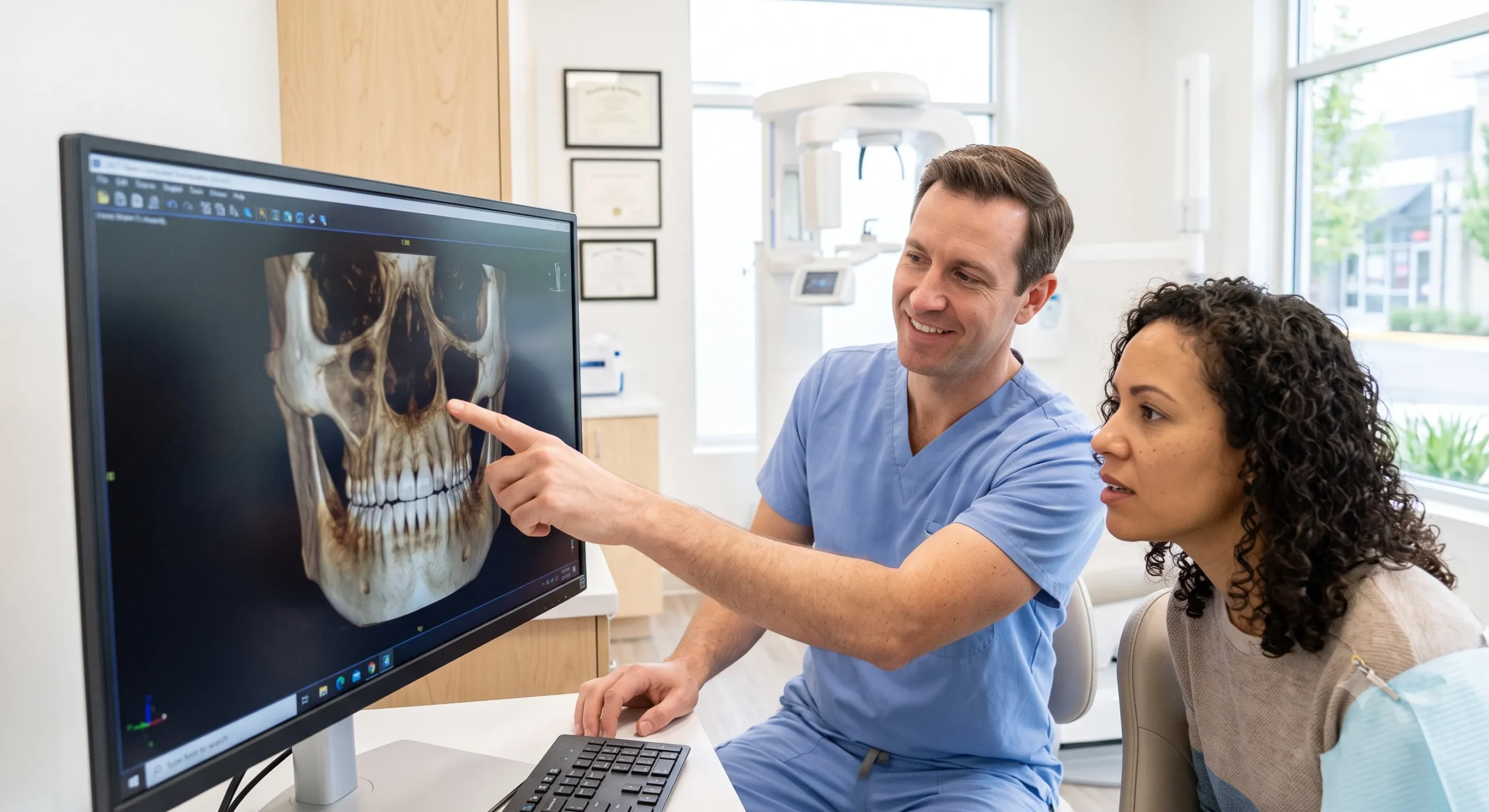
A CBCT scan (a specialised 3D dental X-ray) gives a precise measurement of bone height, width, and density at your specific implant site. This isn’t a decision made by eye or by feel — it’s based on measurable data specific to your jaw, which is exactly why a proper diagnostic scan matters before anyone commits to a treatment plan.
Imaging will reveal if a sinus lift before upper implant treatment is necessary for your particular case.
Sinus Lift Procedure Explained: What Actually Happens
Let’s demystify this properly, because the word “surgery” tends to sound scarier than the reality.
Understanding the sinus lift before upper implant process can alleviate patient anxiety about surgery.
The Two Main Approaches
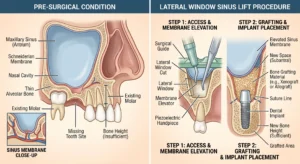
Lateral window (open) technique: Your dentist creates a small opening in the side of the jawbone, gently lifts the sinus membrane, and packs the space with grafting material to build up bone volume.
Crestal (closed) approach: A less invasive technique performed through the implant site itself, typically used when only a smaller lift is needed.
Step-by-Step, In Plain English
Your gum tissue is gently lifted to expose the bone in the treatment area
A small window or access point is created in the bone wall
Ask your dentist if a sinus lift before upper implant placement is right for your needs.
The sinus membrane is carefully lifted upward, creating space above the jaw ridge
Bone grafting material is packed into that newly created space[
The site is closed with stitches, and healing begins
After several months of healing, your implant can then be placed, either at the same time as the lift or afterwards, depending on how much bone was needed
One-Stage vs Two-Stage: Which One Applies to You?
If you’ve got reasonable existing bone height, your dentist might place the implant and perform the sinus lift in the very same appointment — this is the one-stage approach. If there’s very little bone to begin with, a two-stage approach is more common, where the graft is left to heal and mature for several months before an implant is placed into the newly built-up site.
Be prepared to discuss the sinus lift before upper implant process during your consultation.
[EXTERNAL LINK: suggest linking to a peer-reviewed overview of maxillary sinus lift procedures for further reading, such as a PubMed-indexed clinical review]
Bone grafting material creates the extra height needed for a stable implant.
Sinus Augmentation Dental Success Rates: What the Research Shows
If you’re wondering whether this whole process is actually worth it, the long-term data is genuinely reassuring.
Studies support the effectiveness of a sinus lift before upper implant surgeries in improving outcomes.
A large meta-analysis of nearly 4,000 implants placed following sinus augmentation found a survival rate of 94.3 percent. Another systematic review pooling multiple clinical trials with at least three years of follow-up found a similarly strong pooled survival rate of 97.7 percent. A 15-year retrospective study reported success rates as high as 97.2 percent for implants and 98.3 percent for the grafts themselves.
Does the Technique Used Matter?
Interestingly, research comparing direct (lateral window) and indirect (crestal) sinus lift approaches found no statistically significant difference in overall implant survival between the two methods, with figures sitting at roughly 96 percent for both. That’s reassuring if your dentist recommends one approach over the other — it’s typically based on how much lift you need, not because one method is inherently inferior.
What About Bone Height at the Time of Surgery?
One study found implants placed in sites with at least 4mm of existing bone height achieved a 100 percent success rate over 24 months, compared to 87.5 percent in sites with less than 4mm of bone at the time of surgery. This is exactly why your dentist takes bone measurements so seriously — more available bone at the outset generally means a more predictable outcome.
Your dentist will determine if a sinus lift before upper implant placement is necessary through careful evaluation.

Recovery is generally straightforward, with most discomfort settling within days.
What Recovery Actually Looks Like
Nobody loves the word “surgery,” so let’s talk honestly about what recovery involves. Most patients experience mild swelling and some discomfort for a few days, manageable with standard pain relief. Full healing of the graft site, though, takes considerably longer — usually four to nine months before the site is ready for implant placement, depending on how much bone needed to be built up.
Mild swelling and bruising around the cheek area for a few days after surgery
Recovery expectations following a sinus lift before upper implant surgery should be discussed with your dentist.
Some nasal congestion or pressure, similar to a mild sinus infection feeling, in the first week or two
Avoiding blowing your nose forcefully or flying for a period your dentist will specify
Soft foods recommended for the first week to avoid disturbing the surgical site
Follow-up appointments to monitor healing before implant placement proceeds
Knowing about the sinus lift before upper implant procedure can help you feel more prepared.
None of this should be alarming — it’s a well-managed, predictable recovery process for the vast majority of patients.
A Local Note for Sunbury Families
We see plenty of patients across Sunbury, Bulla, and the surrounding suburbs who’ve had a missing upper back tooth for years without realising bone loss was quietly progressing underneath the surface the whole time. That’s not something you can feel day to day, which is exactly why it often gets discovered during an implant consultation rather than beforehand. If it’s been a while since you lost an upper molar or premolar and you’re finally considering an implant, it’s worth getting a proper scan done early, simply so there are no surprises partway through planning.
Questions Worth Asking Your Dentist
How much bone height do I actually have at my specific implant site?
Inquire about specifics regarding a sinus lift before upper implant options during your visit.
Would a one-stage or two-stage approach suit my situation better?
How long is the healing process likely to take before my implant can go in?
What are the realistic success rates for someone with my specific bone levels?
Following the sinus lift before upper implant process can ensure a smoother journey to your new smile.
What can I do to support healing during recovery?
Frequently Asked Questions
How do I know if I need a sinus lift before an upper implant?
Your dentist determines this using a CBCT scan that measures the exact bone height at your implant site, typically recommending a sinus lift if there’s less than 8 to 10mm of bone available. It’s not something you can self-diagnose, as it depends on precise imaging.
Understanding the role of a sinus lift before upper implant procedures can help ease concerns.
Is a sinus lift a painful procedure?
Most patients report only mild discomfort and swelling for a few days afterwards, similar to other minor dental surgical procedures. Pain is generally well managed with standard over-the-counter pain relief.
How long does healing take after a sinus lift before getting an implant?
Healing time typically ranges from four to nine months, depending on how much bone needed to be built up. Your dentist will monitor healing progress before proceeding to implant placement.
Clarifying the sinus lift before upper implant timeline can aid in preparation for your surgery.
Can an implant be placed at the same time as a sinus lift?
Yes, in many cases where there’s reasonable existing bone height, the implant and sinus lift can be done in the same procedure, known as the one-stage approach. When there’s very little existing bone, a staged approach with healing time between procedures is usually safer.
What is the success rate of implants placed after a sinus lift?
Long-term research shows survival rates typically between 94 and 98 percent, depending on the study and technique used. Individual results depend on factors like existing bone quality, smoking status, and overall oral health.
Does smoking affect the success of a sinus lift and implant?
Yes, research has identified smoking as a factor that can negatively affect implant prognosis following sinus augmentation. It’s worth discussing your smoking habits openly with your dentist so they can factor this into your treatment plan.
Post-operative care following a sinus lift before upper implant is essential for successful recovery.
Bringing It All Together
A sinus lift before upper implant might be essential for achieving the best long-term results.
A sinus lift before an upper implant isn’t a red flag or a sign something’s gone wrong — it’s simply a well-established solution for a common bone-height challenge in the upper jaw. The research backs this up clearly, with survival rates consistently sitting in the mid-to-high 90s across long-term studies.
Understanding the need for a sinus lift before upper implant can help patients feel more empowered in their dental care.
If you’ve got a missing upper back tooth and you’re not sure whether you’ll need a sinus lift before upper implant, the only real way to know is with a proper scan and assessment. Book your appointment at Sunbury Dental Group today to find out what your bone levels actually look like:
Consulting with a professional regarding a sinus lift before upper implant is crucial for optimal outcomes.
Book My Implant Bone Assessment
Many patients benefit from the sinus lift before upper implant process, which can enhance stability and success.
Ultimately, the sinus lift before upper implant serves as a valuable step towards achieving a healthy smile.