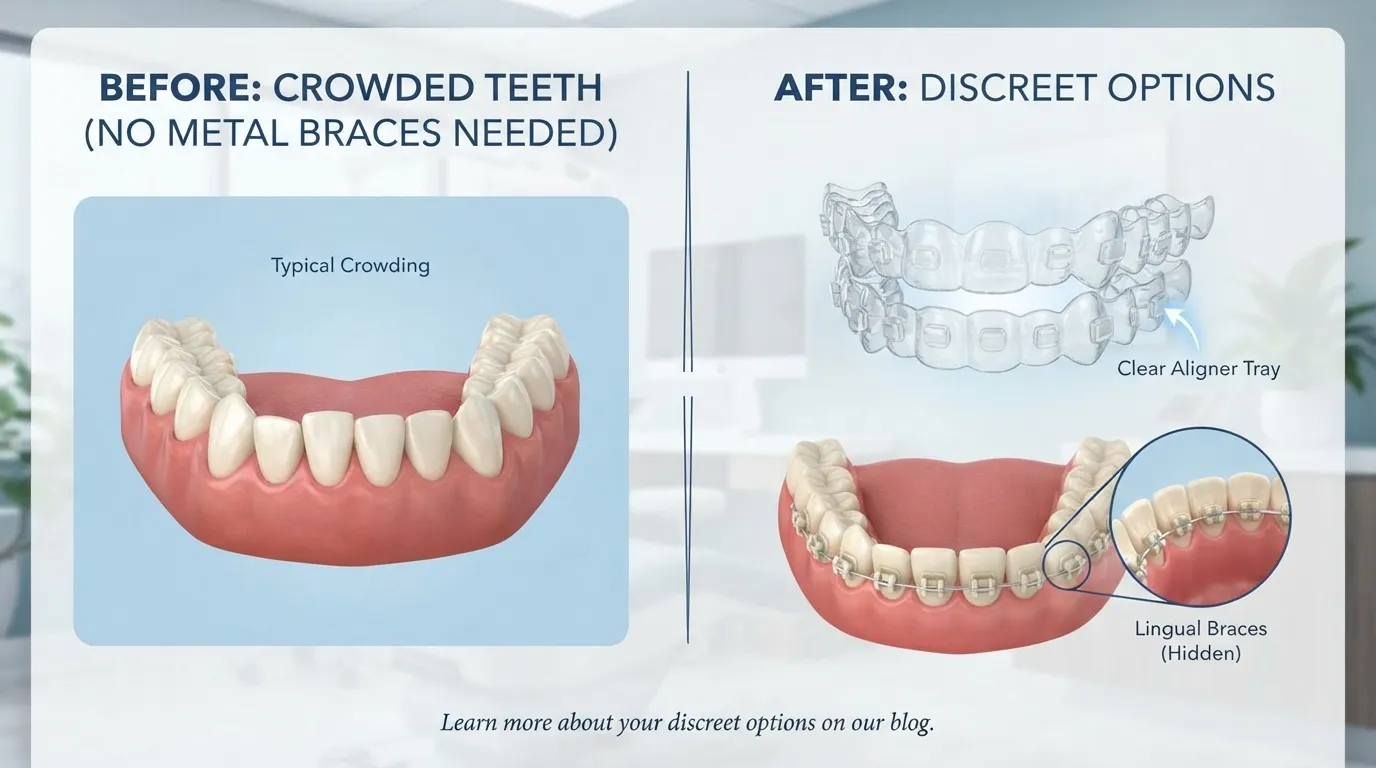
If you’ve been putting off treatment for crowded teeth because you’re dreading a mouth full of metal brackets, you’re not alone. It’s one of the most common reasons adults in Sunbury delay orthodontic care for years, sometimes decades. The good news? Metal braces aren’t the only road to a straighter smile anymore.
There are genuinely discreet options crowded teeth sufferers can consider today, and most of them fit around a busy family life, a demanding job, or a teenager who’d rather die than wear “train tracks” to school. This guide walks you through what’s actually available, how each discreet options crowded teeth method performs, and how to figure out which one suits your situation.
Overview: What This Guide Covers
We’re breaking down the main discreet alternatives to traditional braces — clear aligners, ceramic braces, and lingual braces — and looking honestly at where each one shines and where it struggles. You’ll get a clear picture of how crowding severity affects your options, roughly how long treatment takes, and what it might cost. We’ll also flag the questions worth asking at your consultation, because the right choice really does depend on your specific bite, not just your budget or preference.
In exploring discreet options crowded teeth, we’ll emphasize how these treatments can seamlessly integrate into everyday life.
In This Article, You’ll Discover…
The difference between clear aligners, ceramic braces, and lingual braces — and which suits mild versus severe crowding
Why clear aligners crowding treatment has a high success rate for mild-to-moderate cases, based on published research
Realistic timeframes for straightening crowded teeth discreetly
What invisible orthodontics actually costs in Australia, and what affects that price
Signs your crowding might need a specialist assessment rather than a general dental clinic
Questions to ask before committing to any treatment plan
Why “invisible” doesn’t always mean “invisible” — the honest trade-offs of each option

Why Crowded Teeth Happen in the First Place
Crowding isn’t just a cosmetic quirk. It usually comes down to a mismatch between the size of your jaw and the size of your teeth, sometimes made worse by early tooth loss, thumb-sucking habits from childhood, or simply genetics. Whatever the cause, crowded teeth can trap plaque in hard-to-reach spots, which raises your risk of decay and gum disease over time.
That’s part of why we don’t just look at crowding as a smile issue at Sunbury Dental Group. It’s a bite and hygiene issue too, and that context matters when you’re choosing a treatment path.
Clear Aligners for Crowding: The Most Popular Discreet Option
Clear aligners have become the go-to choice for adults who want straighter teeth without anyone at the office noticing. They’re a series of custom, removable plastic trays, each one nudging your teeth slightly closer to their ideal position before you switch to the next set.
Here’s the honest picture on effectiveness. Research published in a peer-reviewed orthodontic journal found clear aligner treatment resolved crowding with 87% predictability in the upper arch and 81% in the lower arch. Separately, clinical data suggests aligners achieve favourable outcomes in roughly 80% to 96% of mild-to-moderate misalignment cases. That’s a strong track record, though it’s worth being upfront: individual results vary depending on your specific bite, how disciplined you are with wear time, and how complex your case actually is.
What makes clear aligners appealing:
They’re virtually invisible once in place
You can take them out to eat, brush, and floss
There’s no metal to catch on your cheeks or lips
Most people adjust to speaking normally within days
The catch? They demand discipline. You’ll need to wear them 20 to 22 hours a day for them to work as planned, and skipping days can slow your progress or affect your outcome. If you’re the type who’d “forget” to put them back in after lunch, that’s worth being honest with yourself about before you start.
Who Clear Aligners Suit Best
Clear aligners crowding treatment tends to work best for mild to moderate cases — think 3 to 5mm of crowding without major jaw misalignment. Severe crowding can sometimes still respond to aligners, but it often needs more complex planning, and in some cases, a small amount of tooth reshaping to create space.
This is especially pertinent for those seeking discreet options crowded teeth who may have tried other treatments without success.
Ceramic Braces: A Middle-Ground Alternative
If you’ve got more significant crowding and aligners aren’t quite enough, ceramic braces are worth a look. Think of them as braces’ quieter cousin — same brackets-and-wire mechanism, but the brackets are tooth-coloured or clear instead of metallic silver.
They’re genuinely a solid ceramic braces alternative to traditional metal, blending in far more with your natural tooth shade. From a few feet away, most people won’t even notice you’re wearing them. They can also handle more complex movements than aligners in certain cases, which matters if your crowding is on the severe end.
The trade-off is cost and visibility up close. Ceramic braces typically cost more than standard metal braces, and while they’re subtler, they’re still fixed to the front of your teeth — so they’re not fully hidden the way aligners or lingual braces are.
Lingual Braces: The Fully Hidden Option
For patients who want zero visible hardware, lingual braces sit behind the teeth, bonded to the tongue-side surface rather than the front. From the outside, nobody would ever know you’re in treatment.
They work on the same principle as traditional braces — continuous, gentle pressure guiding teeth into place — and they can manage more complex crowding, rotations, and bite issues than aligners sometimes can. The downside is adjustment. Lingual braces take longer to get used to speaking with, and they usually carry a higher price tag than ceramic braces or aligners.
Comparing Your Discreet Options
Discreet Options for Crowded Teeth
How Long Does Discreet Treatment Actually Take?
With the right approach to discreet options crowded teeth, it’s possible to achieve beautiful results without the traditional aesthetic concerns.
This is where patience matters. Mild crowding treated with clear aligners can sometimes show noticeable change within a few months, but more typical cases run somewhere between 12 and 18 months. Ceramic and lingual braces follow a similar general timeframe to traditional braces, which often extends beyond a year for moderate-to-severe crowding.
Here’s a rough breakdown of what influences your timeline:
Severity of crowding — mild cases move faster than severe ones
Compliance with aligner wear time — skipping hours adds delays
Age and bone response — younger patients sometimes see faster movement
Whether extraction or reshaping is needed — this adds planning time upfront
Regular check-ins with your dentist — missed appointments can stall progress
No two mouths move at exactly the same pace, so treat any timeline as a starting estimate rather than a promise.
What Discreet Orthodontic Treatment Costs in Australia
Pricing varies a fair bit depending on which option you choose and how complex your crowding is. As a general guide, clear aligners tend to sit in a comparable range to traditional braces, while ceramic and lingual braces usually cost more due to the specialised materials and lab work involved. The only way to get an accurate figure for your situation is a proper consultation, since quoting a flat number without an assessment wouldn’t reflect your actual case — and wouldn’t be fair to you.
When Crowding Needs More Than a General Assessment
Not every case of crowding is straightforward. If your bite is significantly misaligned, if you’ve got jaw discrepancies, or if previous tooth loss has shifted things around, you may need input from an orthodontic specialist alongside your regular dentist. That’s not a failure of any one option — it’s just how complex cases work best, with the right expertise at the right stage.
FAQ: Discreet Options for Crowded Teeth
If you’re considering discreet options crowded teeth, understanding their effectiveness is crucial.
Can clear aligners really fix crowded teeth, or is that just marketing?
Clear aligners genuinely can resolve crowding, with published research showing high predictability for both upper and lower arches. That said, results depend on your specific case and how consistently you wear them.
Are ceramic braces less effective than metal braces?
No, ceramic braces work through the same mechanism as metal ones and are generally just as effective. The main difference is aesthetics, not performance.
How much do clear aligners cost compared to braces in Australia?
Costs vary by case complexity and provider, but clear aligners often sit in a similar price range to traditional braces overall. Ceramic and lingual options tend to cost more.
Will invisible orthodontics work for severe crowding?
It depends on the case. Mild-to-moderate crowding responds very well to aligners, while severe crowding sometimes needs braces, or a combination approach involving extraction or reshaping.
How do I know if I’m a good candidate for clear aligners?
The only reliable way is a dental assessment that looks at your bite, jaw alignment, and the extent of crowding. What works for a friend’s teeth might not suit yours at all.
Do lingual braces hurt more than regular braces?
They can feel different initially, since your tongue sits closer to the brackets, but most patients adjust within a couple of weeks. Any discomfort is generally temporary as your mouth gets used to the new sensation.
Wrapping It Up
The journey toward a straighter smile can start with discreet options crowded teeth.
Crowded teeth don’t have to mean years of metal brackets and self-conscious smiles. Whether it’s clear aligners, ceramic braces, or a fully hidden lingual option, there’s a path that fits your lifestyle, your budget, and how severe your crowding actually is. The real first step isn’t picking a treatment — it’s getting a proper assessment so you know exactly what discreet options crowded teeth you’re working with.
Ready to explore your discreet options? Book your appointment at Sunbury Dental Group today and let’s map out a plan that actually fits your teeth, and your life.
Book Your Free Smile Assessment