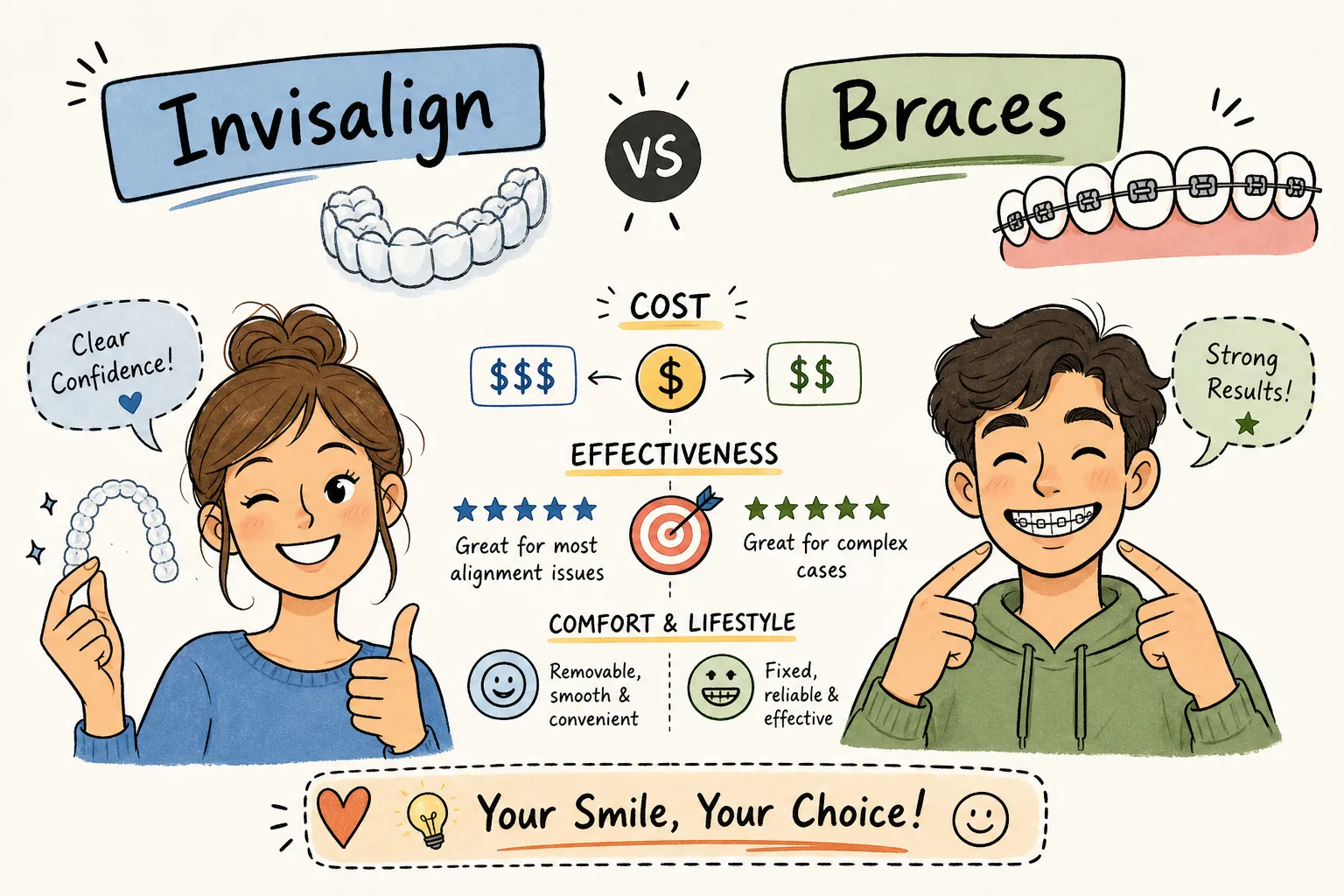
Many patients researching orthodontic treatment reach the same frustrating point: plenty of before-and-after photos, vague price ranges, and very little straight talk about what each option actually costs, what it genuinely fixes, and how long you’ll be wearing it. Comparing Invisalign vs traditional braces, cost and effectiveness included, deserves a clearer answer than most clinics provide at an initial consultation.
When considering treatment, it’s essential to analyze the invisalign vs traditional braces cost and effectiveness to make an informed choice.
At Sunbury Dental Group, it’s one of the most common questions patients bring to an orthodontic assessment. That’s not surprising. Both treatments promise a straighter smile, both are widely available, and the cost gap between them is significant enough to influence a decision. But cost alone is a poor guide if you don’t also understand which problems each option reliably solves.
This article works through four practical pillars: what you’ll actually pay in Australia right now, which clinical problems each treatment handles best, how long treatment takes across different case types, and what the day-to-day experience looks like. By the end, you’ll have enough to make an informed decision, or at the very least, walk into a consultation armed with much better questions.
Additionally, the invisalign vs traditional braces cost and effectiveness will be evaluated in the various sections to highlight the key differences.
Invisalign vs traditional braces: Australian cost ranges and effectiveness
Invisalign cost tiers and what each covers
Invisalign treatment in Australia is priced in three main tiers based on case complexity. Invisalign Express, designed for minor corrections with up to seven aligners, typically runs $2,500 to $4,500 and takes around three to six months. Invisalign Lite, for mild to moderate cases, sits in the $4,000 to $6,500 range and runs six to nine months. Invisalign Full or Comprehensive, which covers standard to complex cases over 12 to 24 months, is the most common tier and ranges from $6,000 to $9,500.
Understanding the invisalign vs traditional braces cost and effectiveness can help patients decide which treatment aligns with their needs.
The national median out-of-pocket cost for a full course of Invisalign treatment sits around $6,275 to $7,000. Based on reported pricing across major Australian cities, Sydney and Melbourne practices tend to push toward the higher end of that range, while Brisbane and Perth generally track the national median.
Traditional braces: where costs sit and why they vary
Standard metal braces in Australia typically range from $4,500 to $8,500, with the average for a moderate case falling between $5,500 and $7,000. For comparable cases, braces are generally $1,000 to $2,000 cheaper than Invisalign, though that gap narrows considerably for complex work. The base quote for braces usually covers bracket placement and adjustment visits, but retainers are almost always billed separately.
Therefore, the invisalign vs traditional braces cost and effectiveness comparison is vital for budget-conscious patients.
The hidden costs most quotes don’t include upfront
Both treatments carry add-on costs that can shift the real total significantly. Retainers run $300 to $800 for either option. Invisalign refinements, additional aligner sets required when mid-course corrections are needed, cost $1,000 to $3,000 if they’re not bundled into the original fee. Emergency repair visits for broken wires are a real cost with braces; lost or damaged aligners can also trigger unplanned expenses.
Both options should be evaluated based on their invisalign vs traditional braces cost and effectiveness to ensure the best choice is made.
When comparing quotes between clinics, always ask directly: does this price include the final retainers and any refinements? An all-inclusive fee of $8,000 can easily work out cheaper than a base quote of $6,500 once those items are added back in.
Which orthodontic problems each treatment handles best
Understanding Invisalign vs Traditional Braces Cost and Effectiveness
Where clear aligners perform just as well as braces
For mild to moderate crowding, gaps between teeth, and straightforward Class I malocclusions, peer-reviewed research in orthodontic literature confirms that clear aligners produce clinical outcomes comparable to fixed braces. Patient satisfaction with aligners in these cases is consistently higher, with overall satisfaction rates of 85 to 92 per cent for aligners versus 65 to 76 per cent for braces. For manageable cases, choosing aligners is a clinically sound decision, not a cosmetic compromise.
Among these treatments, the invisalign vs traditional braces cost and effectiveness will guide the decision-making process.
Cases where traditional braces remain the stronger clinical choice
For more complex problems, the evidence is unambiguous. Studies using the American Board of Orthodontics Objective Grading System (OGS) show Invisalign cases score, on average, 13 points lower than braces cases, with a 27 per cent lower passing rate in complex scenarios. Aligners are rated only “moderate” for severe rotations, compared to “excellent” for braces, and show meaningful deficiencies in significant vertical corrections, large anteroposterior discrepancies, buccolingual tipping, and general overjet and overbite management.
These aren’t minor technical caveats. They’re clinically meaningful distinctions that affect whether your bite actually ends up where it needs to be. A proper assessment is the only way to know which category your case falls into, because marketing materials for aligners don’t make these distinctions clear.
How long treatment takes: Invisalign vs braces across case types
It’s important to analyze the invisalign vs traditional braces cost and effectiveness when considering treatment durations.
Treatment timelines for mild to moderate cases
For mild cases, Invisalign typically runs six to nine months compared to 18 to 24 months for braces, a genuine lifestyle advantage for adults with manageable crowding or spacing. Moderate cases sit at 12 to 18 months for aligners versus 18 to 24 months for fixed appliances. That time advantage is real, but it comes with one important condition: aligners must be worn 20 to 22 hours per day. Compliance drives the clock, and falling short of that daily wear target stretches the timeline directly.
Patients should factor in the invisalign vs traditional braces cost and effectiveness to avoid unexpected costs and delays.
Invisalign also requires check-up appointments approximately every six to ten weeks (most Australian clinics schedule these at six to eight week intervals), compared to every four to six weeks for braces. For a standard 12 to 18-month Invisalign course, that means roughly five to eight check-up visits, while a comparable braces case could involve significantly more adjustment appointments. Fewer clinic visits is a commonly reported advantage among busy adults managing work and family commitments.
Complex cases and what extends the treatment period
For more involved corrections, Invisalign timelines stretch to 18 to 24 months or longer. Refinement aligners, when needed, can add another two to four months to the original estimate. Braces for complex cases typically run 24 to 36 months. Complex Invisalign cases requiring significant tooth movement often need attachments, elastics, or supplemental fixed appliances at certain stages, which changes the simplicity of the treatment experience considerably.
Comfort, lifestyle impact and long-term satisfaction
Daily life with aligners versus fixed braces
The day-to-day experience of these two treatments differs markedly. Aligners are removable for eating, brushing, and flossing, which contributes to an 85 per cent oral hygiene satisfaction rate for aligner users compared to 60 per cent for those in braces. Pain and discomfort scores strongly favour aligners, with mean scores of approximately 2.3 out of 10 versus 5.6 for braces. Broken brackets and emergency wire visits occur at a substantially higher rate with fixed appliances; aligners carry a much lower risk of these mechanical failures.
Ultimately, the invisalign vs traditional braces cost and effectiveness will influence patient satisfaction and treatment choice.
The trade-off is discipline. Aligners only work when they’re in your mouth, and that requires genuine consistency over 12 to 24 months. Patients who remove aligners for social occasions or meals and then forget to replace them regularly will extend their treatment time and potentially compromise the result.
Relapse rates and what research says about holding your results
Post-treatment relapse rates sit at around 12 per cent for Invisalign versus 10 per cent for braces, a difference that is rarely statistically significant but worth understanding. Both treatments require retainer wear after completion to hold the result long term; this is non-negotiable for either option. The slightly higher relapse figure seen with aligners in some studies may relate to cases where occlusal contacts weren’t fully optimised during treatment, which reinforces why clinical skill and proper case selection matter as much as the technology itself.
Furthermore, understanding the invisalign vs traditional braces cost and effectiveness is crucial for long-term success.
How private health cover applies to orthodontic treatment in Australia
What private health funds cover and how rebates are calculated
Most Australian private health funds treat Invisalign and traditional braces identically under their orthodontic benefit. The choice of appliance doesn’t change your rebate amount. Typical rebates cover 25 to 50 per cent of costs (some top-tier policies offer up to 80 per cent), with lifetime limits usually sitting between $1,000 and $3,500 per person. Annual sub-limits commonly run $800 to $2,500, and those reset each calendar year until the lifetime cap is exhausted, figures that reflect the range across major Australian health fund policies.
A standard 12-month waiting period applies for new policies or upgrades to major extras cover, so the timing of when you switch funds or upgrade matters significantly. If you’re planning orthodontic treatment, check when your waiting period ends before booking your assessment. It’s also worth asking your fund exactly what your lifetime limit is, not just the percentage advertised, a policy that says “60% back” but carries a $1,500 lifetime cap on a $9,000 treatment is considerably less generous than it sounds.
As such, the invisalign vs traditional braces cost and effectiveness is a key factor in insurance coverage considerations.
Medicare, the CDBS and what tax rules apply
Medicare does not cover routine orthodontic treatment for either braces or Invisalign, with the narrow exception of patients who have a diagnosed cleft lip or palate condition where the misalignment is directly related. The Child Dental Benefits Schedule covers basic dentistry including check-ups, fillings, and extractions, but explicitly excludes comprehensive orthodontic treatment. Orthodontic expenses don’t qualify as a standard tax deduction through the ATO. Some employers offer salary packaging arrangements that may provide some relief, but this depends entirely on your individual employer’s benefits structure and is not a general rule.
Why a personalised consultation matters more than national averages
Consultants will also help clarify the invisalign vs traditional braces cost and effectiveness based on your individual circumstances.
The cost ranges and timelines in this article are accurate benchmarks, but they can’t account for the specifics of your bite, your crowding pattern, your jaw relationship, or your bone density. A $6,500 Invisalign estimate based on a national average could easily become a $9,000 comprehensive case, or a $3,500 Express case, depending on what’s actually happening in your mouth. The only way to know which tier applies, and whether braces would serve you better clinically, is a face-to-face assessment with digital records and imaging.
At Sunbury Dental Group in Sunbury VIC, Dr Nita Kumari and the team provide orthodontic consultations that include a thorough clinical review, digital X-rays, and a transparent treatment estimate covering all stages of care, including retainers. Rather than leaving with a vague quote and a brochure full of ranges, patients receive a clear picture of which option suits their specific case, what the total cost will realistically look like, and how their private health cover applies. For families in Sunbury, Diggers Rest, Gisborne, or surrounding suburbs, that kind of local, personalised assessment is far more useful than any national comparison.
Here’s the honest summary of Invisalign vs traditional braces cost and effectiveness: Invisalign tends to cost more upfront but offers fewer clinic visits, significantly less discomfort, and faster results for mild to moderate cases. Traditional braces often cost less and remain clinically superior for complex malocclusions. Neither option is universally better. The smartest move is a proper clinical assessment before committing either way. General averages are a useful starting point for budgeting and planning, but a local provider who can examine your actual records will always give you a more accurate and honest picture of what your treatment will involve.
Overall, when considering options, the invisalign vs traditional braces cost and effectiveness should be a priority for any patient.
FAQ – Cost Comparison
What does Invisalign cost in Australia by treatment tier?
Invisalign Express, for minor corrections needing up to seven aligners, typically costs $2,500 to $4,500 and takes three to six months, while Invisalign Lite for mild to moderate cases runs $4,000 to $6,500 over six to nine months. Invisalign Full (Comprehensive), the most common tier covering standard to complex cases over 12 to 24 months, ranges from $6,000 to $9,500, with a national median out-of-pocket cost around $6,275 to $7,000.
How much do traditional metal braces cost in Australia?
Standard metal braces typically range from $4,500 to $8,500, with the average moderate case falling between $5,500 and $7,000. Braces are generally $1,000 to $2,000 cheaper than Invisalign for comparable cases, though that gap narrows considerably for complex work, and the base quote usually excludes retainers.
What hidden costs aren’t included in the initial quote?
Retainers run $300 to $800 for either treatment and are almost always billed separately from the base quote. Invisalign refinements (additional aligners for mid-course corrections) cost $1,000 to $3,000 if not bundled in, while braces carry unplanned costs from emergency repair visits for broken wires.
Does location within Australia affect the price?
Yes, Sydney and Melbourne practices tend to push toward the higher end of the national Invisalign cost range, while Brisbane and Perth generally track closer to the national median. This makes it worth confirming whether a quoted price is all-inclusive, since an $8,000 all-inclusive fee can work out cheaper than a $6,500 base quote once retainers and refinements are added.
Effectiveness and Clinical Suitability
Is Invisalign as effective as braces for mild cases?
Yes, for mild to moderate crowding, gaps between teeth, and straightforward Class I malocclusions, peer-reviewed orthodontic research confirms clear aligners produce clinical outcomes comparable to fixed braces. Patient satisfaction is also consistently higher with aligners in these cases, at 85 to 92 percent versus 65 to 76 percent for braces.
When are traditional braces clinically better than Invisalign?
For complex cases, studies using the American Board of Orthodontics Objective Grading System show Invisalign cases score on average 13 points lower than braces cases, with a 27 percent lower passing rate. Aligners are rated only “moderate” for severe rotations compared to “excellent” for braces, and show meaningful deficiencies in vertical corrections, large anteroposterior discrepancies, and overjet/overbite management.
How do I know which category my case falls into?
Marketing materials for aligners don’t clearly explain these clinical distinctions, so a proper in-person assessment with digital X-rays is the only reliable way to determine whether your case suits aligners or requires braces. A $6,500 Invisalign estimate based on national averages could become a $9,000 comprehensive case or a $3,500 Express case depending on what’s actually happening in your mouth.
Treatment Duration
How much faster is Invisalign than braces for mild to moderate cases?
For mild cases, Invisalign typically takes six to nine months compared to 18 to 24 months for braces, while moderate cases run 12 to 18 months for aligners versus 18 to 24 months for fixed appliances. That time advantage depends entirely on wearing aligners 20 to 22 hours per day, since compliance directly drives the timeline.
How often do I need check-up visits with each treatment?
Invisalign requires check-ups roughly every six to ten weeks (most Australian clinics use six to eight week intervals), meaning five to eight visits for a 12 to 18-month course, compared to every four to six weeks for braces. Fewer clinic visits is a commonly reported advantage among busy adults balancing work and family commitments.
How long do complex cases take with each option?
Complex Invisalign cases stretch to 18 to 24 months or longer, and refinement aligners can add another two to four months on top. Braces for complex cases typically run 24 to 36 months, and complex Invisalign cases often need attachments, elastics, or supplemental fixed appliances that change the simplicity of the treatment experience.
Comfort and Daily Life
Which is more comfortable, Invisalign or braces?
Aligners score significantly better for comfort, with mean pain scores of approximately 2.3 out of 10 versus 5.6 for braces. Aligners are also removable for eating, brushing, and flossing, contributing to an 85 percent oral hygiene satisfaction rate versus 60 percent for braces wearers.
Are aligners less likely to need emergency repairs than braces?
Yes, broken brackets and emergency wire visits occur at a substantially higher rate with fixed braces, while aligners carry a much lower risk of mechanical failure. The trade-off is discipline — aligners only work when worn consistently, and removing them for social occasions without replacing them promptly extends treatment time.
Does either treatment have a higher chance of teeth shifting back after treatment?
Post-treatment relapse rates sit at around 12 percent for Invisalign versus 10 percent for braces, a difference that’s rarely statistically significant. Both treatments require retainer wear after completion to hold results long term — this is non-negotiable regardless of which option you choose.
Insurance and Coverage
Does my private health fund pay more toward braces or Invisalign?
No, most Australian private health funds treat both treatments identically under their orthodontic benefit, so the appliance choice doesn’t change your rebate amount. Typical rebates cover 25 to 50 percent of costs (some top-tier policies up to 80 percent), but lifetime limits usually sit between $1,000 and $3,500 per person, with annual sub-limits of $800 to $2,500.
What should I check before switching health funds for orthodontic cover?
A standard 12-month waiting period applies for new policies or upgrades to major extras cover, so confirm when your waiting period ends before booking an assessment. Ask your fund for the exact lifetime limit, not just the advertised percentage — a “60% back” policy with a $1,500 lifetime cap on a $9,000 treatment is far less generous than it sounds.
Does Medicare or the CDBS cover orthodontic treatment?
No, Medicare does not cover routine orthodontic treatment for either braces or Invisalign, with the narrow exception of diagnosed cleft lip or palate conditions. The Child Dental Benefits Schedule covers basic dentistry like check-ups and fillings but explicitly excludes comprehensive orthodontic treatment, and orthodontic expenses don’t qualify as a standard ATO tax deduction.
Choosing a Clinic
Does Sunbury Dental Group offer Invisalign vs braces consultations?
Yes, Dr Nita Kumar and the team at Sunbury Dental Group provide orthodontic consultations including a thorough clinical review, digital X-rays, and a transparent treatment estimate covering all stages of care including retainers. This local assessment for patients in Sunbury, Diggers Rest, and Gisborne gives a clearer picture than national averages of which option suits your specific case and how your private health cover applies.