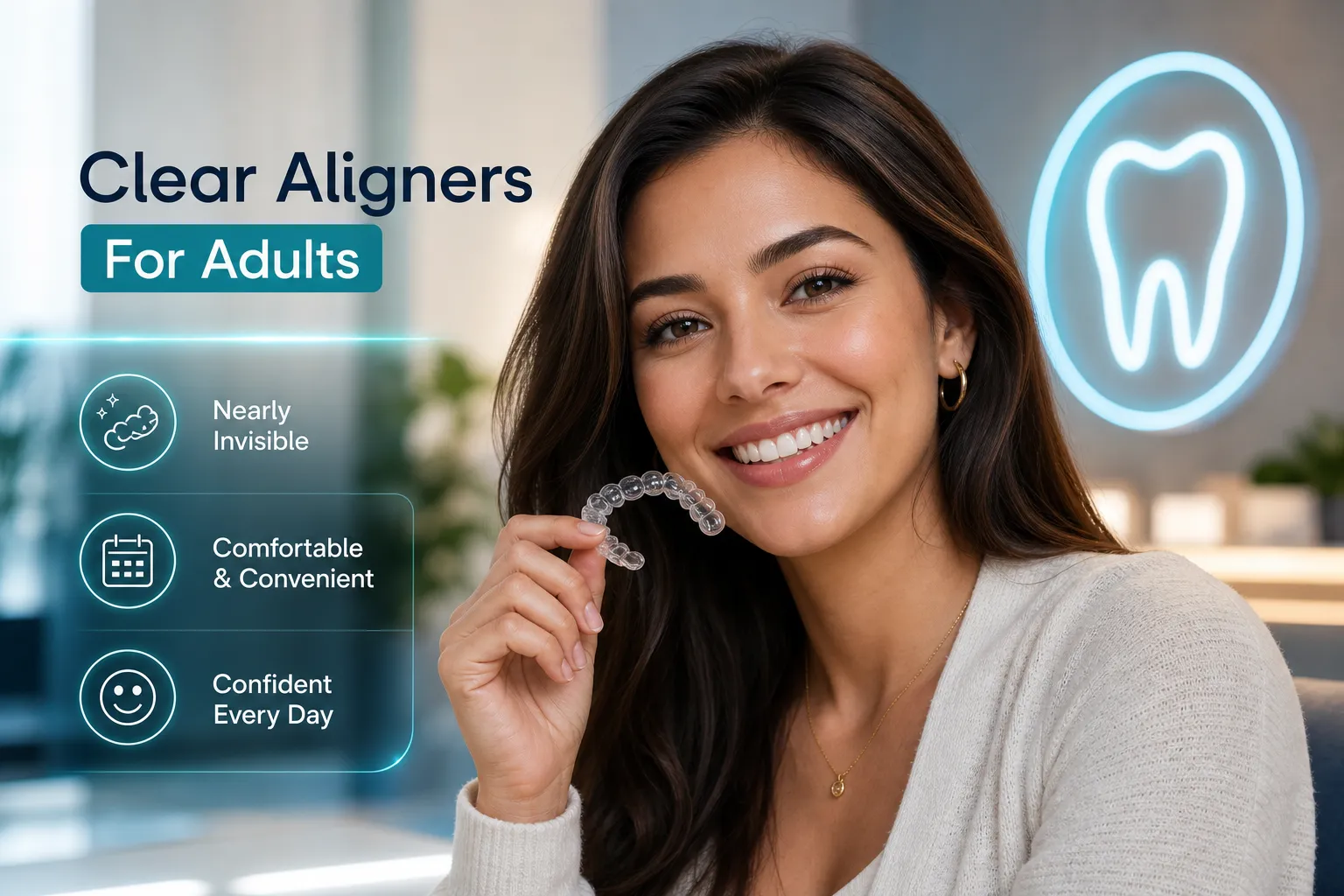
Clear Aligners Adults: Everything You Need to Know
Picture this: you’ve had slightly crooked teeth your whole adult life, told yourself braces were for teenagers, and quietly accepted that a straighter smile just wasn’t on the cards. Then a colleague shows up one day looking noticeably different, and when you ask what changed, they mention clear aligners. Sound familiar? More Australians are straightening their teeth as adults than ever before, and the treatment doing most of the heavy lifting is removable, nearly invisible, and far more manageable than the metal-bracket experience you probably imagined.
More adults are discovering how effective clear aligners adults are for achieving a confident smile.
This guide covers everything you genuinely need to know about clear aligners adults: how the trays actually move your teeth, whether you’re a realistic candidate, what daily life looks like during treatment, how timelines play out compared to what’s often advertised, and how clinic-supervised care in Australia stacks up against at-home programmes. Adults across Sunbury and surrounding suburbs can access clear aligner assessments and treatment at Sunbury Dental Group without needing to travel into Melbourne, and by the end of this article, you’ll know whether clear aligners are worth pursuing and exactly what your next step looks like.
Understanding clear aligners adults can help you make an informed decision about your dental care.
This guide is honest and practical, no selling you a fantasy, no glossing over the parts that require genuine commitment.
Many adults prefer clear aligners adults due to their convenience and effectiveness.
How clear aligners actually move your teeth
The mechanics behind each tray
Clear aligner treatment works through a series of custom-made, removable plastic trays, each designed to apply gentle, calibrated pressure to specific teeth. Every tray shifts those teeth a fraction of a millimetre, and swapping to the next tray at clinician-directed intervals, commonly every one to two weeks, depending on the treatment plan and brand, keeps that progress moving. Before a single tray is made, the entire sequence is planned digitally, which means your provider can show you a projected outcome before treatment begins. Each set of trays is mapped precisely to your dental anatomy, not a generic shape pulled off a shelf.
This digital planning is what separates modern aligner therapy from the clunky impression kits of the past. The technology allows for precise, individualised treatment when it’s done properly in a clinical setting, and that clinical context matters more than most people realise when they first start researching their options.
With clear aligners adults, you can enjoy a comfortable and discreet way to straighten your teeth.
Why attachments and wear time matter so much
For teeth that need rotation or more complex movement, the trays alone often aren’t enough. Small tooth-coloured composite bumps, called attachments, are bonded to specific teeth to give the tray mechanical grip for movements a smooth plastic surface can’t achieve on its own. They’re subtle, but they do become visible at close range, which is worth knowing upfront.
For many, choosing clear aligners adults over traditional methods can make a significant difference in their lives.
The 20 to 22 hours of daily wear isn’t a suggestion. It is the single variable that most directly determines whether your treatment tracks on schedule or drags out significantly beyond the projected timeline. Missing hours each day compounds quickly over weeks and months. Your check-up appointments with your dentist exist partly to catch tracking issues early. That’s why clinical oversight isn’t a nice-to-have, it’s built into the treatment itself.
Clear aligners for adults: who is a genuinely good candidate?
If you’re considering treatment, clear aligners adults might be the perfect solution for your needs.
The Benefits of Clear Aligners for Adults
Conditions aligners handle well
Clear aligners adults are highly effective for various dental concerns, making them a popular choice.
Clear aligners for adults are highly effective across a range of mild to moderate concerns. These include:
- Mild to moderate crowding (typically 1 to 6 mm)
- Spacing and minor gaps, including diastemas under 6 mm
- Mild overbite
- Minor crossbite
- Relapse cases where teeth have shifted after prior orthodontic treatment
These categories cover a large proportion of adults who are unhappy with their smile. If your concern is cosmetic, functional, or a bit of both, and the severity sits in the mild to moderate range, you’re likely a strong candidate.
With clear aligners adults, achieving a straight smile is accessible for many seeking treatment.
Relapse cases, where teeth have gradually drifted back after earlier braces, are particularly well-suited to aligner therapy and represent a common reason adults seek treatment a second time.
When traditional braces or specialist care is the right call
Understanding the limits of clear aligners adults is crucial for a successful treatment outcome.
Severe skeletal discrepancies, rotations beyond 45 degrees, impacted teeth, and cases requiring significant extrusion or intrusion fall outside what aligner therapy handles reliably. In these situations, fixed braces or specialist orthodontic care delivers better outcomes, full stop. Knowing the limits of a treatment is not a weakness; it’s what clinical integrity actually looks like.
Any provider who tells every patient they’re a candidate for clear aligners, regardless of case complexity, is not giving you an honest assessment. A proper clinical evaluation will tell you clearly where you sit.
A thorough assessment will determine if clear aligners adults can provide the results you desire.
Active dental conditions that need resolving first
Untreated cavities, active gum disease, and poor oral hygiene are all contraindications for starting aligner treatment. These conditions must be addressed before any orthodontic work begins, without exception. This is a patient-first point, not a bureaucratic hurdle: placing aligners over unhealthy teeth and gums accelerates damage rather than improving your smile.
This is one of the key reasons a proper clinical assessment, including X-rays and a periodontal review, matters so much before committing to any programme.
Why adults tend to prefer aligners over traditional braces
Life doesn’t stop during treatment
Clear aligners adults allow you to maintain your lifestyle during the treatment process.
Adults wear aligners at work, in meetings, at social events, and at dinner without the self-consciousness that comes with a mouth full of metal. The trays come out at mealtimes, so there are no dietary restrictions: eat what you normally eat, brush and floss as you normally would, clean the trays, and reinsert. Compare this with fixed braces, which require specific food avoidance, specialist flossing tools, and ongoing hygiene vigilance around brackets and wires.
For working professionals or parents managing a full schedule, this practical flexibility is often the deciding factor.
Comfort and periodontal health benefits
Many adults report improved comfort with clear aligners adults versus traditional braces.
Studies comparing aligner and fixed-appliance patients consistently show that aligner therapy is associated with better periodontal health outcomes than fixed appliances, largely because patients can clean their teeth properly throughout treatment. Plaque indices, gingival indices, and bleeding scores are measurably better in patients using aligners compared to those in fixed braces. For adults with existing gum sensitivity or earlier-stage periodontal concerns, this distinction is worth factoring into your decision.
Discomfort is common for the first few days after each tray change, as your teeth adjust to the new position. This is very different from the sustained soreness that wires and brackets can cause, particularly after adjustment appointments.
Realistic timelines for clear aligners for adults
Understanding the timelines associated with clear aligners adults is essential for planning your treatment.
How case complexity shapes your timeline
Once refinements are factored in, realistic timelines look like this: mild cases run 8 to 12 months, moderate cases 14 to 18 months, and complex cases 24 to 36 months. These figures are longer than the headline numbers often cited in advertising, and the gap exists for a specific reason. Refinements, additional aligner sets produced mid-treatment to correct tracking issues, are a normal, expected part of the process for most patients. They’re not a sign something has gone wrong; they’re built into responsible treatment planning.
If a provider promises you a 6-month result without knowing the full complexity of your case, that number deserves scrutiny.
Consistent wear of clear aligners adults is critical for maintaining the treatment schedule.
The compliance factor and what extends treatment
Not wearing your aligners for 20 to 22 hours daily is the single most common reason timelines extend beyond what was projected. Each missed hour compounds across weeks, and teeth that haven’t tracked properly require refinements to correct. The maths is straightforward: consistent wear keeps treatment on schedule; inconsistent wear does the opposite.
Ensure you have a clear understanding of the retention process with clear aligners adults.
Post-treatment retainers are non-negotiable. The modern standard is clear removable retainers for the upper arch combined with a fixed lingual wire behind the lower front teeth, worn full-time for the first three to six months, then nightly for the long term. Skipping retention is the most common cause of relapse, and teeth will shift back without it. Retention is not an optional extra; it’s the final phase of treatment, and it’s ongoing.
Clinic-supervised aligners vs at-home programmes in Australia
What you’re actually paying for at each price point
The investment in clear aligners adults often provides significant long-term benefits.
Clinic-supervised treatment, including Invisalign and comparable clinical brands, runs approximately $3,500 to $9,500 in Australia depending on complexity. Invisalign Lite for minor front-teeth alignment sits around $6,000 to $6,500, Moderate around $7,500 to $8,900, and Full (Comprehensive) from $8,500 upwards for complex cases. At-home mail-order programmes sit between $1,000 and $3,000. The price difference is real, and it’s worth understanding what accounts for it.
Clinic treatment includes clinical diagnosis with X-rays and digital scanning, monitoring of root health throughout treatment, attachments placed by a trained clinician, and the ability to catch and correct complications before they compound. Private health insurance orthodontic rebates, typically ranging from $500 to $3,000 depending on your fund and policy tier, apply to clinic treatment but generally not to at-home programmes. It’s worth checking your specific policy directly, as rebate amounts vary by plan and are subject to lifetime limits. Funds including HCF, nib, Bupa, and Medibank generally provide rebates under mid-tier to gold-level extras policies, subject to a standard 12-month waiting period.
The clinical risks of unsupervised treatment
At-home aligner programmes planned from photos or physical impressions alone, without radiographic assessment, cannot detect underlying issues such as root resorption, bone loss, active decay, or pre-existing gum disease. Australian orthodontic bodies, including Orthodontics Australia and the Australian Society of Orthodontists, have formally advised against direct-to-consumer programmes for exactly this reason. Complications caught late are significantly harder and more costly to resolve than those identified during supervised care.
Prioritizing clear aligners adults can lead to healthier teeth and gums.
The risk isn’t theoretical. The Australian Society of Orthodontists has documented cases of patients requiring tooth removal after using DIY kits, problems that a clinical X-ray would have identified before treatment began.
Flexible payment options that close the gap
Many Australian clinics offering Invisalign provide interest-free payment plans, BNPL options through providers such as Humm or ZipMoney, and in-house instalment arrangements, though availability varies by clinic. At roughly $150 to $350 per month with full clinical oversight included, the value comparison between clinic and at-home treatment shifts considerably. When you factor in insurance rebates and spread payments across a treatment period, the cost difference narrows in a meaningful way.
Clearing up misconceptions about clear aligners adults can empower your decision-making process.
Getting started with clear aligners for adults near Sunbury
Many adults are starting their journey with clear aligners adults to enhance their smiles.
What a smile assessment actually involves
A consultation involves digital scans or impressions, a review of your dental and periodontal health, a conversation about your treatment goals, and a preview of the projected outcome. A good assessment is low-pressure and informational. It’s a conversation, not a commitment, and its purpose is to give you real information: whether you’re a candidate, what complexity tier your case sits in, what the realistic timeline looks like, and an indicative cost before you make any decision.
Understanding your candidacy clearly before committing is exactly what this step is designed for, and it takes the guesswork out of the process entirely.
Getting accurate information about clear aligners adults is vital for effective treatment.
Why local matters for ongoing monitoring
Clear aligner treatment requires regular check-ins throughout, and having that care close to home makes consistent follow-through realistic. Sunbury Dental Group provides Invisalign assessments and ongoing clear aligner treatment for adults across Sunbury, Diggers Rest, Riddells Creek, Gisborne, and surrounding areas. Adults who’ve been putting off the decision because they assumed they’d need to travel into Melbourne for specialist care can access a full clinical assessment and complete treatment locally.
Your local clinic can provide the support needed for clear aligners adults.
The practice offers digital scanning technology, transparent treatment planning, and flexible payment options, all under one roof, without the commute. For adults who’ve previously felt anxious about dental visits, the team is experienced in making that first appointment straightforward and informative.
Is clear aligner treatment right for you?
The answer depends on three things: the complexity of your case, your lifestyle fit, and whether you’re prepared to commit to the wear requirements and retention that make the result last. For most adults with mild to moderate alignment concerns, the lifestyle advantages are well established, the outcomes are clinically supported, and the process is far more manageable than the alternatives.
Many adults find that clear aligners adults fit seamlessly into their daily lives.
Clinic-supervised treatment is the version that gives you both safety and results. It’s the option with clinical oversight, health fund rebates, and a trained clinician managing your progress from start to finish. At-home programmes cost less upfront but carry risks that aren’t always visible until damage is done.
The only way to know for certain whether clear aligners for adults are your path forward is to get a proper assessment. Book a smile consultation at Sunbury Dental Group and walk away knowing exactly where you stand, with no obligation and no pressure. That clarity is worth more than any amount of online research, and it’s exactly what the first appointment is for.
Understanding the benefits of clear aligners adults can help you make a confident decision.

Frequently asked questions about clear aligners for adults
With the right guidance, clear aligners adults can lead to a transformed smile.
Are clear aligners suitable for adults of any age?
Yes. Clear aligners for adults are suitable at any age provided your teeth and gums are healthy enough to begin treatment. There is no upper age limit for aligner therapy. What matters is your oral health baseline, not how old you are. A clinical assessment will determine whether any pre-existing conditions need to be resolved first.
Clear aligners adults are accessible and suitable for a wide range of individuals.
How do clear aligners for adults compare to braces in terms of cost in Australia?
Clinic-supervised clear aligners typically range from $3,500 to $9,500 in Australia, while traditional fixed braces sit in a broadly similar range depending on complexity. At-home aligner programmes are cheaper upfront ($1,000 to $3,000), but they don’t include the clinical oversight, X-rays, or health fund rebates that come with in-clinic treatment. For many adults, the rebate and payment plan options available through a registered clinic make the cost more comparable than it first appears.
Understanding costs associated with clear aligners adults can help you plan your budget.
What happens if I don’t wear my aligners consistently?
Inconsistent wear is the most common reason treatment extends beyond its projected timeline. The 20 to 22 hours of daily wear is a clinical requirement, not a guideline. Missed hours accumulate quickly, and teeth that haven’t tracked properly will need additional refinement trays to correct, adding both time and, in some cases, cost.
Adhering to the requirements of clear aligners adults is essential for successful treatment.