
Jawbone Shrinkage After Tooth Loss: Do You Still Qualify for Implants?
Here’s a sentence we hear more than you’d think: “I’ve been missing this tooth for years, so I’m probably too far gone for an implant now.” It’s a completely understandable worry, but it’s almost never the full story. Jawbone shrinkage after tooth loss is real, it’s well documented, and in most cases it’s genuinely manageable.
Understanding jawbone shrinkage is essential in determining if you can jawbone shrinkage implant qualify after tooth loss.
We’re Sunbury Dental Group, and we regularly meet patients from Sunbury, Diggers Rest, Bulla, and the wider Hume region who’ve put off dealing with a gap for years, sometimes decades, assuming implants were off the table by now. Let’s talk through exactly what happens to your jawbone after tooth loss, how long is “too long,” and what your actual options look like if bone loss has crept in.
Overview: What This Article Covers
We’re going to explain exactly why your jawbone shrinks after losing a tooth, and just how quickly that process actually happens (spoiler: faster than most people expect). You’ll learn how bone loss years after extraction is assessed, what bone graft options exist if you’ve left it a while, and how dentists decide whether you still qualify for a standard implant or need extra preparation first. We’ll also bring it back local, because plenty of Sunbury families are sitting on exactly this question right now.
In This Article, You’ll Discover…
Why jawbone shrinkage happens almost immediately after tooth loss, not just “eventually”
How much bone is typically lost at the 3-month, 1-year, and 5-year marks
Whether you still qualify for an implant after long term missing tooth situations
What bone graft options exist if your jaw has narrowed or shortened
How dentists measure your bone before recommending any treatment path
What alternative implant techniques exist for more advanced bone loss
Realistic questions to bring to your own consultation
Why Your Jawbone Shrinks After Losing a Tooth
Here’s the part that catches most people off guard: bone loss doesn’t wait years to start. It kicks in almost immediately.
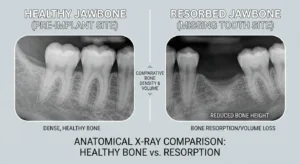
Once a tooth is gone, the bone that used to support its root has no job left to do, so your body starts reabsorbing it in a natural process called resorption. Research shows the majority of this loss happens shockingly fast — up to two-thirds of the total horizontal and vertical bone loss occurs within the first 90 days after extraction. Some studies go further, showing up to half the original bone volume can be lost in as little as 12 weeks.
Bone Loss Years After Extraction: The Realistic Timeline
Once that initial fast phase settles down, bone loss doesn’t stop — it just slows dramatically.
First 8 weeks: The most aggressive phase, with rapid width loss as the outer bone wall resorbs quickly.
3 to 6 months: Continued shrinkage in both height and width as the site stabilises.
1 to 3 years: The rate slows considerably, but height loss becomes more noticeable over this window.
5+ years: Significant cumulative loss of both width and height, sometimes leaving the ridge too narrow for a standard implant without grafting.
Ongoing, for life: Even decades later, bone continues to resorb slowly, at roughly 0.5 to 1 percent per year.
So if you’ve been missing a tooth for five, ten, or twenty years, some degree of bone loss is almost guaranteed. That doesn’t mean you’re out of options — it just means your treatment plan probably needs an extra step.
Do You Still Qualify for an Implant After Long Term Missing Tooth Gaps?
Genuinely, yes, in the vast majority of cases. Research and clinical experience both confirm that patients can receive implants years, even decades, after a tooth extraction. One resource puts it plainly: patients missing teeth for 10 years or more can still be excellent implant candidates.
What Actually Determines Your Eligibility
Your dentist isn’t looking at how long you’ve been missing the tooth as the deciding factor on its own. What matters more is what’s actually left to work with.
Remaining bone height and width at the site itself
Overall gum health and presence of any active infection
Medical conditions like diabetes or osteoporosis that can affect healing
Smoking habits, since this measurably affects bone healing outcomes
Number of teeth missing — a single gap behaves very differently to multiple missing teeth in the same area
Missing just one tooth for a year or two often means there’s still plenty of usable bone, sometimes enough for immediate implant placement with no grafting at all. Missing several teeth for twenty-plus years is a very different picture, and usually calls for more preparation first.
Bone Graft Options: What’s Actually Available
If your assessment shows meaningful bone loss, don’t panic — grafting is one of the most well-established procedures in modern implant dentistry, with decades of research behind it. Here’s what’s typically on the table depending on your situation.
Common Bone Graft Options
Socket preservation grafts: Placed immediately after an extraction to slow future bone loss, ideal if you’re planning ahead.
Lateral ridge grafts: Used to widen a jawbone that’s become too narrow to support a standard implant.
Block grafts: A more substantial option for significant horizontal bone loss, often using a solid piece of bone material.
Sinus lifts: Specifically for upper back jaw bone loss, where the sinus has expanded into the space once occupied by tooth roots.
Guided bone regeneration: A technique using a barrier membrane to encourage new bone growth in a targeted area.
Graft material itself can come from your own bone (autogenous), a donor source, or a synthetic substitute — your dentist will recommend the option best suited to your specific situation and the extent of bone loss involved.
How Long Does Grafting Add to the Process?
Healing from a bone graft alone typically takes four to six months before an implant can be placed on top of it. It’s an extra wait, no doubt about it, but it’s a well-understood, predictable part of the process rather than a sign something’s gone wrong.

There are several bone graft approaches, chosen based on exactly how much bone needs rebuilding.
What Happens If Bone Loss Is More Severe
For patients with really significant, long-term bone loss, standard grafting isn’t always the only path forward. There are alternative techniques worth knowing about.
Advanced Options for Extensive Bone Loss
Zygomatic implants, for example, anchor into the cheekbone rather than the jaw itself, which can eliminate the need for extensive grafting in cases of severe upper jaw bone loss. Subperiosteal implants are another alternative in very specific situations, sitting on top of the remaining bone rather than fully inside it. These aren’t first-line options for most people, but they exist for exactly the kind of long-term, advanced bone loss cases that might otherwise feel hopeless.
What About Bridges or Dentures Instead?
It’s worth mentioning this honestly, because it comes up a lot. Bridges and dentures can absolutely function as a tooth-replacement option, but they don’t stop ongoing bone loss underneath them, and in some cases can actually accelerate it further. That’s not us pushing implants over other options — it’s simply useful information if you’re weighing up your choices long-term.
A Local Note for Sunbury Families
We meet plenty of long-term Sunbury and Bulla residents who’ve genuinely been putting off dealing with a missing tooth for years, sometimes because they assumed it was “too late” or too complicated by now. It’s really common, and there’s no judgement in it — life gets busy, and dental gaps have a way of sliding down the priority list. If that sounds like you, the only way to know your real options is a proper scan, not a guess based on how long it’s been.
Questions Worth Asking at Your Consultation
How much bone loss has actually occurred at my specific site?
Would I need grafting, and if so, what type suits my situation?
How much extra time would grafting realistically add to my treatment?
Are there alternative techniques worth considering given my level of bone loss?
What happens if I choose to wait even longer before deciding?
Frequently Asked Questions
Can you get a dental implant if you’ve been missing a tooth for years?
Yes, in most cases — research and clinical experience show patients can receive implants even a decade or more after extraction. Your dentist will assess remaining bone volume to determine whether grafting is needed first.
How quickly does jawbone shrink after a tooth is removed?
Bone loss begins almost immediately, with up to two-thirds of the total resorption occurring within the first three months after extraction. It continues at a much slower pace for years afterward.
What happens if there’s not enough bone left for a standard implant?
Your dentist may recommend a bone graft to rebuild the site before implant placement, using options like ridge grafts, block grafts, or sinus lifts depending on the location. In cases of more severe bone loss, alternative techniques like zygomatic implants may also be considered.
Does missing multiple teeth in one area make bone loss worse?
Yes, the more teeth missing in a given area, the more likely significant bone loss has occurred, increasing the chance grafting will be needed. A single missing tooth for a short period often retains enough bone for a straightforward implant.
How long does bone grafting add to the implant timeline?
Healing from a bone graft typically takes around four to six months before an implant can be placed. This varies depending on how much bone needed to be rebuilt and your individual healing response.
Are dentures a better option than implants if I have significant bone loss?
Dentures can be a functional short-term solution, but they don’t stop the underlying bone loss and may accelerate it over time. Implants, once placed, help preserve the surrounding bone by restoring normal chewing forces to the jaw.
Bringing It All Together
The short version is genuinely encouraging: jawbone shrinkage after tooth loss is completely normal, well understood, and in most cases doesn’t rule out implants — it just changes the roadmap slightly. Whether that means a straightforward implant, a bone graft first, or an alternative technique for more advanced cases, there’s almost always a path forward worth exploring.
If you’ve been putting off dealing with a long-standing gap because you assumed too much time had passed, it’s worth finding out for certain rather than guessing. Book your appointment at Sunbury Dental Group today for a proper bone assessment and honest advice on your options: