
How Is Periodontal Disease Managed at a Dental Clinic?
Periodontal disease management begins with accurate diagnosis and continues through active therapy and long-term maintenance, and for most patients, the process is far more straightforward than they expect. National oral health surveys suggest that up to half of Australian adults have some form of gum disease, and many are unaware of it. Periodontitis advances quietly, often without pain, until the damage to bone and tissue becomes genuinely difficult to reverse. The good news is that the periodontal disease management pathway for gum disease is well-established, evidence-based, and far less intimidating than most patients anticipate.
At Sunbury Dental Group, we manage most stages of periodontal disease right here at our Evans Street practice, which means many Sunbury patients can avoid travelling to Melbourne for specialist care. The process moves through four clear phases: thorough assessment, non-surgical deep cleaning, surgical intervention if needed, and lifelong maintenance. Here is what each of those phases looks like in practice.
At Sunbury Dental Group, our focus on periodontal disease management allows us to effectively manage most stages of periodontal disease right here at our Evans Street practice, which means many Sunbury patients can avoid travelling to Melbourne for specialist care.
Periodontal Disease Management: Assessment and Staging
Most patients are surprised by how much information a dentist can gather in a single assessment visit. Before any treatment begins, your dentist needs a complete picture of what is happening below your gumline, and that starts with a full-mouth periodontal chart.
Full-mouth charting: what those numbers mean
During a periodontal assessment, your dentist uses a small probe to measure the depth of the space between your gum and tooth at six points per tooth. These numbers, called probing depths, reveal how far the gum has detached from the tooth root. Your dentist also records bleeding on probing and clinical attachment level (CAL), which measures how much supporting tissue has been lost. Charting is generally quick and, for most patients, causes minimal discomfort; for those with sensitivity, reassurance or local anaesthesia can be provided. The result is a precise map of your gum health that no visual inspection alone can provide.
The staging system: how severity is classified
The 2017 World Workshop international classification introduced a four-stage system (Stage I through IV) that replaced older, less precise categories. Stage I reflects early disease (CAL of 1 to 2 mm), Stage II reflects moderate disease (CAL of 3 to 4 mm), and Stages III and IV indicate severe disease, with CAL of 5 mm or more, significant bone loss, and in Stage IV, extensive tooth loss and bite collapse. The stage your dentist assigns is not just a label; it directly determines your treatment plan and what outcomes are realistically achievable.
Grading for progression risk
Alongside staging, your dentist assigns a grade: A (slow progression), B (moderate), or C (rapid). This grade reflects how aggressively your disease is likely to advance, influenced by lifestyle factors like smoking and diabetes. A Grade C patient with uncontrolled blood sugar needs a fundamentally different care plan to a Grade A non-smoker with the same pocket depths. This is why your dentist asks about your medical history and lifestyle at every visit. Those answers shape your entire treatment approach.
Scaling and Root Planing: The First-Line Treatment for Most Patients
For Stage I through III periodontitis, non-surgical periodontal therapy is the starting point. In practice, this means scaling and root planing (SRP), which most patients know as a deep clean. It is more targeted and thorough than a standard scale and polish, but it is not surgery.
What happens during the procedure
Scaling removes calculus and bacterial biofilm from both above and below the gumline, including from root surfaces that a standard clean cannot reach. Root planing smooths those root surfaces, making it harder for bacteria to reattach. The procedure is commonly performed under local anaesthesia and typically completed across two or more appointments, treating one or two sections of the mouth at a time. Many patients tolerate the procedure well and find it more manageable than they had expected.
What outcomes you can realistically expect
Research consistently shows that SRP reduces probing depth by approximately 0.7 to 1.1 mm and improves clinical attachment levels in the same range. Pockets of 4 to 6 mm respond particularly well, with many sites achieving what clinicians call “pocket closure” (reduction to 3 mm or less). Patients with Stage I to III disease typically see significant improvement after non-surgical therapy, provided the procedure is thorough and supported by consistent home care. Some mild gum recession may appear as post-treatment swelling resolves, which is a normal sign that infection is clearing, not an indication that treatment has failed.
When adjunctive antimicrobials are used
In some cases, locally applied antimicrobials such as tetracycline-based agents are placed directly into residual pockets alongside SRP. Evidence supports this approach for specific situations, particularly deep or resistant pockets, where locally delivered tetracycline has shown probing depth reductions of up to 0.93 mm beyond SRP alone. This is not routine for every patient, but it is a well-supported option when standard deep cleaning has not fully resolved a stubborn area.
When Surgical Options Become the Right Next Step
For Stage III to IV cases where non-surgical therapy has not achieved adequate pocket resolution, surgery is the logical progression in evidence-based periodontal disease management. It is not a sign that anything went wrong; some disease presentations simply require direct access to root surfaces and bone that instruments cannot fully reach from above.
Flap surgery for persistent deep pockets
Open flap debridement involves gently lifting the gum tissue to allow the dentist or periodontist to clean root surfaces and bone directly. It is indicated for pockets over 5 to 6 mm that have not responded to SRP, and the results are reliable: most patients see probing depth reductions of 1.5 to 2.5 mm with significant infection control. Long-term stability depends on strict maintenance after surgery, but outcomes in well-maintained patients are consistently strong.
Regenerative options: guided tissue regeneration and bone grafting
For cases involving significant intrabony pockets or substantial bone loss, guided tissue regeneration (GTR) and bone grafting aim to restore lost tissue rather than simply control infection. In favourable defect types, particularly three-walled intrabony pockets, success rates of 70 to 85 percent have been reported, with clinical attachment gains of up to 4.3 mm in deep sites. These procedures, which align with current periodontal surgery and regeneration guidelines, are typically carried out by a specialist periodontist and reserved for specific anatomical situations where regeneration is genuinely achievable. Sunbury Dental Group coordinates referrals for these cases when they arise.
The Link Between Gum Disease and Your Overall Health
Treating periodontitis is not only about saving teeth. The evidence connecting gum disease to systemic health is substantial, and it changes how seriously most patients take their periodontal care once they understand it.
How periodontitis affects blood sugar control
For patients with Type 2 diabetes, treating periodontitis has been shown to reduce HbA1c levels by approximately 0.43 percent within three to four months. That figure is clinically significant: it is comparable in scale to adding a second diabetes medication. The mechanism is straightforward: chronic gum disease drives systemic inflammation that worsens insulin resistance, so reducing that inflammation directly improves glycaemic control. Patients with higher baseline HbA1c levels tend to see the greatest benefit, and the effect can be sustained up to 12 months with ongoing maintenance.
Integrating risk factors into your treatment plan
Smoking, diabetes, age, and oral hygiene habits all influence staging, grading, and how frequently you need to be seen. A Grade C patient who smokes and has poorly controlled diabetes requires more aggressive treatment intervals and closer monitoring than a Grade A patient with the same pocket depths. At Sunbury Dental Group, Dr Nita Kumari and the team account for these factors when building a care plan, addressing your gum health within the context of your broader medical picture and, where appropriate, coordinating with your treating physician.
Periodontal Disease Management: Maintenance and Recall
Ongoing periodontal disease management is crucial, as it ensures that patients are closely monitored and supported after initial treatments.
Periodontitis is managed, not cured. Once you have completed active treatment, the frequency and consistency of your ongoing care becomes the single biggest determinant of whether your results last.
Recall intervals based on disease risk
Current guidelines recommend a three-month recall interval for most patients with moderate to severe periodontitis during and immediately after active therapy. Lower-risk, stable patients may extend to six months once clinical stability is confirmed. The data on this is clear: patients on three-month schedules experience a disease recurrence rate of just 8 percent, compared to 20 percent for those on annual schedules. At each maintenance visit, your dentist reassesses pocket depths, performs a professional clean, and reviews any lifestyle risk factors that may have changed.
Long-term tooth retention outcomes
Long-term cohort data shows that patients who comply with structured maintenance schedules retain over 90 percent of teeth in Stage I to II disease over 20 or more years. Even in Stage III to IV disease, compliant patients retain 70 to 85 percent of teeth over the same period. Compliance, not just the treatment itself, is what separates good long-term outcomes from poor ones. This is why ongoing recall care is treated as a non-negotiable part of periodontal disease management, not an optional add-on.
Managing Gum Disease Locally in Sunbury
One of the most common barriers to periodontal care is the assumption that anything beyond a basic clean requires a trip to a specialist in the city. For many Sunbury patients, that is simply not the case.
What Sunbury Dental Group offers for periodontal care
Sunbury Dental Group provides comprehensive periodontal management as a core part of its services. This includes:
- Full-mouth charting and digital X-ray assessment
- Scaling and root planing across multiple appointments
- Adjunctive treatments for resistant or complex cases
- Structured maintenance programmes tailored to each patient’s risk profile
Many patients with Stage I to III disease are managed entirely in-house at our Evans Street clinic. For most people, that means timely treatment, reduced travel, and care delivered in a familiar environment where your full dental and medical history is already known.
When a specialist referral is the right call
Transparency is central to how we work. Stage IV disease involving complex bone loss, multiple teeth lost to periodontitis, or cases requiring advanced regenerative surgery are situations where a periodontist’s involvement genuinely improves outcomes. When a referral is warranted, Sunbury Dental Group coordinates it directly and maintains continuity of your care throughout the process. The goal is always to manage as much as possible locally, with specialist input at precisely the point it makes a clinical difference.
Where to Start If You’re Concerned About Your Gums
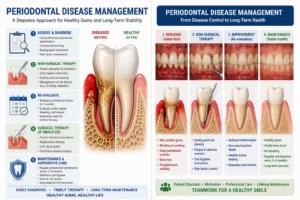
The periodontal disease management pathway follows a logical sequence: accurate assessment and staging, non-surgical deep cleaning, adjunctive therapy or surgery where the evidence supports it, and structured long-term maintenance. Each step builds on the last, and the earlier treatment begins, the more straightforward the pathway tends to be.
By prioritizing periodontal disease management, patients can significantly reduce the risk of progression to more severe stages of gum disease.
Gum disease caught at Stage I or II is far easier to manage than disease that has progressed to Stage III or IV because treatment was delayed. Bleeding gums, persistent bad breath, gum recession, or teeth that feel loose are all reasons to book an assessment sooner rather than later.
Our approach to periodontal disease management emphasizes the importance of taking action at the first signs of gum disease.
If you are in Sunbury or the surrounding suburbs and are overdue for a check-up, or have specific concerns about your gum health, the team at Sunbury Dental Group can provide a full periodontal assessment and a clear, personalised periodontal disease management plan. You will leave knowing exactly what stage you are at, what treatment is recommended, and what to expect over the long term. Book your assessment at our Evans Street clinic today.
Contact us today to discuss your periodontal disease management options and take the first step toward healthier gums.
FAQ Content
How is periodontal disease diagnosed and staged?
Dentists diagnose periodontal disease through full-mouth charting, using a small probe to measure pocket depths and clinical attachment level at six points per tooth. The 2017 World Workshop classification then assigns a stage from I (early, 1-2mm CAL) to IV (severe, 5mm+ CAL with significant bone loss), plus a grade (A, B, or C) reflecting how quickly the disease is likely to progress.
What is scaling and root planing, and does it hurt?
Scaling and root planing (SRP), commonly called a deep clean, removes calculus and bacterial biofilm from above and below the gumline and smooths root surfaces to prevent bacteria reattaching. It’s performed under local anaesthesia across two or more appointments and most patients tolerate it well, finding it more manageable than expected.
What results can I expect from non-surgical gum treatment?
SRP typically reduces probing depth by 0.7 to 1.1mm and improves clinical attachment levels in the same range, with many 4-6mm pockets achieving full “pocket closure”. Mild gum recession sometimes appears afterward as swelling resolves, which is a normal sign of healing rather than treatment failure.
When is periodontal surgery necessary?
Surgery becomes the appropriate next step for Stage III to IV disease when non-surgical therapy hasn’t adequately resolved pockets deeper than 5-6mm, typically through open flap debridement to directly clean root surfaces and bone. This isn’t a sign treatment failed — it reflects that some disease presentations simply need direct surgical access instruments can’t reach from above.
Can gum disease treatment improve diabetes control?
Yes, treating periodontitis has been shown to reduce HbA1c levels by approximately 0.43 percent within three to four months in Type 2 diabetes patients, an effect comparable to adding a second diabetes medication. This happens because chronic gum inflammation worsens insulin resistance, so reducing that inflammation directly improves blood sugar control, with effects sustained up to 12 months with ongoing maintenance.
How often do I need maintenance visits after treatment?
Most patients with moderate to severe periodontitis need three-month recall visits during and after active treatment, while lower-risk stable patients may extend to six months. Patients on three-month schedules see disease recurrence rates of just 8 percent, compared to 20 percent for those on annual schedules.
Will I lose my teeth if I have periodontal disease?
Not necessarily — patients who comply with structured maintenance retain over 90 percent of teeth in Stage I-II disease over 20+ years, and even in Stage III-IV disease, compliant patients retain 70 to 85 percent of teeth over the same period. Consistent maintenance, not just the initial treatment, is what determines long-term tooth retention.
Can I get periodontal treatment locally in Sunbury, or do I need a specialist in Melbourne?
Most Stage I to III periodontal disease is managed entirely in-house at Sunbury Dental Group’s Evans Street clinic, so many patients avoid travelling to Melbourne for specialist care. Referral to a periodontist is reserved for Stage IV disease involving complex bone loss or cases requiring advanced regenerative surgery, with the practice coordinating referrals and maintaining continuity of care.
What are the early warning signs of gum disease I shouldn’t ignore?
Bleeding gums, persistent bad breath, gum recession, and teeth that feel loose are all reasons to book a periodontal assessment sooner rather than later. Gum disease caught at Stage I or II is far easier to manage than disease that has progressed to Stage III or IV due to delayed treatment.