Missing Tooth Solutions: Your Complete Guide to Replacing a Lost Tooth
Losing a tooth raises an immediate, uncomfortable question: what do you do now? Whether it came out suddenly from an accident or was extracted after years of trouble, there’s often a mix of embarrassment, uncertainty, and a nagging worry about finding the right missing tooth solution without it costing a fortune or dragging on for months. The good news is that there are several well-proven missing tooth solution options to replace a missing tooth, and a full-service dental clinic can assess and treat you under one roof. At Sunbury Dental Group, we offer implants, bridges, and denture solutions in one place, which means one team, one treatment plan, and a straightforward path from assessment to result.
This guide walks you through each missing tooth solution in plain language: what it involves, what it costs in Australia right now, how long it lasts, and which questions to ask before you commit. By the end, you’ll know exactly which questions to bring to your first appointment.
This guide walks you through each missing tooth solution in plain language: what it involves, what it costs in Australia right now, how long it lasts, and which questions to ask before you commit to the right missing tooth solution. By the end, you’ll know exactly which questions to bring to your first appointment.
Why you shouldn’t wait after losing a tooth
It’s tempting to delay treatment, especially if the gap is at the back of your mouth where no one can see it. But leaving a gap, even a painless one, sets off a biological chain reaction that works against every future treatment option you have.
The bone loss timeline most patients don’t know about
After a tooth is extracted, the jawbone begins shrinking almost immediately. Studies show that bone width can reduce by up to 50% in the first 12 months, with the most rapid loss occurring within the first three to six months. This matters enormously because dental implants require a minimum bone volume to anchor successfully. The longer you wait, the more likely you’ll need a bone graft before implant placement, adding both cost and months to your treatment timeline.
Bone resorption occurs at all extraction sites, though the rate and pattern can vary depending on tooth location and individual patient factors. It continues at a slower pace indefinitely if nothing is done to replace the root structure, which is why acting early keeps more missing tooth solution options available to you.
Choosing the right missing tooth solution can significantly impact your oral health and confidence.
How a gap changes your surrounding teeth
Neighbouring teeth don’t stay put once there’s a gap beside them. Over time, they tilt and drift toward the empty space, and the opposing tooth above or below the gap can over-erupt because there’s nothing to bite against. These shifts create bite problems, make cleaning harder, and complicate any future treatment significantly. Acting early keeps all replacement options on the table and prevents a straightforward fix from becoming a complex one.
Missing tooth solution options: implants, bridges and dentures
Understanding the pros and cons of each missing tooth solution is crucial in making an informed decision.
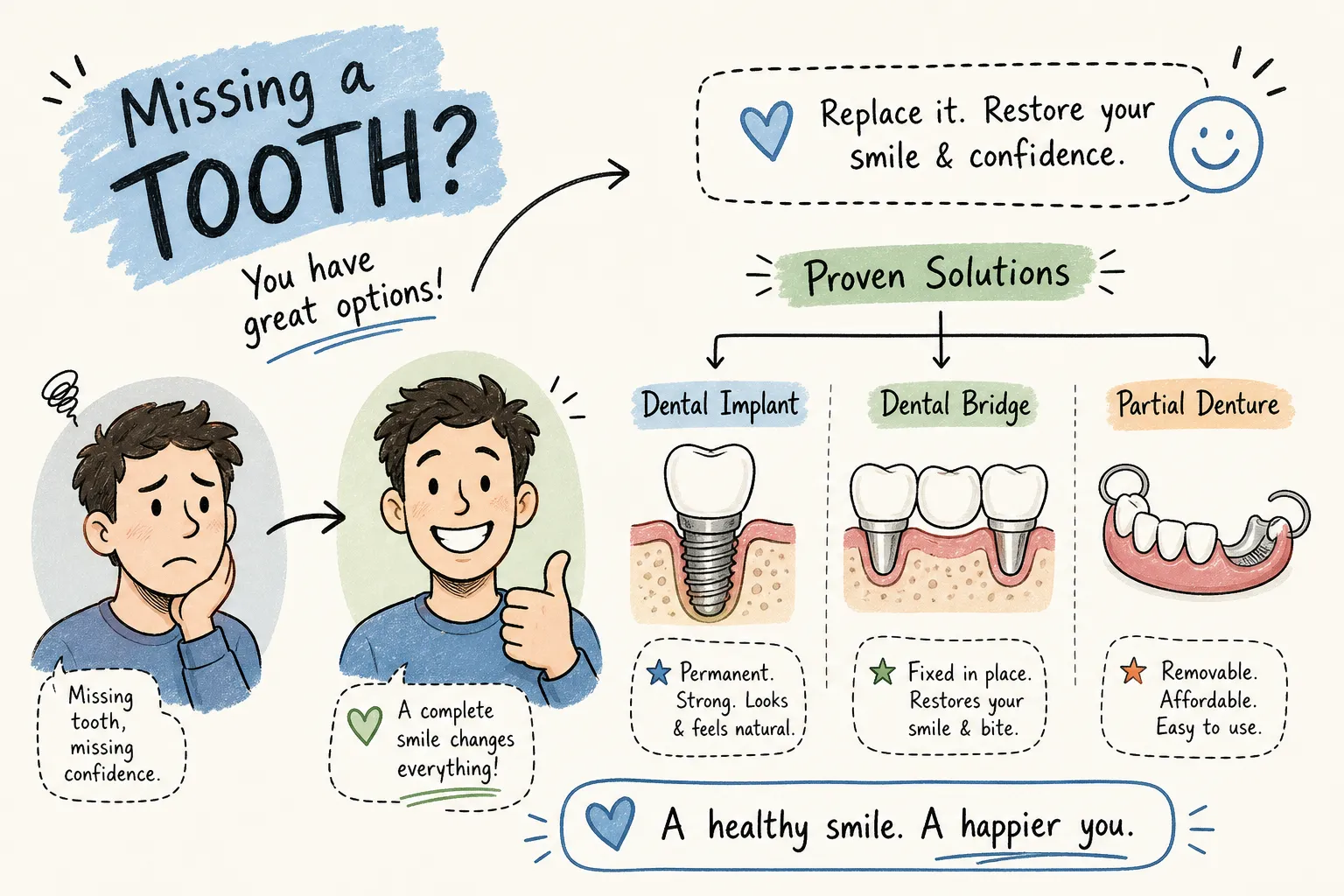
There are three primary solutions for replacing a single tooth, each suited to different clinical situations, budgets, and timelines. Here’s what each one actually involves.
Each missing tooth solution has its unique benefits and considerations, tailored to different patient needs.
Dental implants: the closest thing to a natural tooth
A dental implant is a titanium post that replaces the tooth root, surgically placed into the jawbone and topped with a custom-made crown. Because the implant is self-supporting, it doesn’t rely on neighbouring teeth at all, so there’s no grinding down of healthy enamel to make it work. The process does require surgery and a healing period of three to six months for the implant to fuse with the bone, a process called osseointegration.
For patients with limited bone volume who aren’t ready for grafting, mini dental implants are a smaller-diameter alternative that require less bone and a less invasive procedure. They can support a single crown or anchor a bridge, making them a practical middle-ground option worth asking about.
Dental bridges: fixed and faster
A conventional three-unit bridge uses crowns on the two teeth on either side of the gap to hold a false tooth (called a pontic) in between. It’s a fixed, non-removable solution completed in two to three weeks without surgery. The key trade-off is that the adjacent teeth need to be shaped down to accept the crowns, which means permanently altering otherwise healthy tooth structure.
A resin-bonded (Maryland) bridge is a more conservative alternative that bonds to the back of neighbouring teeth using minimal preparation. It’s not suitable for every clinical situation, but it’s worth discussing if your adjacent teeth are healthy and you want to avoid the more invasive preparation required for a conventional bridge.
Partial dentures: the removable option
Partial dentures can serve as a temporary missing tooth solution while planning for a more permanent option.
A removable partial denture is a plastic or metal framework with a prosthetic tooth that clips onto your remaining teeth. It’s the least invasive and most affordable missing tooth solution, involving no surgery and no alteration of adjacent teeth. That said, it offers the lowest comfort and durability of the three options, and most patients find it best suited as a temporary measure while they plan something more permanent.
What tooth replacement typically costs in Australia
The cost to replace a tooth is one of the first questions people ask, and it deserves a direct answer rather than a vague “it depends.” Here are current Australian benchmarks based on 2026 pricing data.
What implants, bridges and dentures cost in 2026
- Single dental implant (post, abutment, and crown): $3,000, $7,500, with most patients spending $4,500, $6,500
- Conventional three-unit bridge: $2,000, $4,500
- Removable partial denture: $800, $2,500 per jaw
- Bone grafting (if required before implant placement): $1,500, $3,000 or more
Consider the long-term investment in a missing tooth solution that best fits your lifestyle.
What drives the price difference
Location, material choice, and clinical complexity all affect the final figure. A suburban practice will generally charge less than a CBD specialist, and a zirconia crown costs more than a porcelain-fused-to-metal option. Private health insurance with Major Dental cover can reduce out-of-pocket costs for bridges and dentures, while implant rebates vary considerably between funds. Most top-tier extras policies pay back $1,000, $1,500 on a single implant, covering around 20, 25% of the total cost. Note that pricing varies by clinic and case, so always request a detailed quote for your specific situation.
Before any treatment begins, ask for a fully itemised treatment plan in writing. A transparent breakdown lets you compare costs clearly and avoids surprises if additional procedures are needed along the way.
How long each option lasts and what upkeep it needs
Upfront cost is only part of the picture. An option that needs replacing every five to seven years can end up costing more over a lifetime than a higher upfront investment that lasts decades.
Lifespan comparison: what to realistically expect
The implant post itself is designed to last 20, 40 years or longer, often for life, while the crown component typically needs replacing after 10, 15 years. A conventional bridge lasts 10, 15 years on average, with the risk of decay forming under the crown margins over time. Removable partial dentures have the shortest lifespan at five to ten years, requiring periodic relines, clasp repairs, and eventual full replacement. An implant-supported bridge, where two implants anchor a bridge instead of natural teeth, offers better longevity than a conventional bridge and is a strong single tooth replacement option when multiple adjacent teeth are missing, though it comes with a higher upfront cost.
Understanding how each missing tooth solution fits into your personal care routine is vital.
Maintenance requirements for each option
Implants are straightforward to maintain: brush and floss daily, attend six-monthly professional cleans, and avoid smoking, which is a major risk factor for implant failure alongside uncontrolled diabetes and certain medications. Bridges require floss threaders or interdental brushes to clean underneath the pontic where standard floss won’t reach. Partial dentures need to be removed and cleaned daily, kept away from hot water that can warp the framework, and professionally adjusted every one to two years. Consistent oral hygiene extends the lifespan of every option, regardless of which one you choose.
Regular maintenance of your missing tooth solution ensures lasting results and optimal health.
Which missing tooth solution suits your situation?
There’s no single right answer for everyone. Suitability comes down to a combination of clinical findings and personal factors, and a proper assessment is the only reliable way to know which direction makes sense for you.
Clinical factors: bone, gums and neighbouring teeth
Implants require adequate bone volume, typically at least 10mm in height and 6mm in width, though exact requirements vary by implant system and case, to achieve stable integration. If bone loss is significant from a long delay or previous gum disease, grafting may be needed first, or a bridge may be the more appropriate choice. When the teeth on either side of the gap are already heavily restored or crowned, a bridge makes practical clinical sense because those teeth need crowns anyway, reducing the net sacrifice of tooth structure. Weighing up a dental implant vs bridge in this context is something your dentist can help you work through based on your specific clinical picture.
Active gum disease must be treated and stabilised before any implant surgery proceeds. Placing an implant into an infected environment significantly increases the risk of peri-implantitis, an infection around the implant that can lead to failure. Gum disease treatment followed by three to six months of stable periodontal health is the standard protocol before implant placement is considered.
Discussing all available missing tooth solution options with your dentist is essential for a tailored approach.
Health, timeline and personal priorities
Certain systemic conditions, including uncontrolled diabetes, current bisphosphonate therapy, and a history of jaw radiation, increase implant risk and may make a bridge a safer option. Timeline matters too: implants require three to six months of osseointegration, whereas a bridge or partial denture can be completed within weeks. If a significant event is approaching and you need a result quickly, a bridge or temporary denture is a realistic missing tooth solution while you plan for something more permanent.
How to get the right answer from your dentist
Walking into a consult prepared makes the whole process faster and less stressful. You’re not expected to know which option is right before you arrive, but having the right questions ready helps you get a clear answer sooner.
Questions worth asking before you commit to any treatment
Inquiring about different types of missing tooth solution can help you feel more informed and confident.
- “Do I have enough bone for an implant, or would I need a graft?”
- “Are my neighbouring teeth healthy enough to avoid being crowned for a bridge?”
- “What does the full treatment cost include, and what happens if I need additional procedures?”
- “Can I see the treatment plan in writing before I decide?”
Why seeing a clinic that offers all options matters
A practice that only places implants will naturally lean toward implant solutions. A denture clinic will lean toward dentures. A more balanced recommendation tends to come from a full-service practice that offers all three options and can match the solution to your actual clinical picture, not just to what they happen to specialise in. That means advice grounded in your bone density, your neighbouring teeth, your health history, and your budget. Of course, an independent second opinion is always a reasonable step if you want additional confidence before committing.
Finding a clinic that specializes in various missing tooth solution options can lead to better outcomes.
For patients in Sunbury, Diggers Rest, Riddells Creek, and Gisborne, Sunbury Dental Group provides implants, bridges, and removable options through a single coordinated team. Rather than juggling referrals across multiple providers, you work through assessment, planning, and treatment in one place, which keeps your care consistent and your history in one set of hands.
The bottom line on replacing a missing tooth
The right missing tooth solution depends on the health of your jawbone, the condition of your neighbouring teeth, your timeline, and your budget. Most people don’t know which option suits them best until they sit down for a proper clinical assessment, and that’s completely normal. What matters is not delaying that assessment, because the longer the gap remains, the fewer straightforward options you’ll have.
Bring the questions from this article to your first appointment. Your dentist will walk through your imaging, explain what they’re seeing, and give you a clear treatment plan before you commit to anything. If you’re ready to take that step, our team at Sunbury Dental Group is welcoming new patients and happy to help you work through your options with no pressure and no jargon. Book a consultation and we’ll find the right path forward together.
Ultimately, the best missing tooth solution for you will align with your dental goals and lifestyle.
FAQ Content
How soon after losing a tooth should I see a dentist?
You should book an assessment as soon as possible, since the jawbone begins shrinking almost immediately after extraction, with bone width reducing by up to 50 percent in the first 12 months and the most rapid loss occurring within the first three to six months. Waiting doesn’t just delay treatment, it actively narrows your future options because implants require a minimum bone volume to anchor successfully.
What are my main options for replacing a missing tooth?
The three primary solutions are dental implants, dental bridges, and partial dentures, each suited to different clinical situations, budgets, and timelines. Implants offer the closest feel to a natural tooth and don’t rely on neighbouring teeth, bridges are fixed and faster to complete without surgery, and partial dentures are the most affordable removable option, typically best as a temporary measure.How much does it cost to replace a missing tooth in Australia?
Based on 2026 pricing, a single dental implant typically costs between $3,000 and $7,500 with most patients spending $4,500 to $6,500, a conventional three-unit bridge runs $2,000 to $4,500, and a removable partial denture costs $800 to $2,500 per jaw. Bone grafting, if required before implant placement, adds $1,500 to $3,000 or more, and pricing always varies by clinic and individual case.
How long do dental implants, bridges, and dentures actually last?
The implant post itself is designed to last 20 to 40 years or longer, often for life, though the crown component typically needs replacing after 10 to 15 years. A conventional bridge lasts 10 to 15 years on average, while removable partial dentures have the shortest lifespan at five to ten years, requiring periodic relines and eventual replacement.
Do I have enough bone for a dental implant?
Implants typically require at least 10mm of bone height and 6mm of width to achieve stable integration, though exact requirements vary by implant system and case. If bone loss is significant due to a long delay or previous gum disease, a bone graft may be needed first, or a bridge may be the more clinically appropriate choice.
Can I get a dental implant if I have gum disease?
Not immediately — active gum disease must be treated and stabilised before any implant surgery proceeds, since placing an implant into an infected environment significantly increases the risk of peri-implantitis and implant failure. The standard protocol involves gum disease treatment followed by three to six months of stable periodontal health before implant placement is considered.
Does private health insurance cover tooth replacement?
Private health insurance with Major Dental cover can reduce out-of-pocket costs for bridges and dentures, though implant rebates vary considerably between funds. Most top-tier extras policies pay back $1,000 to $1,500 on a single implant, covering roughly 20 to 25 percent of the total cost.
What happens to my other teeth if I don’t replace a missing tooth?
Neighbouring teeth tilt and drift toward the empty space over time, while the opposing tooth above or below the gap can over-erupt because there’s nothing to bite against. These shifts create bite problems, make cleaning harder, and can turn a straightforward fix into a far more complex one the longer you wait.
Why choose a clinic that offers implants, bridges, and dentures rather than a specialist in just one?
A practice that only places implants will naturally lean toward implant solutions, and a denture clinic will lean toward dentures, so a more balanced recommendation tends to come from a full-service practice offering all three options. This means the advice you get is grounded in your actual bone density, neighbouring teeth, health history, and budget, rather than what a single-focus provider happens to specialise in.