
Dental phobia isn’t just feeling a bit nervous before an appointment. For roughly one in six Australian adults, it’s a cycle that takes on a life of its own. You miss a check-up. The anxiety about what might be wrong grows. Then comes the guilt about leaving it so long, which makes picking up the phone even harder. So you don’t. And the cycle continues, sometimes for years, sometimes for a decade or more.
If that sounds familiar, you already know that a generic “just book somewhere nearby” approach won’t work for you. What you need is a dentist whose practice is genuinely built around patients like you, not one that merely tolerates anxious patients between the easy appointments. Knowing how to find a gentle dentist for dental phobia makes all the difference, and the good news is that it’s a process, more straightforward than you’d expect once you know what to look for.
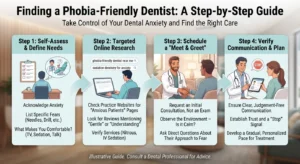
This guide walks you through that process step by step: where to search, how to read reviews properly, what to ask on that first phone call, what to look for in the clinic itself, and which sedation options are available to you. The right fit absolutely exists, and this is how you find it.
How to find a gentle dentist for dental phobia, where to start
Search terms that actually find the right practices
Searching “dentist near me” returns every clinic registered in the suburb, from bulk-billing practices running back-to-back appointments to boutique cosmetic clinics. That’s not what you need. Refining your search to “gentle dentist near me,” “dentist for anxious patients,” or “dental phobia dentist [your suburb]” immediately filters for practices that have structured their online presence around this patient type, which may indicate they’ve structured their actual care around it too, though it’s always worth verifying with a phone call and a credentials check.
Beyond Google, Healthengine listings and local Facebook community groups are genuinely useful. A recommendation from a real person in your suburb who was also anxious, and who can tell you what specifically made the experience different, carries far more weight than any star rating. Some areas also have special care dentistry services or community health centres that specifically accommodate patients with significant dental anxiety, so it’s worth asking around locally.
Verifying credentials through AHPRA
Before you book anywhere, spend a few minutes on the AHPRA National Register (the Australian Health Practitioner Regulation Agency website). You can search any dentist by name and confirm they’re registered with the Dental Board of Australia. You can also check whether they hold an endorsement for conscious sedation, the regulatory requirement to administer certain forms of in-chair sedation in Australia. A practice claiming to offer “sleep dentistry” without the relevant endorsement on their registration is a red flag worth acting on.
This step takes only a few minutes and tells you more than most practice websites will. A dentist who has completed the postgraduate training required for sedation endorsement has invested seriously in managing patient comfort, not just in acquiring equipment.
When word of mouth beats any directory
There is no single national directory in Australia that lists dentists by their experience with dental phobia or lists dentists who treat dental phobia as a clinical focus. The most efficient shortcut is a personal referral, specifically from someone who was also anxious. When you ask, go specific: what made this dentist different? Did they feel rushed? Were they ever made to feel judged? Local Facebook groups and community forums frequently surface these firsthand accounts, and the detail in those posts tells you things no review platform captures.
Reading online reviews through a phobia lens
The language that signals a genuinely gentle practice
Star ratings are almost useless for this search. A five-star review that says “great dentist, highly recommend” tells you nothing about how a practice handles someone shaking in the waiting room. What you’re looking for is specific behavioural description: reviewers who mention the dentist explaining each step before doing it, staff who checked in during the appointment, or patients who hadn’t seen a dentist in years walking out feeling calm.
Search the reviews for words like “nervous,” “scared,” “anxiety,” “phobia,” or “breaks.” The phrases that carry real weight include: “didn’t make me feel stupid for being scared,” “explained everything before touching me,” “let me stop when I needed to,” and “hadn’t been in twelve years and felt safe.” These describe actual clinical behaviour. Generic praise describes nothing.
Red flags worth noting
Be cautious of practices where all the positive reviews centre on speed and efficiency. A culture that celebrates throughput is not a culture built around patient comfort. Similarly, if you can’t find a single review that references an anxious patient having a positive experience, that absence is informative. When multiple reviews, ideally five or more, explicitly mention anxiety or phobia and describe a positive outcome, that’s a meaningful signal that a practice has genuine experience in this area.
Finding a gentle dentist for dental phobia, the phone call that tells you everything
Questions worth asking before you book
Call rather than book online. The phone interaction itself is a data point. Ask these questions directly: Do you have experience treating patients with dental phobia or significant anxiety? What specific comfort options do you offer for anxious patients? And: can I pause or stop treatment at any point if I feel overwhelmed?
These aren’t trick questions, and a practice experienced with anxious patients won’t treat them as unusual. Vague answers like “we’re very gentle here” are not answers, they’re a prompt to keep looking. A confident, specific response will reference actual protocols, options, and a commitment to your control over the appointment.
What a phobia-aware answer sounds like
Listen for concrete details: a consultation-only first visit with no treatment, on-site availability of happy gas, a stop signal system the dentist uses routinely, or reception staff trained specifically in communicating with highly anxious patients. A practice that describes a protocol, rather than just a personality, has built anxiety management into how it operates.
Also note how the receptionist responds to the question. A team trained in supporting phobic patients will take the enquiry seriously, slow down, and engage with it. If the response is to quickly redirect you to the online booking calendar, that tells you something too.
What a truly phobia-friendly clinic looks and feels like
The physical environment and first impressions
Phobia-friendly practices make deliberate choices about their physical environment. Calm lighting, minimal clinical sounds from reception, and no rushed energy at the front desk, these aren’t luxuries, they’re design decisions that reduce ambient anxiety before a patient even sits down. Some clinics offer noise-cancelling headphones, sunglasses to block overhead lights, or a weighted blanket on request. These are practical sensory tools that help patients feel in control, not gimmicks.
The no-treatment first visit
A dentist genuinely experienced in treating dental phobia will offer a first appointment that involves no instruments, no examination, and no pressure. The visit is purely conversational: discussing your dental history, your specific fears, and building rapport before anything clinical happens. This structure is one of the clearest indicators that a practice is set up for anxious patients rather than simply claiming to be.
Ask specifically whether this type of visit is available when you call. These introductory consultations typically cost somewhere in the range of $80 to $180 at Australian practices, though fees vary, and some offer them complimentary. The investment in attending one, before committing to any treatment, is well worth it.
Your right to pause, stop, and stay in control
Every patient has an ethical and clinical right to stop treatment at any point, this is a principle embedded in Australian dental consent standards. A phobia-friendly dentist establishes a stop signal before any procedure begins, typically a raised hand, and commits to pausing immediately when it’s used. This isn’t a courtesy; it’s a clinical boundary that experienced practitioners build into their process as standard.
If a dentist doesn’t raise this unprompted, ask directly: “Do you use a stop signal during procedures?” The answer, and the speed of the answer, will tell you a great deal.
Sedation and comfort options available in Australian dental practices
Nitrous oxide: the most accessible starting point
Nitrous oxide, or happy gas, is the most widely available in-chair option for mild to moderate anxiety. It takes effect within a few minutes, keeps you fully conscious and responsive, and wears off almost immediately once the mask is removed. Critically, patients can drive home afterwards, meaning it doesn’t disrupt your day. As a rough guide, costs across Australia generally range from $100 to $400 per session depending on duration and location, with practices in and around Melbourne typically sitting in the higher end of that range. Contact your preferred clinic directly for current pricing, as fees vary.
Oral and IV sedation for more significant anxiety
Oral sedation involves a prescribed benzodiazepine taken approximately one hour before your appointment. You’ll feel deeply relaxed but remain conscious, and you’ll often have limited memory of the visit. A driver home is mandatory. IV sedation, sometimes called twilight sedation, is a deeper form of conscious sedation delivered via a cannula. It’s suited to severe dental phobia or complex procedures, and only dentists holding the relevant Dental Board of Australia endorsement can legally administer it. Costs for IV sedation can vary considerably, as a general guide, fees typically range from $500 to $2,000 depending on the duration and complexity of the session, so it’s worth asking your dentist for a specific quote.
Standard extras health cover rarely includes sedation fees. Hospital cover may apply if general anaesthesia is used in a hospital setting. Call your fund directly before your appointment to clarify what your specific policy covers, as this varies considerably between insurers and policy tiers.
For patients near Sunbury, this practice is worth calling first
A team built around anxious patient support
Sunbury Dental Group, located at 5/92 Evans Street, Sunbury VIC, has built its practice culture around patients who have avoided dental care due to fear, past negative experiences, or significant anxiety. From the first phone call, the focus is on listening without judgement, discussing comfort options before a single appointment is booked, and treating every enquiry as seriously as any clinical question.
The clinic serves not just Sunbury but surrounding suburbs including Diggers Rest, Riddells Creek, Gisborne, Bulla, and Lancefield. Patients across this corridor don’t need to travel into Melbourne to access genuinely supportive dental care. The practice combines modern diagnostic technology, including digital X-rays, with transparent treatment planning and flexible payment options designed to remove as many barriers as possible for patients who have been putting this off.
Taking the first step with confidence
If the idea of making that first call still feels daunting after reading this, that’s completely understandable, and it’s precisely why practices like Sunbury Dental Group exist. A brief, low-pressure phone conversation about your concerns costs nothing and commits you to nothing. Most initial calls take only a few minutes, and you’re under no obligation to book after speaking with the team. They already know how to have that conversation.
Pulling it all together
Knowing how to find a gentle dentist for dental phobia means approaching the search as a process, not a single Google query. Search smart using terms that filter for anxiety-focused practices, “gentle dentist near me,” “dentist for anxious patients,” or “special care dentistry” in your area. Read review text carefully and look for specific behavioural language, not star ratings. Make the call, ask the right questions, and listen for a protocol rather than a personality. Trust what the clinic feels like in person during that first, no-treatment visit. And understand your sedation options before you commit to anything, because having that information removes a significant layer of uncertainty.
Every step in this guide exists to replace guesswork with clarity. The right practice is out there, and following this process gets you there without having to rely on luck or wade through clinics that aren’t the right fit.
If you’re in Sunbury or the surrounding area, Sunbury Dental Group is a straightforward place to start that conversation. One phone call, no pressure, and a team that’s ready to meet you exactly where you are.
FAQ Content
What is dental phobia?
Dental phobia is an intense, persistent fear of dental visits or procedures that goes beyond normal nervousness, often causing people to avoid check-ups entirely for years or even decades. It affects roughly one in six Australian adults and typically stems from a cycle of avoidance, growing worry about undetected problems, and guilt that makes booking an appointment feel harder over time.
What causes dental phobia?
Dental phobia usually develops from a past negative or painful experience, a loss of control during treatment, or fear of needles, drills, or specific sensations like the smell of a clinic. For some patients it can also stem from embarrassment about the condition of their teeth after avoiding care for a long period, which reinforces the avoidance cycle.
How do I find a dentist experienced with dental phobia?
Search specific terms like “gentle dentist near me” or “dentist for anxious patients” rather than a generic “dentist near me,” since this filters for practices structured around anxiety-focused care. Reading reviews for specific behavioural language, such as mentions of a dentist explaining steps before touching a patient or allowing pauses during treatment, is more reliable than star ratings alone.
What should I ask a dental clinic before booking if I have dental phobia?
Ask directly whether the practice has experience treating dental phobia, what specific comfort options they offer, and whether you can pause or stop treatment at any point if you feel overwhelmed. A phobia-aware practice will answer with concrete protocols, such as a no-treatment first visit or a stop-signal system, rather than vague reassurances like “we’re very gentle here”.
What is a no-treatment first visit for dental phobia?
It’s an introductory appointment involving no instruments and no examination, used purely to discuss dental history and fears and build rapport before any clinical work begins. These visits typically cost between $80 and $180 at Australian practices, though some clinics offer them free of charge.
What sedation options are available for dental phobia?
Options range from nitrous oxide (happy gas), which wears off almost immediately and allows patients to drive home, through to oral sedation and IV (twilight) sedation for more severe phobia or complex procedures. Nitrous oxide generally costs $100 to $400 per session, while IV sedation, which requires a dentist with a specific Dental Board of Australia endorsement, typically ranges from $500 to $2,000 depending on complexity.
Can I stop dental treatment partway through if I feel anxious?
Yes — every patient has an ethical and clinical right to pause or stop treatment at any point, and this is embedded in Australian dental consent standards. Phobia-friendly dentists establish a stop signal, usually a raised hand, before starting any procedure and commit to pausing immediately when it’s used.
Does health insurance cover sedation for dental phobia?
Standard extras cover rarely includes sedation fees, though hospital cover may apply if general anaesthesia is administered in a hospital setting. Coverage varies significantly between insurers and policy tiers, so it’s best to confirm directly with your fund before the appointment.
Where can I find phobia-friendly dental care near Sunbury?
Sunbury Dental Group, located at 5/92 Evans Street, Sunbury VIC, has built its practice culture specifically around patients who have avoided care due to fear or past negative experiences, offering judgement-free phone consultations before any appointment is booked. The clinic also serves surrounding suburbs including Diggers Rest, Riddells Creek, Gisborne, Bulla, and Lancefield.