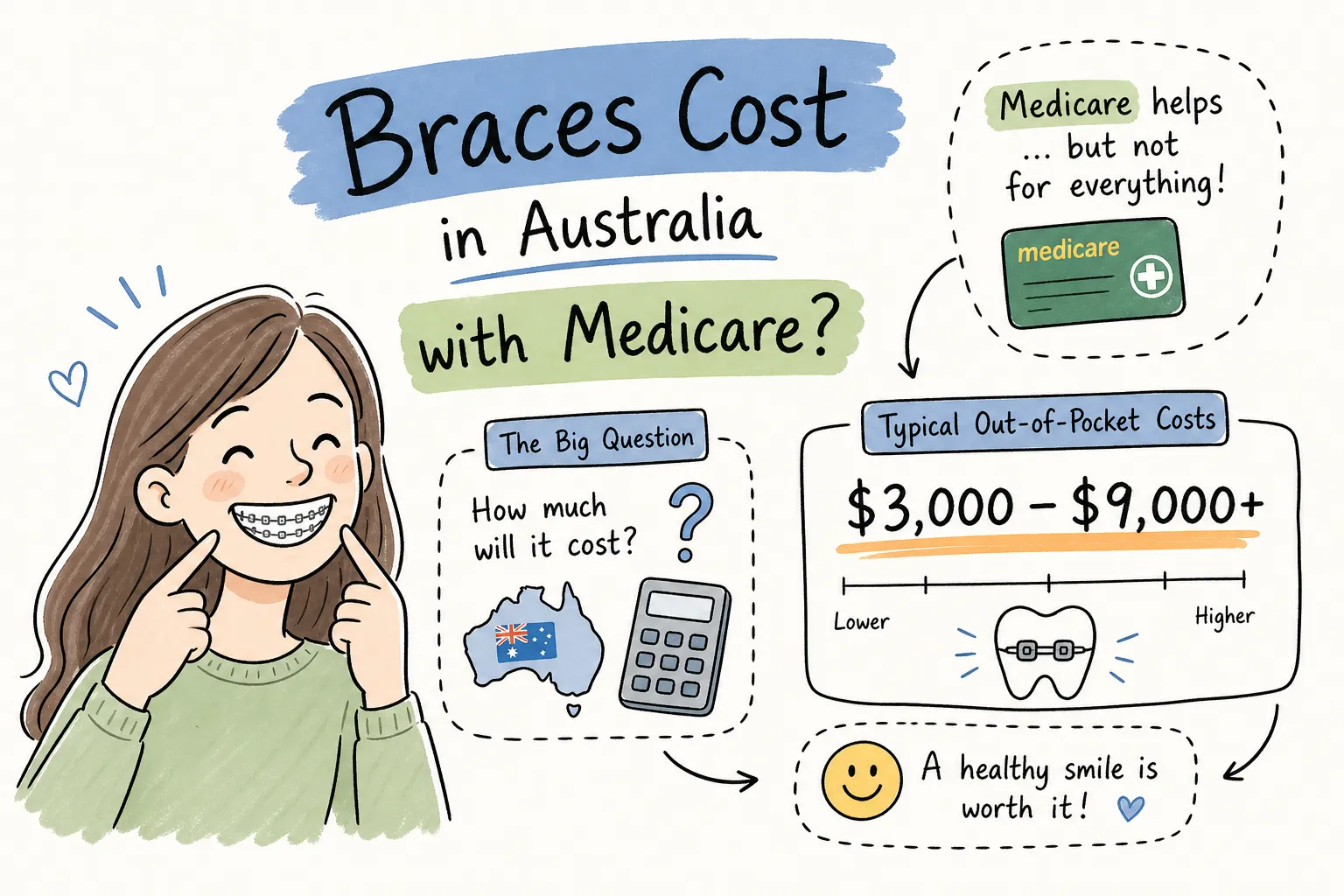
How much do braces cost in Australia with Medicare is one of the most common questions we hear at Sunbury Dental Group, and one of the most misunderstood. Anecdotally, a surprising number of Australian families come to us having done hours of research online, only to walk through the door believing Medicare will cover a meaningful chunk of their child’s orthodontic treatment. The reality, unfortunately, is far more limited than most expect. Medicare, the Child Dental Benefits Schedule, private health extras, and public concession programmes all sound like they should help, and the overlap between them makes the whole picture genuinely confusing. Many people wonder how much do braces cost in Australia with Medicare before coming in, but it’s essential to clarify the details.
Families from Sunbury, Diggers Rest, and Gisborne have often spent hours reading before they even pick up the phone, and they still leave the first consultation surprised by how the funding really works. This guide gives you the straight answer: what orthodontic treatment costs in Australia in 2026, when Medicare actually contributes (and when it doesn’t), how private health insurance factors in, what public pathways exist, and the practical steps to reduce what you pay out of pocket.
Understanding how much do braces cost in Australia with Medicare can help families make informed decisions. It’s important to ask the right questions during consultations and get clear answers about coverage and out-of-pocket expenses.
What braces actually cost in Australia in 2026
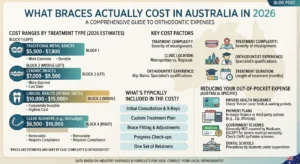
Before you can work out how much any funding scheme saves you, you need a realistic baseline. Orthodontic costs vary by treatment type, case complexity, and the practice you attend, but the figures below reflect current mid-market pricing across Australia for 2026.
Metal braces: where the price range starts
When evaluating options, many ask how much do braces cost in Australia with Medicare, which leads to discussions about affordability and coverage.
Metal braces remain the most affordable fixed option, typically sitting in the $6,000 to $9,000 range nationally, with a practical average of around $7,000 to $8,000 depending on complexity and the treating practice. Many practices include initial records, adjustments across the treatment period, and retainers within that fee, though this varies significantly by clinic, always ask for a written breakdown of exactly what’s included before comparing quotes. Complex cases or premium practices can push metal braces above $9,500.
Ceramic and lingual braces: what the upgrade costs
Ceramic braces use tooth-coloured brackets and typically run $7,000 to $10,000, sitting slightly above metal for aesthetics without going fully invisible. Lingual braces, which attach to the inside of the teeth, are the most expensive fixed option at $9,000 to $15,000, reflecting the technical difficulty of placement and adjustment. Clinical outcomes for ceramic and lingual braces are generally comparable to metal braces in many cases; the higher price reflects cosmetic and comfort considerations rather than superior results.
Clear aligners and Invisalign: where they sit in the range
Invisalign and comparable clear aligner systems typically land between $8,000 and $10,000, with a national average closer to $8,500 to $9,500. Pricing varies based on case complexity and the number of aligners required, so mild crowding cases can sit meaningfully lower in that range. This matters particularly for patients comparing options, because Invisalign often lands in a surprisingly comparable bracket to ceramic braces once actual quotes are on the table.
Patients exploring clear aligners often inquire about how much do braces cost in Australia with Medicare, seeking the most cost-effective options available.
How much do braces cost in Australia with Medicare? What you need to know
To truly understand how much do braces cost in Australia with Medicare, it’s vital to navigate the often confusing landscape of private health insurance and public programs.
This is where the most common and costly misconceptions live. It helps to understand both where the boundaries are and what’s coming, specifically, the CDBS clarification and the narrow cleft and craniofacial exception, so you can build a budget on accurate assumptions rather than hopeful ones.
The Child Dental Benefits Schedule and braces: a common misconception cleared up
The Child Dental Benefits Schedule, known as the CDBS, provides up to $1,095 per eligible child aged 2 to 17 over a two-calendar-year period. It does not cover braces or orthodontic treatment. The CDBS is explicitly limited to basic dental services: examinations, X-rays, fillings, extractions, and some preventive treatments. Parents who’ve factored the CDBS into their orthodontic budget will need to set it aside entirely for this purpose, orthodontics falls completely outside its scope.
As seen, the Child Dental Benefits Schedule does not cover how much do braces cost in Australia with Medicare, leading many families to seek alternative funding sources.
When Medicare does contribute to orthodontic costs
Medicare does subsidise orthodontic treatment in one specific and narrow circumstance: patients with a diagnosed cleft lip and palate or craniofacial condition may access treatment under the Medicare Cleft and Craniofacial Services framework, including MBS item 75048 and related items. Eligibility is assessed through specialist review, and treatment must be carried out in Australia by an eligible dental practitioner. For the vast majority of patients seeking braces for crowding, spacing, or bite issues, Medicare contributes nothing to orthodontic treatment costs. That’s not a gap in the system; it’s the design of the system.
How private health insurance factors into the total cost
Knowing how much do braces cost in Australia with Medicare helps parents evaluate if their private health cover is sufficient for orthodontic needs.
Private health extras with orthodontic cover will reduce your out-of-pocket costs, but the reduction is often smaller than families expect, and the timing of your cover matters enormously.
Typical rebates and lifetime limits across major funds
Most Australian health funds with orthodontic cover on their extras policies offer a lifetime limit in the $1,200 to $3,000 range, with the benefit paid progressively during treatment. As a practical example: Medibank’s orthodontic benefit structure works on a $400 opening balance topped up by $200 per year, capped at a $1,200 lifetime limit. GMHBA’s higher-tier products reach around $3,000 lifetime. We recommend confirming the exact figures directly with your insurer, as product details change and vary between policies. Even at the upper end of these limits, the gap remains substantial. On a $7,500 course of treatment with a $2,500 lifetime rebate, your out-of-pocket cost is still $5,000. Private health cover is helpful, but it doesn’t come close to closing the gap on its own.
Waiting periods and why timing your cover matters
Almost all private health funds impose a 12-month waiting period before orthodontic claims can be made. This is standard across the industry, not a quirk of one particular fund. Families who sign up for extras cover after a child has already been diagnosed as needing braces will wait a full year before a dollar of orthodontic benefit becomes payable. The practical takeaway: if your child is 10 or 11 and orthodontic treatment looks likely in a year or two, taking out appropriate extras cover now makes clear financial sense. A year of premiums is almost certainly less than the benefit you’d otherwise forfeit.
Public programmes and concession pathways worth knowing about
Many families discover the reality of how much do braces cost in Australia with Medicare only after extensive research.
Australia does not offer universal free braces. Many families are surprised to hear this, it’s something we clarify regularly at Sunbury Dental Group. What exists is a patchwork of state-based services and one national programme, and both come with significant limitations on eligibility and timing.
The Give a Smile programme and state public orthodontic services
The Give a Smile programme allocates orthodontic treatment through participating private practices for eligible patients drawn from state public orthodontic waiting lists. To access it, a patient must hold a Health Care Card or Pension Card and already be on the public orthodontic waiting list in their state or territory. You cannot self-refer directly into Give a Smile.
In Victoria, public orthodontic assessment typically requires the patient to be under 18 and hold a current concession card or be a dependant on one. In addition, the case must involve a clinically significant problem assessed as likely to benefit meaningfully from correction. Dental Health Services Victoria manages access to these public orthodontic pathways in this state, and a small co-payment applies in Victoria under the Give a Smile programme.
Who qualifies and how long the wait is
Based on reporting from Dental Health Services Victoria and similar state bodies, public orthodontic waiting times are often two years or longer, and no state or territory publishes a fixed wait time. These programmes are not designed for mild crowding or cosmetic alignment issues; they’re intended for severe or functional cases with a significant clinical need. For most families in Sunbury and surrounding suburbs, the public system is not a realistic path to routine orthodontic care. Private planning, ideally with private health cover already in place, remains the more practical starting point for most patients.

Braces costs in Australia (2026): practical ways to bring your out-of-pocket costs down
Ultimately, understanding how much do braces cost in Australia with Medicare will guide families towards making better financial decisions regarding their orthodontic care.
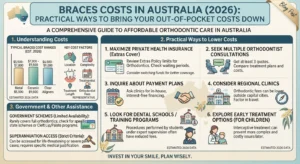
Even without a meaningful Medicare contribution, there are genuine strategies to reduce what you pay. No single approach will eliminate the cost, but combining a few of these could realistically save you $500 to $2,000 or more across the course of treatment.
Bulk-billed X-rays and what they save on diagnostic records
Orthodontic workups typically include an OPG (panoramic X-ray) and a lateral cephalometric X-ray. When these are bulk-billed to Medicare, the cost to the patient is $0, representing a saving of roughly $70 to $300 depending on the provider and region. Not all practices bulk-bill these imaging items, so it’s worth asking up front whether diagnostic imaging is included in the consultation fee or charged separately, and whether it’s bulk-billed through Medicare. The saving doesn’t shift the total orthodontic cost dramatically, but it reduces the upfront expense during the assessment phase and is worth confirming before you commit to a workup.
Getting quotes and exploring payment plans
Always get written quotes from at least two or three providers, and ask each clinic to break down exactly what’s included, adjustments, retainers, and emergency appointments can all vary and add up. Many practices offer interest-free or low-interest payment plans that spread the cost across the treatment period; it’s always worth asking each clinic about their payment options, as these can make a $7,000 to $9,000 course of treatment considerably more manageable month to month.
One thing many patients find genuinely surprising when they come in for a consultation at Sunbury Dental Group: Invisalign often lands in a comparable price bracket to ceramic braces, and in some moderate cases, even close to metal braces. If you’ve been assuming clear aligners are out of reach financially, it’s worth getting an actual figure before ruling them out. We offer a no-obligation Invisalign consultation so you can weigh up your options with real numbers in front of you rather than working from assumptions.
Getting an accurate quote: your next steps
So, how much do braces cost in Australia with Medicare? For most patients, the honest answer is that Medicare contributes very little, and nothing at all for routine orthodontic treatment. The CDBS doesn’t cover braces. Private health insurance can offset a few thousand dollars if you’ve held the right cover long enough. The actual out-of-pocket cost depends heavily on the treatment type, the practice you choose, and whether you’ve done the groundwork on timing your health cover correctly.
For clarity, when asking how much do braces cost in Australia with Medicare, it’s important to consider all possible expenses involved in the treatment process.
Before starting treatment, contact your private health fund directly and confirm your exact lifetime limit, your current waiting period status, and how benefits are paid during active treatment. These details vary between funds and even between products within the same fund, so don’t rely on estimates.
If you’re in Sunbury, Diggers Rest, Riddells Creek, or Gisborne and ready to get real figures rather than ballpark numbers, the team at Sunbury Dental Group is here to help. We offer straightforward, transparent treatment quotes with no pressure, and our no-obligation Invisalign consultation is a great first step for anyone who wants to understand all their orthodontic options before making a decision. Book online or give us a call to get started.
In conclusion, understanding how much do braces cost in Australia with Medicare is crucial for families looking to navigate their options efficiently.

Frequently asked questions
How much do braces cost in Australia with Medicare?
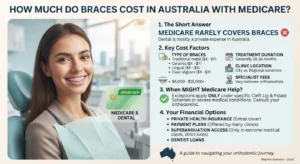
For most patients, Medicare covers nothing for routine braces. The exception is patients with a diagnosed cleft lip and palate or craniofacial condition, who may access subsidised treatment under specific MBS items. Everyone else pays out of pocket, with private health insurance and public concession programmes offering partial relief in certain circumstances.
Are braces covered by Medicare?
No, not for standard orthodontic treatment. Medicare only contributes to orthodontic costs in the narrow case of cleft lip and palate or craniofacial conditions. Crowding, spacing, and bite issues, the most common reasons people seek braces, are not covered by Medicare.
Does the CDBS cover braces?
No. The Child Dental Benefits Schedule covers basic dental services only: examinations, X-rays, fillings, extractions, and some preventive treatments. Orthodontic treatment, including braces and clear aligners, falls entirely outside the CDBS. The $1,095 benefit per eligible child cannot be applied to braces in any circumstance.
How much does Invisalign cost in Australia?
Invisalign typically costs between $8,000 and $10,000 nationally, with a practical average of $8,500 to $9,500 depending on case complexity and the treating practice. This often puts Invisalign in a comparable price range to ceramic braces, which surprises many patients who assume clear aligners are substantially more expensive.
What is the cheapest way to get braces in Australia?
The most cost-effective approach combines several strategies: taking out private health extras cover well in advance of treatment (to clear the 12-month waiting period), confirming that diagnostic X-rays will be bulk-billed through Medicare, getting written quotes from multiple providers, and asking about interest-free payment plans. For eligible low-income families, the public orthodontic waiting list and Give a Smile programme may also be worth exploring, though waiting times are typically two years or longer.