Implant vs Bridge Cost Comparison: What the 20-Year Numbers Actually Show
If you’re staring down a quote for a dental bridge and a quote for an implant, and the implant number is making your eyes widen, we get it completely. But sticker price and true cost aren’t the same thing, and this is genuinely one of those decisions where looking only at the upfront number can cost you more down the track.
We’re Sunbury Dental Group, and we walk families across Sunbury, Diggers Rest, Bulla, and the wider Hume region through this implant vs bridge cost comparison regularly. Let’s break down the real numbers, backed by actual research, so you can make this decision with your eyes open rather than just going with whatever feels cheaper today.
Overview: What This Article Covers
We’re going to compare the upfront and long-term cost dental implant investment against a traditional bridge, using published research rather than guesswork. You’ll learn the realistic bridge vs implant lifespan figures, what actually happens when a bridge fails, and how the total tooth replacement cost stacks up over 10, 20, and 30-year windows. We’ll also look at where a bridge genuinely makes sense, because this isn’t a one-size-fits-all answer.
In This Article, You’ll Discover…
The real upfront cost difference between implants and bridges in Australia
Why bridges cost less now but often cost more eventually
What bridge vs implant lifespan actually looks like based on published data
The hidden costs of bridge failure that rarely make it into the initial quote
A realistic 20-year cost breakdown for both options
Why implants protect your jawbone in a way bridges simply can’t
Situations where a bridge is still the smarter choice
The Upfront Numbers: What Each Option Actually Costs
Let’s start with the honest starting point, because pretending cost doesn’t matter would be silly. In Australia, a single dental implant, including the post, abutment, and crown, typically runs between $3,500 and $7,500, with some sources citing figures up to $9,000 depending on complexity and location. A traditional three-unit bridge generally costs somewhat less, ranging from $1,800 to $5,000, with more affordable options like Maryland bridges sometimes available from around $1,200.
So yes, on day one, the bridge usually wins on price. That’s not in dispute, and nobody’s trying to talk you out of that reality.
Where the Comparison Gets Interesting
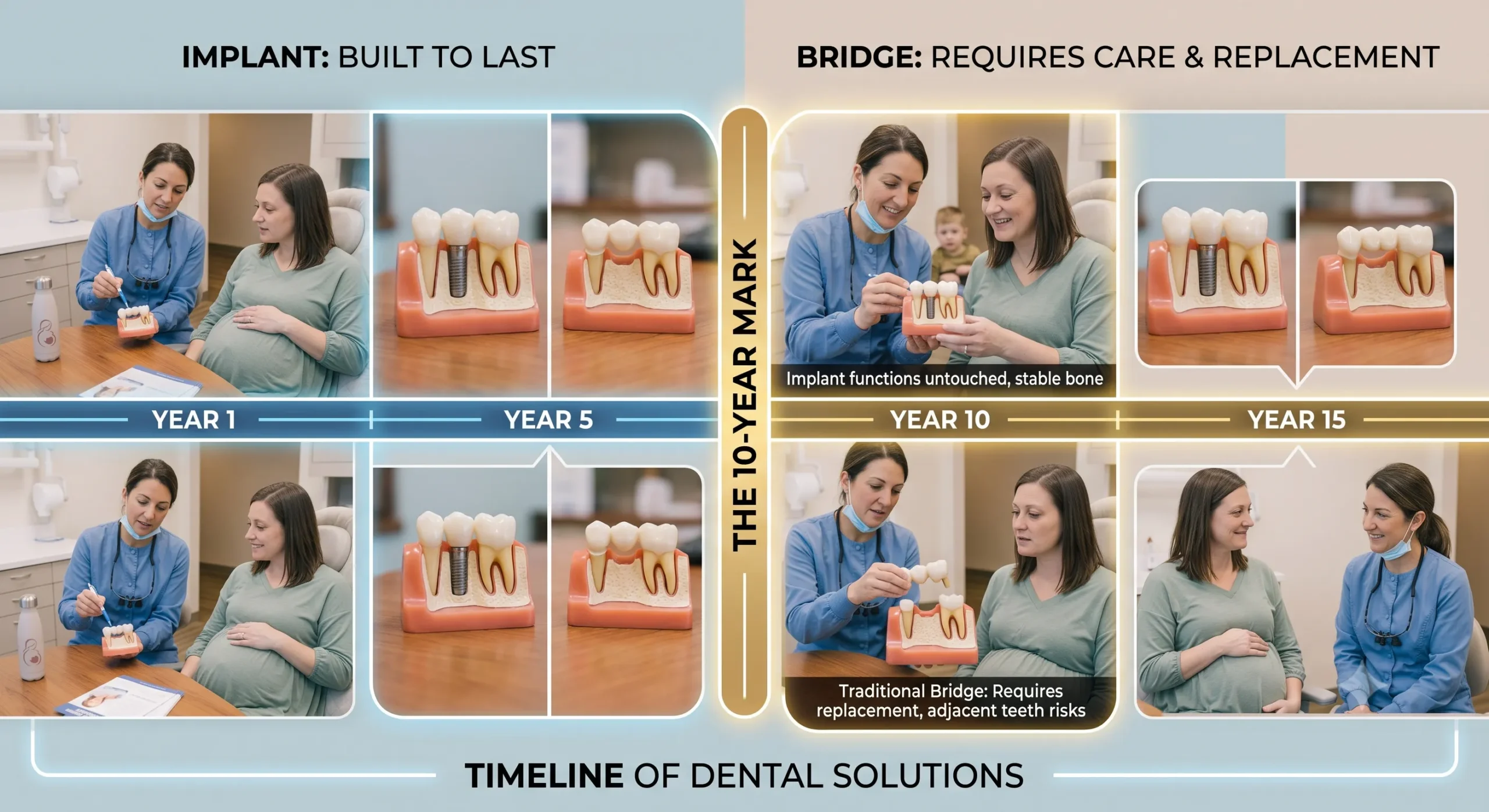
Here’s where it stops being a simple “cheaper vs pricier” conversation. Implants are designed as a long-term, often permanent solution, while bridges have a defined lifespan that means replacement is genuinely built into the equation from the start.
Bridge vs Implant Lifespan: What the Research Actually Shows
This is genuinely the crux of the whole comparison, so let’s look at real numbers rather than vague claims.
How Long Do Bridges Actually Last?
Published research on resin-bonded bridges shows survival rates of 87.7 to 91.4 percent at five years, with a slight decline by ten years. Annual failure rates vary by material, with all-ceramic resin-bonded bridges failing at roughly 11.7 percent per year, compared to 4.1 to 4.6 percent for metal or fibre-reinforced frameworks. Most clinical sources put the practical lifespan of a traditional bridge at 10 to 15 years, sometimes extending to 20 with excellent care, though the average lifespan in some surveys sits closer to just six years when complications occur early.
How Long Do Implants Actually Last?
The picture here is genuinely more favourable. A 2024 meta-analysis analysing 20-year implant survival data found a mean survival rate of 92 percent across prospective studies and 88 percent across retrospective studies. Ten-year survival rates for implants consistently exceed 95 percent in the broader literature, compared to roughly 87 percent for bridges over the same window. Many patients see their implant post itself last decades, sometimes a lifetime, with only the crown on top potentially needing replacement after 15 or so years.
Implants help preserve jawbone volume in a way bridges alone can’t replicate.
What Happens When a Bridge Fails: The Hidden Costs
This is the part that genuinely doesn’t make it into most initial quotes, and it’s exactly why the long-term picture shifts so much.
Why Bridge Failure Often Costs More Than Expected
A bridge relies on your neighbouring healthy teeth as anchors, and those anchor teeth need to be shaved down and crowned to support it. When a bridge eventually fails, it’s rarely a simple like-for-like swap. Secondary decay under the anchor crowns, gum disease around the supporting teeth, or an anchor tooth failing outright are the most common causes of bridge failure.
If an anchor tooth fails, the entire bridge typically has to come out, and you’re then facing a bigger decision about what replaces it, sometimes including root canal treatment or extraction of the compromised anchor tooth itself. That’s a materially different, and often more expensive, situation than simply replacing a crown on an existing implant.
The Bone Loss Factor Nobody Talks About Enough
Bridges don’t stimulate the jawbone underneath the missing tooth gap the way a tooth root or implant does, meaning bone loss can continue quietly underneath a bridge for years. Implants, by contrast, integrate directly with the bone and help maintain its volume and density over time. This matters because ongoing bone loss can eventually affect the fit of your bridge and the health of the surrounding teeth, adding yet another potential cost down the line.
The 20-Year Tooth Replacement Cost: A Realistic Breakdown
Numbers make this so much clearer, so let’s actually run through it.
One Australian Dental Journal study cited in industry research found patients choosing implants over bridges saved around 40 percent in total treatment costs over a 20-year period. A separate 10-year economic evaluation found implants cost $251 to $325 more than a comparable 3-unit bridge, but delivered a 10.4 percent higher survival rate over that decade — meaning the extra spend genuinely bought measurably better durability.
The 30-Year Picture Is Even More Pronounced
Stretch the timeline to 30 or 40 years, and the gap widens further. Bridge replacement cycles, combined with potential endodontic complications and gradual loss of periodontal support on anchor teeth, typically end up substantially exceeding the initial implant investment over that longer window. Health economic modelling consistently favours implants in cost-per-year-of-function analysis, particularly for patients with more than 15 years of remaining life expectancy to factor into the calculation.
Under 10 years remaining need: bridges can be genuinely cost-competitive and perfectly reasonable
10 to 20 years remaining need: the two options become more comparable, implant advantage starts emerging
20+ years remaining need: implants typically deliver clearly superior long-term value
When a Bridge Genuinely Makes More Sense
We’re not here to push implants as the only valid answer for everyone. Bridges remain a perfectly reasonable choice when the neighbouring teeth already need crowns for other reasons, when bone volume doesn’t support implant placement without significant grafting, or when the upfront cost of an implant simply isn’t achievable right now. A good dentist will discuss both honestly rather than steering you toward the pricier option by default.
A Local Note for Sunbury Families
We talk to plenty of Sunbury and Bulla patients who are choosing based purely on which quote feels more manageable today, and that’s a completely understandable starting point. What we’d rather do is walk you through the actual 10, 20, and 30-year picture for your specific situation, because the “cheaper” option now isn’t always cheaper once you’re standing at the 15-year mark facing a failed anchor tooth. Every mouth and every budget is different, so this decision deserves a proper, personalised conversation rather than a generic answer.
Questions Worth Asking at Your Consultation
What would my specific implant vs bridge cost look like given my current oral health?
Are my neighbouring teeth healthy enough to avoid needing crowns of their own regardless?
What’s my realistic long-term bone volume outlook if I choose a bridge instead of an implant?
What ongoing maintenance costs should I budget for with each option?
Given my age and health, which option offers better value over my likely remaining years?
Bridges typically need replacement within 10 to 15 years, while implants often last decades.
Frequently Asked Questions
Is a dental implant really cheaper than a bridge in the long run?
For many patients, yes — while bridges cost less upfront, they typically need replacement every 10 to 15 years, and research suggests implants can save around 40 percent over a 20-year period. This depends on individual circumstances, so a personalised cost comparison is the most reliable way to know for certain.
How long does a dental bridge typically last?
Most traditional bridges last 10 to 15 years, though failure rates vary depending on the material used and how well the anchor teeth are maintained. Secondary decay under anchor crowns is one of the most common reasons bridges need earlier replacement.
Why do dental implants cost more upfront than bridges?
Implants involve a surgical procedure, specialised materials, and typically a longer treatment timeline including healing, which contributes to a higher initial investment compared to a bridge. That higher upfront cost is generally offset over time by a longer functional lifespan.
Does a bridge affect the health of the surrounding teeth?
Yes, a bridge requires shaving down the neighbouring healthy teeth to serve as anchors, which can increase their long-term risk of decay or structural issues. Implants avoid this by not relying on adjacent teeth for support.
Can a failed bridge always be replaced with the same type of bridge?
Not always — if an anchor tooth has failed or developed significant decay, that tooth may need root canal treatment, extraction, or a different long-term solution altogether. This is one of the hidden costs that can make bridge replacement more expensive than initially expected.
Which option preserves jawbone better, an implant or a bridge?
Implants integrate directly with the jawbone and help maintain its density, while a bridge sits above the gum and doesn’t prevent bone loss underneath the missing tooth gap. This is one of the meaningful long-term health differences between the two options.
Bringing It All Together
The honest, research-backed answer is that bridges cost less today, but implants generally deliver better long-term value, often with survival rates exceeding 95 percent at ten years compared to roughly 87 percent for bridges. The true tooth replacement cost only becomes clear once you factor in replacement cycles, potential anchor tooth complications, and jawbone preservation over decades rather than years.
If you want a genuine, personalised cost comparison based on your own mouth and circumstances rather than generic averages, that’s exactly what a proper consultation is for. Book your appointment at Sunbury Dental Group today to get clear, honest numbers for your situation: