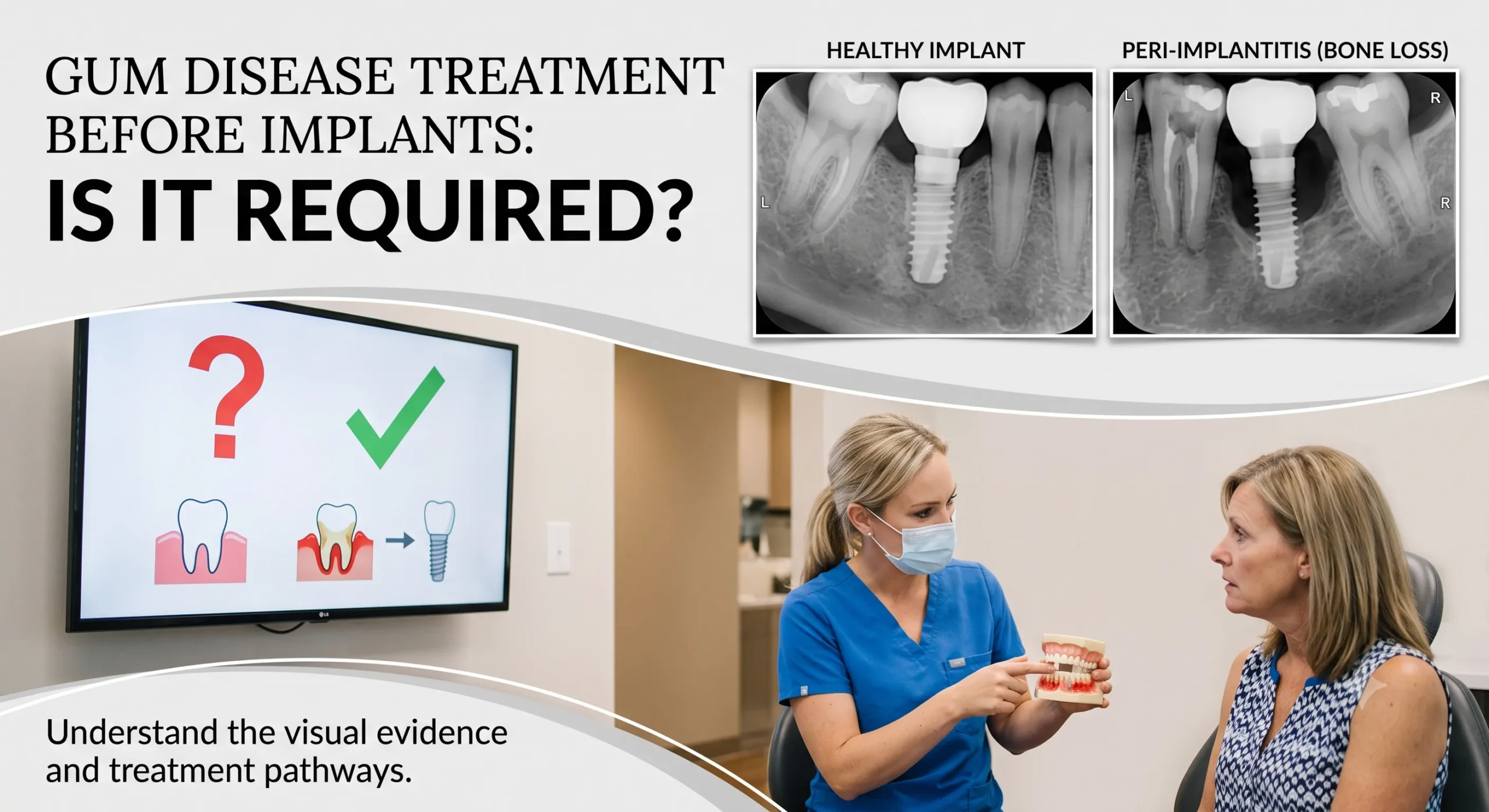
Gum Disease Treatment Before Implants: Why It’s Not Optional
Here’s a question we get asked more than you’d think: “Can I just get the implant now and deal with my gums later?” We get why you’d ask. Waiting feels frustrating when you just want your smile sorted. But the honest, research-backed answer is no, and once you understand why, it actually makes a lot of sense.
We’re Sunbury Dental Group, and we walk families across Sunbury, Diggers Rest, Bulla, and the wider Hume region through this exact conversation regularly. Gum disease treatment before implants isn’t a box-ticking formality your dentist adds to run up the bill. It’s genuinely one of the biggest predictors of whether your implant will still be doing its job in ten years.
Overview: What This Article Covers
We’re going to explain exactly why active gum disease and implant surgery don’t mix, using the actual research rather than vague warnings. You’ll learn what periodontal treatment implant candidacy really depends on, the specific numbers around implant failure risk in patients with a history of gum disease, and what treating gum disease first genuinely involves. We’ll also bring it back local, because this is a conversation that comes up constantly here in Sunbury.
In This Article, You’ll Discover…
Why gum disease and implant surgery are fundamentally incompatible while active
The actual failure rate statistics for implants placed with a history of gum disease
What periodontal treatment implant candidacy assessment actually looks like
The specific steps involved when you treat gum disease first
What peri-implantitis is and why it’s the biggest long-term risk
How long healthy gums need to be stable before implant surgery
What ongoing gum health implants maintenance looks like after placement
Why Gum Disease and Implants Genuinely Don’t Mix
Let’s start with the biology, because once you understand what’s actually happening in your mouth, this stops feeling like an arbitrary rule and starts feeling like common sense. Dental implants rely on a process called osseointegration, where the implant fuses directly with your jawbone — and that fusion needs healthy bone and healthy surrounding tissue to happen properly.
Gum disease disrupts exactly that foundation. Gingivitis, the earlier and milder stage, causes inflammation and bleeding, but left untreated it progresses into periodontitis — a deeper infection that actively destroys the connective tissue and bone holding your teeth in place. Here’s the part that really matters for implant planning: the same bacteria driving that destruction don’t just pack up and leave once an implant goes in. Research shows they attack the surface of a titanium implant just as readily as they attack a natural tooth root.
What Happens If Implants Are Placed Anyway
When gum disease bacteria attack tissue around an implant, the result is a condition called peri-implantitis — essentially gum disease’s equivalent problem, but centred on your implant instead of a natural tooth. Left unmanaged, peri-implantitis causes bone loss around the implant and can eventually lead to full implant failure. It’s a genuinely serious complication, and it’s largely preventable by addressing gum health beforehand.
Periodontal Treatment Implant Candidacy: What the Research Actually Shows
If you’re the type who wants the actual numbers rather than just being told to trust the process, here they are — and they’re pretty compelling.
The Statistics Worth Knowing
A 2024 systematic review and meta-analysis covering over 4,000 implants found that patients with a history of periodontitis had a 65 percent greater risk of implant failure within five years, and more than double the risk after five years, compared to periodontally healthy patients. Zoom out further, and a broader analysis of nearly 4,500 implants tracked for up to 20 years found the overall risk of implant failure was 74 percent greater in patients with a periodontitis history, climbing to 2.4 times greater risk at five years and 2.6 times greater at ten years.
One long-term cohort study covering 2,336 implants found something even more striking: patients with untreated or severe gum disease faced a hazard ratio for implant failure more than eight times higher than periodontally healthy patients after the four-year mark. Another systematic review found the odds ratio for implant survival significantly favoured periodontally healthy patients, at 3.02.
Peri-Implantitis Risk Specifically
Beyond outright failure, that same 2024 review found patients with a periodontitis history had roughly five times higher risk of developing peri-implantitis, along with 0.75mm greater marginal bone loss around the implant. A separate study comparing implant fracture rates found failure rates of 14.3 percent in periodontitis patients versus just 4.9 percent in healthy patients. These aren’t small differences we’re talking about — they’re the kind of numbers that genuinely change treatment planning.
[EXTERNAL LINK: suggest linking to the systematic review in Clinical Implant Dentistry and Related Research on periodontitis history and implant failure for further reading]
Peri-implantitis causes bone loss around an implant in much the same way gum disease affects natural teeth.
What Treating Gum Disease First Actually Involves
If your dentist has told you gum disease needs sorting before implants, here’s genuinely what that process looks like, step by step.
The Typical Treatment Pathway
Full periodontal assessment: measuring gum pocket depths, checking for bleeding, and assessing bone levels around any remaining teeth
Non-surgical therapy first: deep cleaning through scaling and root planing to remove bacteria and calculus below the gumline
Addressing modifiable risk factors: improving oral hygiene habits, and discussing smoking cessation or managing conditions like diabetes that affect healing
Surgical treatment if needed: for more advanced cases, surgical intervention may be required to fully stabilise the gum tissue
Extraction of unsalvageable teeth: severely loose or infected teeth may need removing and healing time allowed before implant planning proceeds
Confirming stability: your dentist reassesses to confirm the condition has reached a genuinely stable, healthy endpoint
How Long Does This Actually Take?
Clinical guidance from the Royal College of Surgeons of England recommends patients with a periodontitis history have their disease treated and stabilised for at least six months before starting implant treatment. That might feel like a long wait when you’re keen to move forward, but it’s exactly the window needed to confirm your gums have reached a genuinely stable state rather than just a temporarily improved one.
So, Can You Get Implants With a History of Gum Disease?
Genuinely, yes — this isn’t a permanent disqualification. Even patients with severe gum disease can qualify for implants once the periodontal infection is fully treated and gums and bone are stabilised. The research doesn’t say “gum disease history means no implants ever.” It says untreated or unstable gum disease significantly raises the risk, which is a completely different, and much more manageable, situation.
A British Dental Journal review put it plainly: placement of implants in patients with periodontal disease should never happen without a full periodontal assessment and stabilisation of the disease first. That’s not overly cautious dentistry — that’s simply following the evidence to protect your investment in the long run.
Active, untreated gum disease: implants generally deferred until treatment is complete
Treated and stabilised gum disease: implants can proceed with appropriate monitoring
History of periodontitis, currently stable: higher risk profile, but implants remain a valid option with close follow-up
No history of gum disease: standard candidacy assessment applies
Gum Health Implants Maintenance: It Doesn’t Stop After Placement
Here’s something equally important that often gets overlooked in this conversation. Treating gum disease before your implant isn’t a one-time hurdle you clear and then forget about. Ongoing periodontal and implant maintenance care is described as a lifelong requirement for anyone with a periodontitis history, specifically to reduce the risk of peri-implant disease developing down the track.
That means regular hygiene visits, consistent home care, and monitoring aren’t optional extras — they’re part of what actually protects your investment for years to come.
A Local Note for Sunbury Families
We understand the frustration of being told “not yet” when you’re ready to move forward with an implant. Nobody loves hearing that there’s another step between them and their new smile. But we’d genuinely rather have that honest conversation upfront than watch a patient invest in an implant that’s set up to fail within a few years because the groundwork wasn’t done first. If you’ve noticed bleeding gums, persistent bad breath, or gum recession, it’s worth getting that checked before implant planning even begins.
Questions Worth Asking at Your Consultation
Do I currently have any signs of active gum disease that need addressing first?
If treatment is needed, how long before I’d realistically be ready for implant planning?
What ongoing maintenance will I need to protect my implant long-term?
Given my history, what’s my realistic risk profile for peri-implantitis?
What can I do at home to support healthy gums during and after treatment?

Non-surgical deep cleaning is often the first step in stabilising gum disease before implant planning.
Frequently Asked Questions
Do I need gum disease treatment before getting a dental implant?
Yes, active gum disease needs to be treated and stabilised before implant placement, since the same bacteria causing gum disease can attack implant surfaces just as aggressively as natural teeth. Skipping this step significantly raises your risk of implant failure.
Can you get dental implants if you’ve had gum disease in the past?
Yes, a history of gum disease doesn’t permanently disqualify you, but it does raise your risk profile, and your dentist will want confirmation your condition is currently stable. Ongoing maintenance becomes especially important in these cases.
What happens if an implant is placed while gum disease is still active?
The infection can spread to affect the implant site, leading to peri-implantitis, bone loss, and a significantly higher risk of implant failure. This is exactly why dentists recommend treating gum disease to a stable point first.
How long does gum disease treatment take before I can get an implant?
Clinical guidance recommends periodontitis be treated and stabilised for at least six months before implant treatment begins. The exact timeline depends on the severity of your specific case.
What is peri-implantitis and how is it related to gum disease?
Peri-implantitis is an infection of the tissue and bone surrounding a dental implant, caused by the same type of bacteria responsible for natural gum disease. Patients with a periodontitis history face roughly five times higher risk of developing this condition.
Does treating gum disease first actually improve implant success rates?
Yes, research consistently shows implant survival is significantly better in periodontally healthy patients compared to those with untreated periodontal disease. Proper treatment and stabilisation beforehand is one of the most effective ways to protect your long-term outcome.
Bringing It All Together
The evidence here is genuinely consistent and pretty hard to argue with: treating gum disease before implant placement substantially lowers your risk of implant failure, bone loss, and peri-implantitis down the track. It’s not a formality, and it’s not your dentist being overly cautious — it’s a well-established clinical standard backed by decades of published research.
If you’re considering an implant and aren’t sure where your gum health currently stands, that’s exactly what a proper periodontal assessment is for. Book your appointment at Sunbury Dental Group today to get your gum health checked before starting your implant journey: