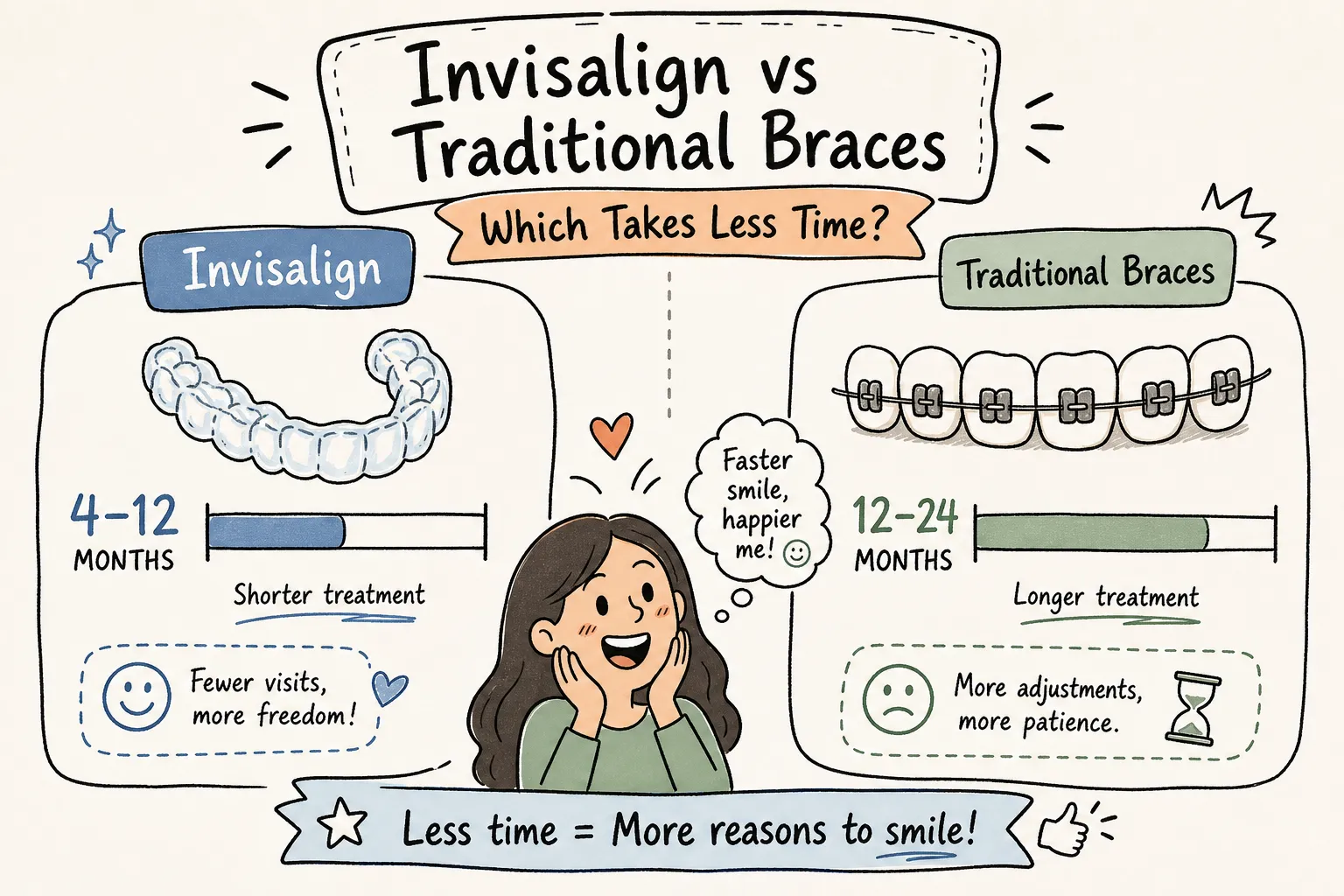
How Long Does Invisalign Take vs Traditional Braces? Understanding how long does Invisalign take vs traditional braces is vital.
How long does Invisalign take vs traditional braces? It’s one of the most common questions patients ask before committing to orthodontic treatment, and the honest answer is that neither option is universally quicker. The real answer depends on case complexity, the type of tooth movement required, and, for Invisalign specifically, how consistently you wear your aligners every single day. Understanding how long does Invisalign take vs traditional braces is essential for anyone considering orthodontic options.
When pondering how long does Invisalign take vs traditional braces, knowing the key factors is essential for informed decisions.
What follows is a straightforward, side-by-side breakdown of realistic treatment timelines across mild, moderate, and complex cases, drawn from clinical research rather than marketing materials. No spin, just the numbers your dentist would give you over a coffee.
How long does Invisalign take vs traditional braces, timelines by case severity
The clearest way to understand orthodontic treatment timelines is to look at cases by severity. The differences are significant, and they don’t all favour the same treatment type.
Mild cases: where Invisalign has a clear speed advantage
For anyone curious about how long does Invisalign take vs traditional braces, the distinction in treatment times is crucial.
For minor crowding or small gaps, Invisalign averages 6 to 9 months for clear aligner treatment time, and with Invisalign Lite or Express options, some patients finish in as little as 3 to 6 months. Traditional braces duration for the same corrections typically runs 12 to 18 months. The reason for this gap is that digital tray sequencing allows precise, incremental movements for small corrections without the overhead of wire-based adjustment cycles. For mild presentations, Invisalign is not just the more comfortable option; it is genuinely more efficient from a timing standpoint.
When evaluating how long does Invisalign take vs traditional braces, it’s crucial to consider individual treatment plans tailored to specific needs.
To clarify how long does Invisalign take vs traditional braces, we must examine individual case details.
Moderate cases: a closer race than most people expect
For moderate misalignment, noticeable crowding, or mild bite issues, Invisalign plans are typically set at 9 to 15 months. In reality, once refinement rounds are factored in, the real-world average stretches to 12 to 18 months for most adult patients. Traditional braces for moderate cases run 18 to 24 months, with in-chair adjustment appointments every 4 to 6 weeks. The gap narrows considerably here, and patient compliance starts to play a major role in determining which treatment actually finishes first.
To grasp how long does Invisalign take vs traditional braces, it’s essential to look at the specific treatment plans.
Complex cases: when braces pull ahead
For severe crowding, deep bites, significant rotations, or cases requiring tooth extractions, Invisalign can take 15 to 24 months or more, with some complex cases running past 30 months across multiple refinement rounds. Traditional braces for the same complexity typically run 24 to 36 months, but they tend to be more predictable: continuous mechanical force handles difficult movements more efficiently without the compliance variable. Clinical research on extraction cases has found that clear aligners can take up to 44% longer than braces in some studies, a clinically significant difference when you’re planning around a realistic Invisalign vs traditional braces timeline.
Understanding how long does Invisalign take vs traditional braces helps set realistic expectations with your orthodontist.
Why some case types are inherently faster with braces
Understanding why braces outperform Invisalign for complex cases helps you have a more informed conversation with your dentist. It’s not a marketing distinction; it’s mechanics.
The mechanics behind severe rotations and bite correction
Braces finish severe rotations and significant crowding over 6mm roughly 4 to 6 months faster than aligners. Wires apply continuous, friction-reduced force without the “slippage” issue aligners face when a tray doesn’t seat perfectly against a tooth. Deep overbites and Class II malocclusions also respond faster to braces because the orthodontist can use elastics and wires simultaneously for vertical control, something clear aligners cannot reliably achieve on their own.
Extraction cases and large vertical movements
When a treatment plan involves removing teeth, braces typically close the resulting spaces 3 to 6 months faster. Fixed brackets maintain precise control over both the root and crown during space closure, which is mechanically demanding. Large vertical movements, intruding or extruding specific teeth, are also more efficiently handled with braces due to direct mechanical attachment at the bracket level.
Where Invisalign holds the speed advantage
Minor spacing of 1 to 3mm, simple crowding under 4mm, and post-braces relapse cases are consistently faster with Invisalign, roughly 3 to 6 months ahead of what braces would achieve for the same issue. For these mild presentations, the clinical evidence is clear: Invisalign finishes these cases faster, and the average months to straighten teeth is meaningfully shorter than with fixed appliances.
How long does Invisalign take vs traditional braces when compliance is factored in
To really grasp how long does Invisalign take vs traditional braces, one must weigh factors like compliance and treatment complexity.
Most Invisalign marketing skips past this part, so it’s worth being direct: compliance is the single biggest variable separating a planned Invisalign timeline from the real one.
The 20 to 22 hour rule and what happens when you miss it
To address the question of how long does Invisalign take vs traditional braces, patient compliance is a key factor.
Every Invisalign treatment plan is built on the assumption that aligners are worn 20 to 22 hours per day. Every hour below that slows tooth movement and can cause trays to gradually lose their fit. Missing just 2 hours daily over a year adds up to 730 hours of lost treatment time, roughly a month of delayed progress, though the precise conversion varies by individual case. Studies tracking real-world wear patterns suggest that only around 36% of patients consistently meet full compliance, meaning the majority of Invisalign cases run longer than initially planned.
How this compares to braces
Ultimately, understanding how long does Invisalign take vs traditional braces can help set realistic expectations for treatment.
Traditional braces are fixed appliances: they work continuously without relying on patient behaviour between appointments. A 14-month braces plan stays on track as long as appointments are kept and brackets aren’t broken. A 14-month Invisalign plan can drift into 18 or 20 months with inconsistent wear. This predictability gap matters, particularly for patients who travel frequently, work irregular hours, or who are honest with themselves about their habits.
In comparing how long does Invisalign take vs traditional braces, the importance of patient behavior becomes apparent.
Refinements: the hidden time factor for Invisalign patients
Refinements are mid-course corrections in Invisalign treatment where a new digital scan is taken and a fresh set of trays is manufactured. They’re common, and they add time.
When evaluating how long does Invisalign take vs traditional braces, refinements play a significant role in the overall timeline.
How common are refinements and how much time do they add?
Reported rates vary widely across studies, with between 40% and 94% of Invisalign patients requiring at least one refinement round depending on case complexity and compliance. Each refinement cycle typically adds 2 to 6 months to total treatment time, and across comprehensive cases the average sits at around 2.5 refinement rounds per patient. The cumulative impact on the original orthodontic treatment timeline can be substantial. Braces do not have a refinement cycle: the orthodontist adjusts wires and bands in-chair at each scheduled visit, correcting any tracking issues in real time without manufacturing new appliances or adding months to the plan.
When you reflect on how long does Invisalign take vs traditional braces, refinements are an important consideration in treatment duration.
What causes refinements and how to reduce the risk
Poor compliance is the leading cause. Trays that don’t sit flush against teeth stop moving them correctly, and a fresh treatment plan is required to reset progress. Case complexity is also a factor: cases with a higher pre-treatment severity score tend to require more refinements regardless of how well the patient complies.
Ultimately, knowing how long does Invisalign take vs traditional braces can guide patients in their treatment choices.
Keeping wear time at or above 22 hours daily is the most reliable way to stay on the original timeline. It also reduces the risk of mid-course corrections that add both time and cost to your treatment.
What else can speed up or extend your treatment
For a complete picture of how long does Invisalign take vs traditional braces, consider all influencing factors.
Beyond compliance, several clinical and lifestyle factors influence how both orthodontic options track against their planned timelines.
Factors that shorten treatment for both options
To understand how long does Invisalign take vs traditional braces, keep in mind the role of patient age and compliance.
Attending all scheduled appointments without delays keeps both treatment types on track. For braces, missed adjustments directly stall wire progressions. For Invisalign, prompt tray changes and regular check-ins prevent tracking drift from going unnoticed for months. Age is also a genuine factor: younger patients tend to move teeth faster due to more active bone remodelling, which is why teen cases often finish closer to the shorter end of the estimated range.
Factors that push timelines out
Considering how long does Invisalign take vs traditional braces, factors affecting timelines must be addressed.
Broken brackets in braces, or lost and damaged Invisalign trays, can each set a case back by weeks depending on how quickly they’re replaced. Smoking and poor oral hygiene affect gum and bone health, which in turn affects how efficiently teeth respond to any orthodontic force. Starting treatment with untreated decay or active gum disease also adds time, because those issues must be resolved before tooth movement can begin safely. This is precisely why a thorough initial examination matters before any orthodontic treatment starts.
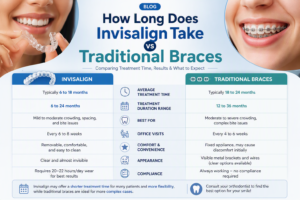
To fully grasp how long does Invisalign take vs traditional braces, the importance of accurate assessments cannot be overstated.
Getting a timeline that’s actually accurate for your teeth
When seeking a timeline for treatment, asking how long does Invisalign take vs traditional braces is essential.
For a comprehensive understanding of how long does Invisalign take vs traditional braces, personalized assessments are invaluable.
The timelines throughout this article are drawn from clinical studies and averaged across large patient populations. They give you a useful framework, but they don’t tell you where your case sits within that range.
To answer the question of how long does Invisalign take vs traditional braces, it’s crucial to have a personalized assessment.
A general estimate of “12 to 18 months” tells you nothing specific about whether your crowding is on the mild or moderate end, whether your bite issue is one that Invisalign handles efficiently, or whether the health of your gums might affect how quickly your teeth respond to treatment. General averages are a starting point; a proper assessment is the only thing that replaces guesswork with a real number.
How long does Invisalign take vs traditional braces in Sunbury, VIC, what a real consultation tells you
For those inquiring how long does Invisalign take vs traditional braces, a detailed consultation is the best approach.
At Sunbury Dental Group in Sunbury VIC, an Invisalign consultation with Dr. Nita Kumari goes beyond a quick look at your smile. It includes digital X-rays and imaging to assess your bite, root positions, and bone structure, giving you a treatment plan built around your actual case rather than population averages. You’ll leave with a realistic sense of your Invisalign vs traditional braces timeline, a clear understanding of whether clear aligner treatment suits your case mechanically, and straightforward information about costs. For anyone in Sunbury, Diggers Rest, Gisborne, or nearby suburbs weighing up whether the clear aligner timeline fits their life and schedule, booking a consultation is the one step that turns a general estimate into a personalised answer.
The bottom line on orthodontic timing
Readers should understand how long does Invisalign take vs traditional braces to make informed decisions about their treatment.
When comparing how long Invisalign takes vs traditional braces, the short answer is this: Invisalign is faster for mild to moderate cases when compliance is strong. Traditional braces hold the advantage for complex bite correction, severe rotations, and cases requiring extractions. For moderate cases, the gap is smaller than most people expect, and the deciding factor often comes down to the patient’s own habits rather than the technology itself.
In conclusion, the question of how long does Invisalign take vs traditional braces often leads to personalized discussions between the patient and orthodontist.
For anyone pondering how long does Invisalign take vs traditional braces, practical discussions with an orthodontist are invaluable.
The 22-hour wear rule for Invisalign is not optional. It’s the foundation the entire treatment plan is built on. Falling short consistently slows progress and can add months and additional refinement rounds that were never part of the original plan.
General timelines are useful context, but the only number that matters is the one based on a thorough assessment of your teeth. If you’re comparing options and want clarity on which treatment suits your case and realistic schedule, book an Invisalign consultation at Sunbury Dental Group. A proper examination gives you a specific timeline rather than a bracket estimate, and lets you make a confident decision based on your actual situation rather than averages from a web search.
In summary, knowing how long does Invisalign take vs traditional braces can impact your choice of treatment.
FAQ
Understanding how long does Invisalign take vs traditional braces requires addressing common patient questions and concerns.
How long does Invisalign take compared to traditional braces?
Invisalign averages 6–18 months depending on case severity, while traditional braces typically take 12–36 months. Mild cases finish faster with Invisalign (6–9 months vs 12–18 months for braces), but complex cases favor braces, which finish 4–6 months sooner than aligners for severe rotations or extraction cases.
Is Invisalign always faster than braces?
No. Invisalign is faster only for mild-to-moderate cases with strong patient compliance. For complex cases involving extractions, deep bites, or severe rotations, traditional braces are more predictable and often finish 3–6 months faster because they don’t depend on patient wear time.
For clarity on how long does Invisalign take vs traditional braces, detailed FAQs provide helpful insights.
How many hours a day do I need to wear Invisalign for it to work on schedule?
Invisalign aligners must be worn 20–22 hours per day to stay on the planned timeline. Studies show only about 36% of patients meet this consistently, and missing just 2 hours daily for a year can add roughly a month of delay to treatment.
What happens if I don’t wear my Invisalign aligners enough?
Under-wearing aligners slows tooth movement and can cause trays to lose fit against your teeth. This often triggers a refinement, a new scan and fresh set of trays, adding 2–6 months to the original treatment plan.
Each answer contributes to understanding how long does Invisalign take vs traditional braces in practical terms.
What are Invisalign refinements and how much time do they add?
Refinements are mid-treatment corrections where a new scan and new aligner trays are made after tracking drifts off plan. Between 40% and 94% of patients need at least one refinement round, with each round adding 2–6 months and an average of 2.5 refinement cycles per comprehensive case.
Do traditional braces have anything like Invisalign refinements?
No. Braces don’t require refinement cycles because the orthodontist adjusts wires and bands directly at each in-chair visit, correcting tracking issues in real time without manufacturing new appliances or extending the treatment timeline.
Ultimately, addressing how long does Invisalign take vs traditional braces is crucial for potential patients.
For which cases are braces faster than Invisalign?
Braces are faster for severe crowding over 6mm, deep overbites, Class II bite corrections, and extraction cases, typically finishing 3–6 months sooner. Continuous mechanical wire force handles these complex movements more reliably than removable aligner trays.
For which cases is Invisalign faster than braces?
Invisalign has a clear speed advantage for mild crowding under 4mm, minor spacing of 1–3mm, and post-braces relapse cases, finishing roughly 3–6 months faster than braces for the same corrections when worn as directed.
In conclusion, knowing how long does Invisalign take vs traditional braces can guide treatment decisions effectively.
Can smoking or gum disease affect how long Invisalign or braces take?
Yes. Smoking and poor oral hygiene impair gum and bone health, slowing how efficiently teeth respond to orthodontic force. Untreated decay or active gum disease must be resolved before treatment starts, which extends the overall timeline for both options.
How can I get an accurate Invisalign vs braces timeline for my own teeth?
General ranges like “12–18 months” don’t reflect your specific case. A consultation at Sunbury Dental Group with Dr. Nita Kumari includes digital X-rays and imaging to assess bite, roots, and bone structure, giving a personalised timeline instead of a population average.
In essence, understanding how long does Invisalign take vs traditional braces is key to a successful orthodontic journey.