
You’ve decided you want straighter teeth. You’ve done a quick search, maybe asked a friend, and now you’re staring at a lineup of orthodontic treatments that all promise results yet look completely different from one another. Metal brackets, clear trays, hidden wires, it’s easy to feel overwhelmed before you’ve even booked a consultation. If you’re exploring orthodontic treatment options for the first time, this guide breaks down everything you need to know to make a confident, informed decision.
When exploring orthodontic treatment options, it’s essential to consider your personal needs and goals. The range of orthodontic treatment options available today can help you achieve the smile you’ve always wanted.
This article covers the four main orthodontic treatment options: traditional metal braces, ceramic braces, lingual braces, and clear aligners like Invisalign. By the end, you’ll understand how each one works, what it costs in Australia in 2026, roughly how long it takes, and which suits your age and situation, including a brief look at fixed vs removable appliances, types of braces, and when more specialised approaches such as palatal expanders or orthodontic surgery options may come into the picture. For patients in Sunbury and surrounding suburbs, Sunbury Dental Group offers orthodontic consultations as part of their cosmetic and general dental services, so exploring discreet options close to home has never been more straightforward.
Each of the orthodontic treatment options has unique benefits and considerations that can impact your choice.
Additionally, understanding the differences among orthodontic treatment options is crucial for making an informed decision.
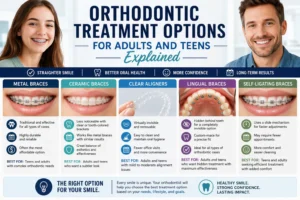
The four main types of orthodontic treatment
Traditional metal braces: reliable and effective
Metal braces work by bonding small metal brackets to the front of each tooth and connecting them with a wire that your dentist or orthodontist tightens progressively over time. That steady tension is what shifts your teeth into alignment. The process is tried and tested, and metal braces remain the most widely used orthodontic appliance globally because they work for virtually any level of severity.
They’re the go-to recommendation for complex crowding, significant bite issues, and patients where consistent use of a removable device might be a concern, particularly younger teenagers. Visibility is the obvious trade-off, but many patients and clinicians report that modern low-profile brackets feel considerably less obtrusive than the hardware of past decades, so the aesthetic impact is often less dramatic than people expect.
Ceramic and lingual braces: the discreet fixed options
Ceramic braces function identically to metal braces, using the same bracket-and-wire system, but the brackets are made from tooth-coloured ceramic that blends with your enamel. From a few feet away, they’re far less noticeable in everyday life, which makes them a popular choice for adults who need a fixed appliance but don’t want visible hardware. One practical consideration: the elastic ties that hold the wire can stain with coffee, tea, and curry, so consistent hygiene after meals matters.
Choosing between the various orthodontic treatment options can be overwhelming, but knowing your preferences can help narrow it down.
Lingual braces take discretion further still, sitting on the inside surfaces of your teeth and remaining completely invisible from the outside. They’re custom-fabricated to fit your individual tooth anatomy, which makes them the most precise and the most expensive fixed option available. They also require more frequent appointments and demand an adjustment period, particularly for tongue comfort and speech clarity in the early weeks.
Both ceramic and lingual braces are a strong fit for adults who want fixed treatment without the visible metalwork, a useful middle ground between standard metal hardware and fully removable appliances.
Clear aligners: the Invisalign approach
Clear aligners are a series of custom-made transparent plastic trays worn snugly over your teeth. Each tray is slightly different, and you swap to the next one every one to two weeks, with each change nudging your teeth a little closer to their final position. Because the trays are removable, you take them out to eat, brush, and on special occasions, a level of flexibility many patients report finding transformative compared to fixed appliances.
According to Invisalign clinical guidance, the recommended wear time is 20 to 22 hours per day. Skipping hours consistently doesn’t just slow things down; it can throw your whole treatment plan off schedule. Clear aligners work best for mild to moderate crowding and spacing. For more severe skeletal bite issues, a fixed appliance or a combination approach is often the clinically stronger choice.
As you review your options, keep in mind that all orthodontic treatment options require commitment and maintenance for the best results.
When other appliances come into play
Beyond the four main types of braces, some patients, particularly children or teenagers with developing jaws, may be assessed for a palatal expander. This fixed or removable appliance widens the upper arch to create space before full orthodontic treatment begins. In more complex cases involving significant jaw misalignment that cannot be corrected by braces or aligners alone, a clinician may discuss orthodontic surgery options, typically in combination with a fixed appliance. These approaches are less common and are always assessed and planned by a qualified dental professional based on clinical imaging and examination.
It’s also essential to discuss all available orthodontic treatment options with your orthodontist to find the best fit for your specific situation.
Fixed vs removable appliances: understanding the key difference
One of the most fundamental distinctions when comparing orthodontic treatment options is whether the appliance is fixed or removable. Fixed appliances, metal braces, ceramic braces, and lingual braces, are bonded to your teeth and stay in place for the full duration of treatment. Removable appliances, such as clear aligners and some retainers, are taken out for eating, drinking, and oral hygiene.
Fixed appliances tend to be preferred for complex corrections because compliance isn’t a variable, the appliance is doing its job around the clock regardless of patient behaviour. Removable options offer greater comfort and lifestyle flexibility, but they require genuine daily discipline. Understanding this difference is one of the most useful starting points when evaluating which path is right for you.
In choosing among orthodontic treatment options, remember that each option comes with distinct advantages and considerations.
How comfort and daily life differ across each option
What it’s like living with fixed braces
Consider how each of the orthodontic treatment options aligns with your lifestyle and preferences for the best outcome.
In the first few days after fitting or after each adjustment appointment, fixed braces cause tenderness as your teeth begin to respond to the new tension. This often settles within a few days for most patients and becomes a familiar, manageable rhythm over the course of treatment. Over-the-counter pain relief and eating softer foods during those first days helps considerably.
Food restrictions are a real part of the commitment: hard, crunchy, or sticky foods can dislodge brackets or bend wires, both of which mean an unplanned appointment and a potential delay to your timeline. Oral hygiene also requires more attention because brackets create extra surfaces for plaque to cling to. Interdental brushes and a careful technique around the wire make a real difference to gum health during treatment.
Why removable aligners suit a different lifestyle
Because you take aligners out at mealtimes, there are no food restrictions. You eat normally, brush and floss as you usually would, and then put the trays back in. For patients who found the idea of dietary adjustments off-putting, this alone is often the deciding factor. The trays themselves are smooth plastic with no sharp edges or wires, so mouth ulcers and lip irritation are far less common than with fixed appliances.
The main lifestyle adjustment is discipline: remembering to reinsert aligners after every meal and drink (other than water). Patients who regularly leave trays out for extended periods will see slower progress and may need additional aligner stages, adding time and cost. If you travel frequently, speak publicly, or simply prefer the flexibility of a removable appliance, aligners tend to be the more practical fit for your day-to-day life.
How long each orthodontic treatment takes
Treatment timelines by type
Treatment duration varies significantly depending on the type of appliance and the complexity of your case. Here’s a general guide based on 2026 Australian clinical practice to help you set realistic expectations:
- Metal braces: 18 to 24 months for most full cases, with complex corrections extending to 36 months
- Ceramic braces: 12 to 36 months, driven more by case complexity than the bracket material itself
- Lingual braces: 18 to 36 months on average, with slightly more frequent appointments factored in
- Invisalign Lite: 6 to 12 months for minor corrections and mild crowding
- Invisalign Comprehensive: 12 to 24 months for moderate to more involved cases
These ranges reflect national averages and can vary with individual case complexity and patient compliance. Confirm expected timelines with your treating clinician during your initial assessment.
What affects your personal timeline
Case complexity is the single biggest variable. Mild spacing can be resolved in months, while correcting a significant overbite or severe crowding across the full arch takes considerably longer regardless of which appliance you choose. Age also plays a role: adult bone is denser and responds more slowly to pressure than a teenager’s still-developing jaw, so adult treatment can run slightly longer than the same correction in a 14-year-old.
For aligner patients specifically, daily compliance directly determines whether real progress matches the digital treatment plan. Consistent wear is the most controllable variable in your timeline, and it’s entirely in your hands from day one.
Orthodontic treatment options: cost and what’s included
A realistic look at the numbers
Costs across Australia in 2026 vary by case complexity, treatment duration, and clinic location. As a general guide, traditional metal braces typically sit between AUD $5,000 and $9,000 for a full course of treatment, making them the most accessible fixed option on price. Ceramic braces carry a premium for the aesthetic benefit, generally coming in between AUD $6,500 and $10,000.
Lingual braces are the highest-cost non-surgical option, with comprehensive treatment ranging from AUD $9,500 to $15,000 and complex cases potentially pushing beyond that. Invisalign costs vary by scope: Lite options start around AUD $4,000 to $6,500, while a comprehensive Invisalign case typically falls between AUD $6,500 and $9,500. These figures reflect general market data and regional variation applies, suburban and regional practices such as those in Sunbury, VIC often quote more competitively than Melbourne CBD clinics.
Invisalign is one of the popular orthodontic treatment options due to its aesthetic appeal and convenience.
What drives the price difference
Understanding the costs associated with each of the orthodontic treatment options can help you budget effectively for your care.
Case complexity, the number of adjustment appointments, and treatment duration all factor into the final fee. Clinic location matters too: fees in Melbourne’s CBD tend to run higher than those at local suburban or regional practices. Comparing what’s actually included in a quoted fee is more useful than comparing headline numbers alone, because some clinics include retainers, records, and follow-up appointments in the price, while others quote separately for each component.
When you receive a written treatment proposal, ask specifically whether retainers are included, whether refinements are covered if your result needs minor adjustment, and whether emergency appointments for broken brackets or lost aligners attract an additional fee. These details can shift the true cost of treatment by several hundred dollars.
Which orthodontic treatment options suit adults and teens?
What works well for teenagers
Teenagers are strong candidates for traditional metal braces because treatment outcomes don’t depend on voluntary compliance with a removable device throughout the school day. Fixed appliances stay in place regardless of what the patient decides at lunchtime, which makes them a reliable choice for complex cases in younger patients. Growth also works in a teenager’s favour: developing bone responds more readily to orthodontic pressure, which can mean shorter treatment times for equivalent corrections.
For teens who are motivated and image-conscious, Invisalign Teen is specifically designed for adolescent patients. According to Invisalign product guidance, it includes blue compliance indicator tabs that fade with wear, a useful visual check for parents and clinicians, plus additional replacement aligners to account for the occasional lost tray. A dentist or orthodontist will assess jaw development and may also consider whether a palatal expander is needed before recommending the most appropriate treatment path.
For adults, researching the various orthodontic treatment options available can lead to a more satisfying choice.
How adult priorities tend to differ
Many adults find that exploring different orthodontic treatment options helps them align their needs with available services.
Adults generally prioritise discretion and minimal disruption to professional and social life. Ceramic braces, lingual braces, and clear aligners are commonly chosen by adult patients in Australia for exactly this reason. Lifestyle flexibility is also a key consideration: for adults who travel frequently or present publicly, removable aligners often feel like the more practical solution day to day.
For straightforward crowding or spacing corrections, many adults find Invisalign an ideal fit, delivering strong results with minimal visibility. For more complex bite corrections, a fixed appliance or a combination approach may still be the stronger clinical recommendation. The right answer depends on your specific case, not on a general preference for one appliance over another.
What to ask at your first consultation
Preparing for a productive first appointment
Go in with a clear sense of your priorities before the appointment. Is discretion the most important factor, or are you focused primarily on the fastest or most cost-effective result? Knowing your priorities helps you have a focused conversation rather than leaving with a brochure and unanswered questions.
Your consultation should include a detailed discussion about the different orthodontic treatment options that best fit your case.
Key questions worth raising include: which treatment types are clinically appropriate for your specific case, what the likely total duration is, what is included in the quoted fee, and what happens if you need refinements or additional trays along the way. Many clinics now use digital planning tools that can show a visual simulation of expected outcomes before treatment begins, ask to see this if it’s available. Seeing a projected result before you commit takes a lot of the uncertainty out of the decision.
Finding the right clinic close to home
For patients in Sunbury and surrounding suburbs, including Diggers Rest, Riddells Creek, and Gisborne, Sunbury Dental Group offers orthodontic consultations as part of their cosmetic and general dental services. Working with a local, community-based clinic means you attend regular progress appointments without the time and cost of travelling into Melbourne, which adds up meaningfully over an 18-month treatment course.
As you begin your orthodontic journey, knowing the range of orthodontic treatment options available will empower your decision-making.
No two orthodontic cases are the same, and no article can replace a face-to-face review with digital imaging. The information here gives you a solid framework for understanding your options and comparing likely costs and timelines, but a personalised assessment is what turns general knowledge into an actual treatment plan suited to your teeth.
Making the right choice for your situation
The four main orthodontic treatment options each serve a distinct purpose, whether it be for functionality or aesthetics. Metal braces are the clinically versatile workhorse, suited to complex cases at an accessible price point. Ceramic braces offer a subtler fixed alternative for patients who want the reliability of a bonded appliance without the visible metalwork. Lingual braces deliver complete invisibility from the outside, at the cost of higher investment and a longer adjustment period. Clear aligners offer genuine flexibility and discretion for mild to moderate corrections, provided the daily wear commitment is taken seriously. Understanding these orthodontic treatment options can enhance your decision-making process.
The right choice depends on your case severity, your age, your lifestyle, and your budget. No single option is universally better than the others; the best orthodontic treatment is the one that suits your specific clinical needs and fits into your life in a realistic way. Use the cost and timeline information in this article as a starting framework, then verify the specifics with a qualified dental professional who can assess your individual situation with the benefit of digital imaging and a clinical examination.
Ultimately, being well-informed about orthodontic treatment options will help you choose the right path for a healthier smile.
If you’re weighing up your orthodontic treatment options and want a local, no-pressure starting point, booking a consultation at Sunbury Dental Group is a clear next step. The conversation itself, guided by a clinician who can actually see your teeth, will answer more questions than any amount of online research.
Whether you are leaning toward clear aligners or traditional braces, exploring your orthodontic treatment options further will ensure you make a well-informed choice.
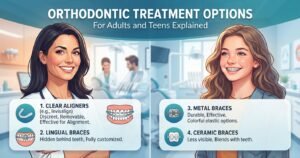
FAQ – General Orthodontic Options
What are the main orthodontic treatment options available today?
The four main orthodontic treatment options are traditional metal braces, ceramic braces, lingual braces, and clear aligners such as Invisalign. Each differs in visibility, cost, and how well it suits complex versus mild-to-moderate corrections, so the right choice depends on your specific case rather than a general preference for one appliance.
What’s the difference between fixed and removable orthodontic appliances?
Fixed appliances — metal, ceramic, and lingual braces — are bonded to the teeth for the full treatment duration, while removable appliances like clear aligners and some retainers are taken out for eating and hygiene. Fixed options are often preferred for complex cases because results don’t depend on patient compliance, whereas removable aligners offer more lifestyle flexibility but require consistent daily wear.
When might a palatal expander or orthodontic surgery be needed?
A palatal expander may be recommended for children or teens with developing jaws to widen the upper arch before full treatment begins, while orthodontic surgery is reserved for significant jaw misalignment that braces or aligners alone can’t correct. Both approaches are less common and are only planned after clinical imaging and examination by a qualified dental professional.
Cost and Timelines
How much do braces and Invisalign cost in Australia in 2026?
In 2026, metal braces typically cost AUD $5,000 to $9,000, ceramic braces AUD $6,500 to $10,000, and lingual braces AUD $9,500 to $15,000 for a full course of treatment. Invisalign Lite starts around AUD $4,000 to $6,500, while comprehensive Invisalign cases range from AUD $6,500 to $9,500, with suburban clinics like those in Sunbury often quoting more competitively than Melbourne CBD practices.
What drives the price difference between orthodontic treatments?
Case complexity, the number of adjustment appointments, and total treatment duration are the biggest factors in final cost. Comparing what’s actually included in a quote — retainers, refinements, and emergency appointment fees — matters more than comparing headline prices alone.
How long does each type of orthodontic treatment take?
Metal braces typically take 18 to 24 months (up to 36 for complex cases), ceramic braces 12 to 36 months, and lingual braces 18 to 36 months. Invisalign Lite takes 6 to 12 months for minor corrections, while Invisalign Comprehensive runs 12 to 24 months for moderate to more involved cases.
What affects how long my personal treatment will take?
Case complexity is the biggest variable, followed by age, since adult bone is denser and responds more slowly to pressure than a teenager’s developing jaw. For aligner patients specifically, consistent daily wear is the most controllable factor in staying on schedule.
Adults vs Teens
Which orthodontic option is best for teenagers?
Traditional metal braces are strong candidates for teens because outcomes don’t rely on voluntary compliance throughout the school day, and developing bone responds more readily to pressure, often shortening treatment time. Invisalign Teen is also designed specifically for motivated adolescents, featuring blue compliance indicator tabs that fade with wear and extra replacement aligners for lost trays.
Which orthodontic option is best for adults?
Adults generally prioritise discretion, choosing ceramic braces, lingual braces, or clear aligners to minimise disruption to professional and social life. For straightforward crowding or spacing, many adults find Invisalign ideal, while more complex bite corrections may still need a fixed appliance or combination approach.
Comfort and Daily Life
Is it painful to wear braces or aligners?
Fixed braces typically cause tenderness for a few days after fitting or adjustment, which usually settles with over-the-counter pain relief and softer foods. Clear aligners have no sharp edges or wires, so mouth ulcers and lip irritation are far less common than with fixed appliances.
Do I need to avoid certain foods with braces or aligners?
With fixed braces, hard, crunchy, or sticky foods can dislodge brackets or bend wires, risking delays to your timeline. Aligners are removed at mealtimes, so there are no food restrictions at all — you simply reinsert them afterward.
What questions should I ask at my first orthodontic consultation?
Ask which treatment types suit your specific case, what the likely total duration and cost will be, and whether refinements or additional trays are covered if needed. It’s also worth asking whether the clinic offers a digital simulation of expected outcomes before you commit to treatment.
Does Sunbury Dental Group offer orthodontic consultations?
Yes, Sunbury Dental Group offers orthodontic consultations as part of its cosmetic and general dental services for patients in Sunbury and surrounding suburbs including Diggers Rest, Riddells Creek, and Gisborne. A local, community-based clinic also means attending progress appointments without the time and cost of travelling into Melbourne over an 18-month treatment course.