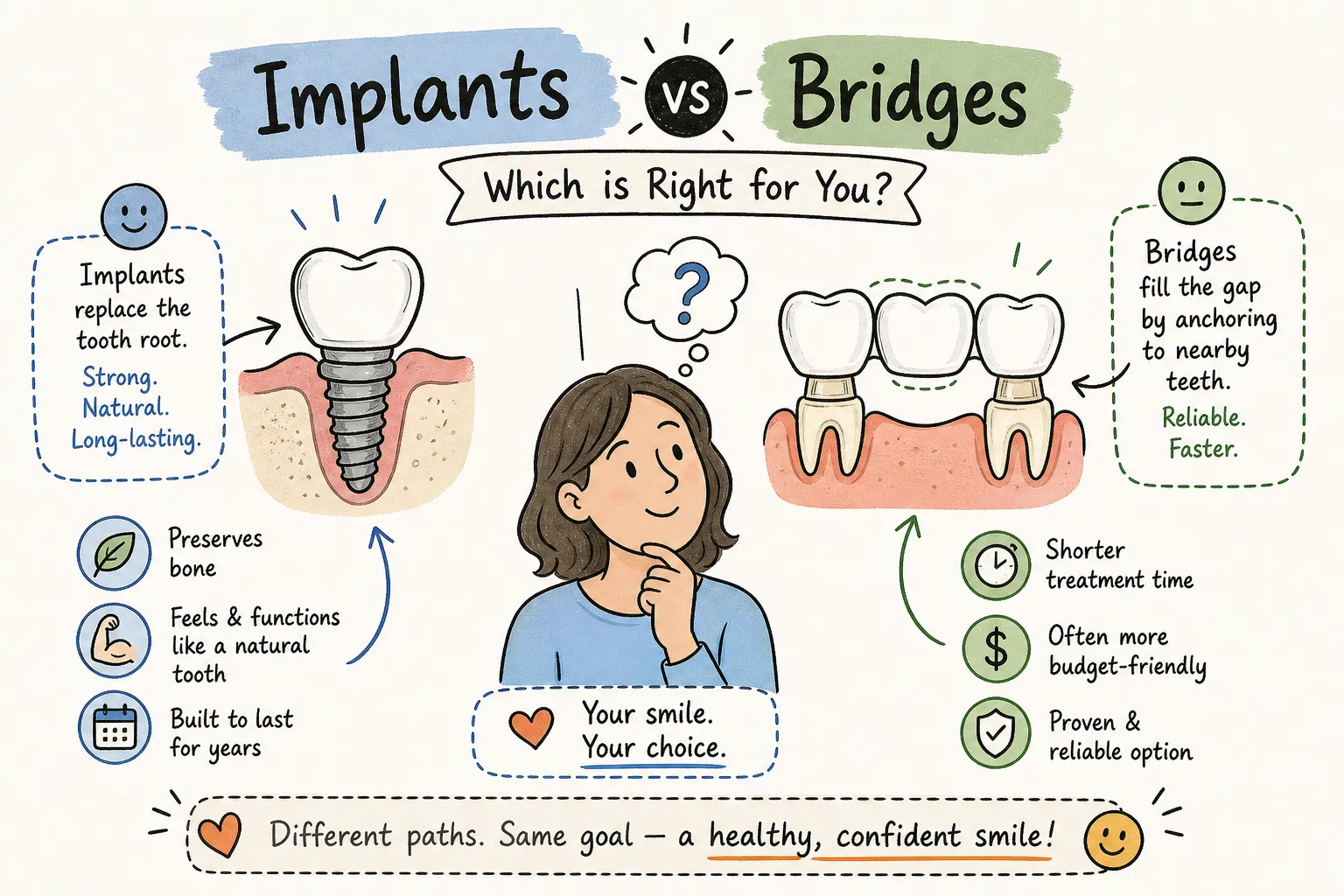
Dental Implants vs Bridges: Which Is Right for You?
You’ve just lost a tooth, or you’re about to. Your dentist mentions two options, and for most patients, that’s exactly where the confusion begins. When weighing dental implants vs bridges, both treatments can restore your smile and your ability to chew properly, but they work in fundamentally different ways and suit very different patients depending on their health, budget, and long-term goals. At Sunbury Dental Group, it’s one of the most common questions that comes up during restorative consultations, especially when considering dental implants vs bridges.
This guide breaks down the key differences across procedure, cost, longevity, bone health, and clinical suitability. By the end, you’ll walk into your next dental appointment already knowing the right questions to ask.
This guide will also highlight why understanding dental implants vs bridges is crucial for your oral health.
How each treatment actually works
Before comparing cost or longevity, it helps to understand what you’re actually signing up for with each option. The mechanics are quite different, and that difference has a direct bearing on everything that follows.
The implant process: from surgery to crown
A dental implant involves placing a small titanium post directly into the jawbone, where it acts as a replacement tooth root. Over the following three to six months, the post fuses with the surrounding bone through a process called osseointegration. Once that integration is confirmed, an abutment and custom-made implant-supported crown are attached on top.
If your bone volume is insufficient at the time of surgery, a bone graft is required first, which can extend the full treatment timeline to nine to twelve months. The end result is a restoration that functions completely independently of your neighbouring teeth, which is one of its defining structural advantages.
How a bridge comes together
A dental bridge works by suspending an artificial tooth (called the pontic) between two crowns fitted over the teeth on either side of the gap. Those neighbouring teeth must be permanently reshaped and capped to anchor the bridge, even if they’re otherwise perfectly healthy. The entire process is non-surgical and typically completed across two appointments over two to three weeks. That faster timeline is genuinely appealing for many patients, but the trade-off involving healthy adjacent teeth is worth understanding clearly before you commit.
Dental implants vs bridges: longevity and long-term success rates compared
The upfront cost is only one part of the financial equation. Where implants and bridges diverge most dramatically is in their long-term performance, and that changes the investment calculation significantly.
Implant survival rates over the decades
Long-term systematic reviews consistently report implants achieving 95 to 98% survival rates at ten years, with documented case series showing successful outcomes at forty to fifty years. While the implant fixture itself is designed to last a lifetime, it is worth noting that long-term survival can decline slowly in some patients, particularly where peri-implantitis develops, so ongoing maintenance remains important. The implant-supported crown attached above may eventually need replacing after around fifteen years. Even accounting for that, the implant fixture’s long-term performance represents one of the strongest arguments for implants as a restorative investment.
When assessing dental implants vs bridges, consider these crucial differences in longevity.
Where bridges tend to fall short over time
A dental bridge averages around ten years before it requires replacement, and success rates decline steadily after that point. The primary failure modes are decay developing under the bridge (which is harder to clean), cement bond failure, and the progressive deterioration of the abutment teeth supporting it. In the context of dental implants vs bridges, clinical cohort studies have found that a significant proportion of abutment teeth require root canal treatment or extraction within five to seven years of bridge placement.
What each option costs in Australia
Both treatments represent a meaningful financial investment, so it’s worth grounding the comparison in realistic Australian figures rather than vague generalisations about which option is “cheaper”.
Breaking down the cost of a single implant
A single dental implant in Australia typically costs between $3,000 and $7,000 when the implant screw, abutment, and crown are all included. In Victoria specifically, most patients pay in the $3,900 to $6,300 range for a straightforward case. Additional procedures can push complex cases higher: bone grafting adds approximately $700 to $1,800, a sinus lift adds $700 to $1,000, and sedation for anxious patients can add a further $800 to $1,600. Always confirm whether a quoted price includes the crown and abutment, as some clinics advertise only the surgical component.
Bridge pricing and the real lifetime cost picture
A single fixed bridge in Australia typically costs $1,500 to $4,500, and private health insurance is generally more likely to contribute to bridge costs than to implant costs. That lower upfront figure makes bridges look more accessible on paper. However, when you factor in replacement at ten years, potential crown work on the abutment teeth, and any root canal treatment those teeth may require, the lifetime cost of a bridge often catches up with or exceeds the cost of a well-maintained implant. This is a conversation worth having with your dentist before making a decision based on upfront price alone.
Dental implants vs bridges and bone health: what most patients overlook
To further understand dental implants vs bridges, we will explore their respective impacts on bone health.
Most patients focus on what the restoration looks like above the gumline. What happens beneath it is equally consequential, especially when comparing dental implants vs bridges.
Why an implant protects your jaw over time
The titanium implant post stimulates the jawbone the same way a natural tooth root does. That stimulation prevents bone resorption, the gradual shrinkage that begins almost immediately after a tooth is lost. Longitudinal studies on post-extraction ridge resorption indicate that the jaw at the missing tooth site can lose approximately 25% of its width within the first three months alone. Patients who choose implants maintain their jaw structure long term, which supports facial shape and the stability of neighbouring teeth as they age.
What happens to the bone beneath a bridge
A bridge restores chewing function from above the gumline, but the jawbone beneath the gap receives no stimulation at all. Bone resorption continues regardless of the bridge sitting above it, because the bone responds to load through the root, not the crown. Over time, this can cause the gumline to recede in that area, affect the fit of the bridge itself, and compromise the neighbouring teeth. It’s not an automatic reason to rule out a bridge, but it is a long-term consequence worth factoring into your decision.
Matching the right treatment to the right patient
Understanding dental implants vs bridges is essential for making an informed choice.
No two patients present with identical circumstances, and the “better” option genuinely depends on your clinical picture, not just your preference. Here’s how dentists typically think through the decision.
When a single-tooth implant is the stronger clinical choice
A single-tooth implant vs bridge comparison generally favours the implant when the jawbone has adequate volume and density, when neighbouring teeth are healthy and don’t need crowns, and when the patient is in good general health without surgical contraindications. Non-smokers, patients without active gum disease, and those who can manage a six to twelve month staged treatment timeline are the strongest candidates. For these patients, the outcome is a restoration that functions and feels like a natural tooth, without compromising anything that didn’t need to be touched.
When a bridge is the more appropriate solution
A bridge is clinically preferred when the adjacent teeth are already crowned or heavily restored, when bone volume is insufficient and the patient declines grafting, or when medical conditions make surgery inadvisable. Uncontrolled diabetes, bisphosphonate use, a history of jaw radiation, and heavy smoking all significantly increase implant failure risk. For patients who need a faster result due to work commitments, budget timing, or personal preference, a fixed bridge vs dental implant approach delivers a reliable and aesthetic outcome in a matter of weeks, without the surgical phase.
Getting clarity on the right choice for your situation
No article, no matter how thorough, can substitute for a proper clinical assessment. The right choice when comparing dental implants vs bridges depends on factors that only imaging, a thorough oral examination, and a frank conversation about budget and timeline can accurately determine. Ultimately, your decision about dental implants vs bridges should be based on comprehensive clinical insights.
At Sunbury Dental Group, restorative consultations are structured to give patients the full clinical picture before any decision is made. That typically involves reviewing bone volume through digital X-rays and advanced imaging, assessing the condition of adjacent teeth, and building a treatment plan that fits both the clinical findings and your long-term goals. Whether you’re leaning toward an implant or a bridge, the aim is that you leave the consultation with a clear understanding of your options, not just a price comparison you found online.
If you’ve lost a tooth or you’re facing extraction and weighing your options, book a restorative consultation at our clinic on Evans Street in Sunbury. We see patients from across Sunbury, Diggers Rest, Riddells Creek, Gisborne, and the surrounding area. When it comes to dental implants vs bridges, that’s the conversation we’re set up to have.

FAQ Content
How do I know if I need a dental implant or a bridge?
An implant is usually the better choice if your jawbone is healthy and your neighbouring teeth don’t need crowns, while a bridge suits you if the adjacent teeth are already crowned, your bone volume is low and you’d rather not graft, or a medical condition rules out surgery. Your dentist confirms this with X-rays and an oral exam before recommending either option.
What’s the main structural difference between a dental implant and a bridge?
A dental implant is a titanium post placed in the jawbone that stands independently, while a bridge suspends a false tooth between two crowns fitted onto your natural neighbouring teeth. That difference means a bridge always requires reshaping healthy teeth, while an implant does not touch them at all.
Do dental implants last longer than bridges?
Yes, implants achieve 95 to 98% survival rates at ten years, with documented cases lasting forty to fifty years, while bridges average around ten years before needing replacement. The implant-supported crown may need replacing after roughly fifteen years, but the underlying titanium fixture is designed to last a lifetime.
Are dental implants more expensive than bridges in Australia?
Upfront, yes: a single implant typically costs $3,000 to $7,000 (around $3,900 to $6,300 in Victoria), while a fixed bridge costs $1,500 to $4,500. However, once you factor in bridge replacement at ten years and possible root canal or crown work on the abutment teeth, the lifetime cost of a bridge often matches or exceeds an implant’s cost.
Does insurance cover implants or bridges better?
Private health insurance in Australia is generally more likely to contribute toward bridge costs than implant costs. This is one reason bridges can look more affordable upfront, even though the long-term cost comparison often favours implants.
Do dental bridges damage the neighbouring teeth?
The teeth on either side of a bridge must be permanently reshaped and capped, even if they were previously healthy, and clinical studies show a significant proportion of these abutment teeth need root canal treatment or extraction within five to seven years. This is one of the key trade-offs patients weigh against a bridge’s faster, non-surgical process.
What happens to the jawbone under a bridge compared to an implant?
An implant post stimulates the jawbone like a natural tooth root, preventing the bone shrinkage that begins almost immediately after tooth loss, whereas a bridge provides no stimulation to the bone beneath the gap. Studies show the jaw can lose about 25% of its width at the missing tooth site within the first three months, a process implants actively slow.
How long does treatment take for each option?
A bridge is typically completed in two appointments over two to three weeks, while an implant takes three to six months for osseointegration, extending to nine to twelve months if a bone graft is needed first. Patients who need a faster fix often choose a bridge for this reason alone.
Who is not a good candidate for dental implants?
Patients with uncontrolled diabetes, those taking bisphosphonates, anyone with a history of jaw radiation, and heavy smokers face significantly higher implant failure risk, making a bridge the more suitable option. Insufficient bone volume combined with a preference to avoid grafting is another common reason to choose a bridge instead.
Can I get a proper recommendation without seeing a dentist?
No, choosing between implants and bridges requires digital X-rays, an assessment of bone volume, and an evaluation of the adjacent teeth’s condition, which only a clinical consultation can provide. Sunbury Dental Group structures its restorative consultations specifically to give patients this full clinical picture before any decision is made.