
When your dentist starts talking about probing depths, attachment loss, and bone levels at a routine check-up, it can feel like the conversation has shifted gear without warning. A condition you thought was just “bleeding gums” suddenly becomes a clinical discussion with several treatment pathways on the table. Understanding the best treatment options for gum disease at a dental clinic starts with knowing which stage of disease you’re dealing with, because the right approach at the wrong stage produces poor results, and vice versa.
Knowing the best treatment options for gum disease at a dental clinic can significantly enhance your oral health and overall well-being.
Understanding the best treatment options for gum disease at a dental clinic is crucial for effective management.
This guide explains every in-clinic treatment pathway available, from a professional clean for early gingivitis through to surgical intervention for advanced periodontitis. By the time you finish reading, you’ll understand which approach suits your stage of disease, what each procedure involves, and what questions to ask before any treatment begins. For patients in Sunbury and surrounding areas, Sunbury Dental Group provides a structured, stage-appropriate gum disease management programme locally, so a trip to Melbourne for periodontal assessment may not be necessary.
Understanding the best treatment options for gum disease at a dental clinic allows patients to take informed steps towards recovery.
Choosing the best treatment options for gum disease at a dental clinic is essential for achieving optimal oral health.
How gum disease stage determines your treatment pathway
No single treatment fits every patient because gum disease is a spectrum. A dentist’s first job is to classify the disease using three clinical measures: probing pocket depth, clinical attachment loss, and radiographic bone loss visible on digital X-rays. These measurements directly determine which gum disease treatment pathway is appropriate, which is why your dentist records those numbers at every periodontal appointment.
Gingivitis versus periodontitis: understanding the key difference
Gingivitis is inflammation without bone loss and is fully reversible with professional cleaning and improved home care. Periodontitis involves irreversible structural damage to the bone and connective tissue holding your teeth in place. It cannot be reversed, only managed. Treatment shifts from reversal to stabilization once periodontitis is established.
The current classification system uses four stages. Stage I (mild) involves probing depths of up to 4 mm and bone loss under 15%. Stage II (moderate) presents with depths up to 5 mm and bone loss between 15 and 33%. Stages III and IV (severe and complex) involve pockets of 6 mm or deeper and significant tooth loss. These stages determine everything that follows.
These stages are critical in deciding the treatment approach and help your dentist formulate an effective management plan tailored to your needs.
What your dentist is measuring at a periodontal assessment
A periodontal charting appointment involves your dentist or hygienist using a calibrated probe to measure the depth of the space between your gum and each tooth at six points per tooth. A healthy pocket sits at 1 to 3 mm. Depths of 4 to 5 mm indicate mild disease; 5 to 7 mm signals moderate involvement; pockets deeper than 7 mm indicate severe periodontitis requiring more aggressive intervention.
Identifying the best treatment options for gum disease at a dental clinic early can significantly impact your overall health.
Identifying the best treatment options for gum disease at a dental clinic can lead to more effective management strategies.
It’s worth noting that probing depth alone doesn’t formally stage periodontal disease. The 2018 AAP/EFP classification system relies primarily on clinical attachment loss and radiographic bone loss to determine stage and complexity, with probing depth serving as one of several clinical indicators. Digital X-rays complement probing charting by showing bone levels beneath the gum line that the probe alone cannot reveal.

Best treatment options for gum disease at a dental clinic: scaling and root planing
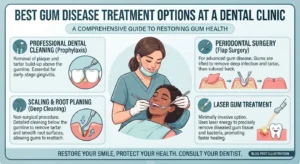
Scaling and root planing (SRP) is the standard first-line treatment for most patients diagnosed with periodontitis, and one of the most well-supported non-surgical periodontal treatment options available. It differs substantially from a routine clean: SRP removes calculus and bacterial biofilm from both above and below the gum line, then smooths root surfaces to discourage future bacterial reattachment. For mild to moderate disease, this is typically the first and often the only active treatment required before re-evaluation.
What happens during a deep cleaning appointment
Local anaesthetic is applied before the dentist or hygienist works through each quadrant of your mouth systematically. A full-mouth case is usually completed across two appointments. In Australia, SRP runs approximately $200 to $350 per quadrant, or $800 to $1,400 for full-mouth treatment across two visits. Private health insurance with major dental cover often contributes to this cost, so it’s worth checking your policy before your appointment.
Realistic outcomes: what the evidence shows
SRP produces meaningful improvements for early to moderate disease, with pocket depths typically reducing by 1 to 2 mm on average. The response is depth-dependent. Shallow pockets of 1 to 3 mm show minimal measurable reduction, while moderately deep sites reduce by around 1.3 mm, and deep sites of 6 mm or more show reductions of up to 2.16 mm. A re-evaluation at 3 to 6 months after treatment confirms whether further intervention is needed.
For effective management, the best treatment options for gum disease at a dental clinic should always be considered.
For comprehensive care, discuss the best treatment options for gum disease at a dental clinic with your dentist.
Antibiotic therapy: when and how it helps
Antibiotics are not a standalone treatment for gum disease. They work as adjuncts to mechanical debridement, either amplifying the results of SRP or addressing bacteria that instruments alone cannot fully eliminate. There are two delivery methods, and the choice between them depends on the pattern and severity of disease.
Local antibiotic delivery: targeted treatment for isolated pockets
Local antibiotic gels or chips are placed directly into deep pockets following SRP when isolated sites fail to respond adequately. This approach delivers a high drug concentration precisely where it is needed without the systemic effects of tablets. It works best for patients with one or two persistently deep pockets rather than widespread disease across multiple sites.
Systemic antibiotics: when they’re prescribed alongside deep cleaning
For aggressive periodontitis or moderate-to-severe disease that hasn’t responded to SRP alone, systemic antibiotics such as doxycycline, or the combination of metronidazole and amoxicillin, may be prescribed alongside mechanical treatment. The evidence supports their use as an adjunct rather than a replacement for cleaning. Prescribing antibiotics for gum disease is a clinical decision based on disease classification and response to prior treatment, not a routine addition to every periodontal appointment.
Laser periodontal therapy and regenerative adjuncts
Exploring the best treatment options for gum disease at a dental clinic can help you avoid invasive procedures.
It’s crucial to consider the best treatment options for gum disease at a dental clinic when planning your dental care.
Laser therapy and platelet-based regenerative adjuncts are among the more advanced gum disease treatments for patients who need enhanced tissue regeneration or who haven’t responded adequately to conventional non-surgical approaches. These are not universally available at every clinic, and their suitability depends on individual clinical presentation as much as the equipment available.
Laser-assisted treatment: how LANAP differs from conventional approaches
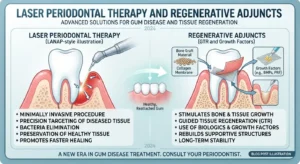
The LANAP (Laser-Assisted New Attachment Procedure) protocol uses a targeted laser to remove diseased tissue and bacteria from periodontal pockets while leaving healthy tissue intact. Clinical data shows pocket depth reductions of 1 to 3 mm after a single session, with one study recording a 2.5 mm reduction at six months compared to 2.2 mm for SRP alone. Combined success rates reach 80 to 90% for chronic periodontitis. Recovery typically involves 3 to 5 days of reduced activity with complete tissue healing within two weeks, making it a faster-recovery alternative to conventional surgery for eligible patients.
PRF and PRP: which patients benefit from regenerative adjuncts
Platelet-rich fibrin (PRF) and platelet-rich plasma (PRP) are prepared from the patient’s own blood and introduced into treatment sites to accelerate healing and reduce reinfection risk. The best candidates are patients with deep bone defects, those with persistent wound healing difficulties, or patients with antibiotic-resistant bacterial profiles. PRF shows stronger results for soft tissue clinical attachment improvement, while PRP contributes more to hard tissue reconstruction.
Patients with complex needs should ask about the best treatment options for gum disease at a dental clinic.
These adjuncts are not suitable for everyone. Patients with platelet dysfunction, active infections at the treatment site, bleeding disorders, or a current anticoagulant regimen are not candidates. A thorough medical history review is essential before these options are considered.
Surgical best treatment options for gum disease at a dental clinic
Recognizing the best treatment options for gum disease at a dental clinic is vital for long-term success.
Understanding the best treatment options for gum disease at a dental clinic is key to long-term oral health success.
Surgery is indicated when SRP and adjunctive therapy fail to reduce pockets to a clinically acceptable level, typically 5 mm or less. It is crucial when disease severity at initial presentation makes non-surgical treatment insufficient. Surgery is not a failure of earlier treatment but a logical escalation within a stepwise model.
Patients with probing depths exceeding 7 mm and significant bone loss should expect a surgical discussion as part of their overall treatment plan.
Flap surgery and pocket reduction procedures
Flap surgery involves folding back the gum tissue to allow direct access to root surfaces and underlying bone for thorough debridement. This approach achieves greater pocket depth reduction than SRP alone for pockets over 6 mm and carries a success rate of 85 to 95%. Soft tissue heals within 1 to 2 weeks, and most patients return to normal activities within a week, with dietary modifications such as eating soft foods and avoiding vigorous rinsing.
Guided tissue regeneration, bone grafts, and gum grafts
Guided tissue regeneration uses barrier membranes to encourage the growth of bone and connective tissue where loss has occurred. Bone grafts fill defects using the patient’s own bone, donor material, or synthetic substitutes, and require 3 to 6 months for full integration. Gum grafts address recession and exposed roots. Success rates for guided tissue regeneration range from 70 to 90%. In Australia, surgical periodontal interventions, including flap surgery and grafting, vary considerably in cost depending on complexity, the extent of disease, specialist involvement, and private health cover. As a rough guide, expect a range of $1,000 to $5,000 or more, contact your clinic or insurer directly for accurate figures, as costs differ between providers.
Follow-up and the importance of periodontal maintenance
Regardless of the treatment approach, every patient enters a periodontal maintenance schedule after active treatment concludes. This means professional cleans every 3 to 4 months rather than the standard six-month recall. In treated patients, pathogenic bacteria return to destructive levels within 9 to 11 weeks, so the 3-month interval disrupts that cycle before inflammation triggers further bone loss. The success of any surgical or non-surgical procedure depends heavily on consistent maintenance appointments and thorough home care between visits.
Effective follow-up is part of the best treatment options for gum disease at a dental clinic.
Integrating the best treatment options for gum disease at a dental clinic into your care plan can enhance treatment outcomes.
Gum disease management at Sunbury Dental Group
Many residents in Sunbury and surrounding suburbs, including Diggers Rest, Riddells Creek, Gisborne, and Lancefield, have historically needed to travel to Melbourne for specialist-level periodontal assessment. Sunbury Dental Group, led by AHPRA-registered dentist Dr Nita Kumari, offers a structured, stage-appropriate gum disease management pathway locally. Patients are encouraged to confirm the full scope of services and available referral arrangements when booking their initial assessment.
A structured treatment pathway from assessment to maintenance
The programme begins with a comprehensive periodontal assessment: digital X-rays and full-mouth probing charting to classify disease stage and determine the appropriate periodontal treatment options. Patients with early to moderate disease are managed with SRP and reassessed at 3 to 6 months. Cases requiring surgical input are co-ordinated with appropriate specialist referrals. All patients, regardless of treatment stage, are enrolled in supportive periodontal therapy with scheduled maintenance visits.
Transparent treatment planning is central to every appointment at Sunbury Dental Group. Before any procedure begins, patients receive a clear explanation of their diagnosis, the recommended pathway, expected outcomes, and associated costs. Patients managing treatment across multiple quadrants and visits are encouraged to ask about available payment arrangements, including any applicable insurer rebates or payment plan options, to understand what comprehensive periodontal care will mean for their budget.
This ensures that patients understand the best treatment options for gum disease at a dental clinic through every step of their journey.
Questions to ask your dentist before starting treatment
Walking into your appointment prepared makes a real difference to the outcome. Here are the questions worth raising:
- What stage and grade is my gum disease, and how was that determined?
- Is non-surgical treatment likely to be sufficient, or should I expect a surgical referral?
- How often will I need maintenance appointments after treatment completes?
- What will my private health insurance cover for scaling and root planing or periodontal surgery?
- What changes should I make at home to give the treatment the best chance of working?
An informed patient consistently achieves better outcomes. These questions open the conversation and give your dentist the opportunity to align the treatment plan precisely to your clinical picture and personal circumstances.
The most effective periodontal treatment is matched precisely to the stage of disease. Gingivitis responds to professional cleaning and improved home hygiene. Mild to moderate periodontitis is managed with scaling and root planing, while advanced disease calls for surgical intervention followed by long-term maintenance. Early action produces the best outcomes with the least invasive care.
The most effective periodontal treatment is always the one matched precisely to the stage of disease. Gingivitis responds to professional cleaning and improved home hygiene. Mild to moderate periodontitis is managed with scaling and root planing, with antibiotics or laser therapy added when clinical indicators warrant it. Advanced disease calls for surgical intervention followed by long-term maintenance. What connects every stage is straightforward: untreated gum disease progresses, and early action produces the best outcomes with the least invasive care.
If you’d like to discuss the best treatment options for gum disease at a dental clinic close to home, Sunbury Dental Group is ready to help. Book an appointment with the team at 5/92 Evans Street, Sunbury VIC 3429. You’ll receive transparent pricing and a full explanation of your gum disease treatment options from the very first visit.
If you’re exploring the best treatment options for gum disease at a dental clinic, consider reaching out to our team for guidance.
If you’re exploring the best treatment options for gum disease at a dental clinic, consider reaching out to our team for guidance.
We specialize in the best treatment options for gum disease at a dental clinic tailored to individual needs.
We are dedicated to providing the best treatment options for gum disease at a dental clinic customized to your specific needs.
FAQ Content
Q1: What are the best treatment options for gum disease at a dental clinic?
Treatment depends entirely on the stage of disease: gingivitis responds to professional cleaning and improved home hygiene, mild to moderate periodontitis is managed with scaling and root planing (SRP), and advanced disease requires surgical intervention followed by long-term maintenance. Antibiotics and laser therapy are added as adjuncts when clinical indicators warrant it, meaning the right approach always matches the specific stage rather than a one-size-fits-all solution.
Contact us for more information on the best treatment options for gum disease at a dental clinic.
Q2: What’s the difference between gingivitis and periodontitis treatment?
Gingivitis is inflammation without bone loss and is fully reversible with professional cleaning and better home care, while periodontitis involves irreversible structural damage to the bone and connective tissue holding teeth in place. Once periodontitis is established, treatment shifts from reversal to stabilisation, since the goal becomes preventing further damage rather than undoing what’s already occurred.
Q3: What happens during scaling and root planing (deep cleaning)?
SRP removes calculus and bacterial biofilm from above and below the gum line, then smooths root surfaces to discourage bacteria from reattaching, typically performed under local anaesthetic across two appointments covering the full mouth. In Australia, this runs approximately $200 to $350 per quadrant, or $800 to $1,400 for full-mouth treatment, with private health insurance often contributing toward the cost.
Q4: How effective is scaling and root planing for gum disease?
SRP produces meaningful improvements for early to moderate disease, with pocket depths typically reducing by 1 to 2 mm on average, though deep sites of 6 mm or more can see reductions of up to 2.16 mm. A re-evaluation at 3 to 6 months after treatment confirms whether further intervention is needed or whether the disease has stabilised.
Antibiotics are never a standalone treatment; they work as adjuncts to mechanical debridement, either amplifying SRP results or targeting bacteria instruments can’t fully eliminate. Local antibiotic gels suit one or two persistently deep pockets, while systemic antibiotics like doxycycline are reserved for aggressive or moderate-to-severe disease that hasn’t responded to SRP alone.
Understanding what the best treatment options for gum disease at a dental clinic entail is essential for effective care.
Q6: What is LANAP laser therapy for gum disease?
LANAP (Laser-Assisted New Attachment Procedure) uses a targeted laser to remove diseased tissue and bacteria from periodontal pockets while leaving healthy tissue intact, achieving combined success rates of 80 to 90% for chronic periodontitis. Recovery typically involves just 3 to 5 days of reduced activity with complete healing within two weeks, making it faster than conventional surgery for eligible patients.
For more details on the best treatment options for gum disease at a dental clinic, review our resources online.
Q7: When is surgery needed for gum disease?
Surgery is indicated when SRP and adjunctive therapy fail to reduce pockets to 5mm or less, or when initial disease severity makes non-surgical treatment insufficient on its own. Patients with probing depths exceeding 7mm and significant bone loss should expect a surgical discussion as part of their overall treatment plan, with flap surgery achieving success rates of 85 to 95%.
Our clinic emphasizes the best treatment options for gum disease at a dental clinic tailored to each patient.
Q8: How much does gum disease surgery cost in Australia?
Surgical periodontal interventions, including flap surgery and grafting, generally range from $1,000 to $5,000 or more depending on complexity, disease extent, and specialist involvement. Costs vary between providers, so contacting your clinic or insurer directly gives the most accurate figure for your specific case.
Discuss with your dentist the best treatment options for gum disease at a dental clinic to determine the right approach.
Q9: Why do gum disease patients need cleanings every 3 months instead of 6?
After active treatment, patients enter a periodontal maintenance schedule with professional cleans every 3 to 4 months rather than the standard six-month recall. This tighter interval matters because pathogenic bacteria return to destructive levels within just 9 to 11 weeks in treated patients, so the shorter cycle disrupts bacterial regrowth before it triggers further bone loss.
Patients should inquire about the best treatment options for gum disease at a dental clinic during their visits.
Q10: What questions should I ask my dentist about gum disease treatment?
Ask what stage and grade your gum disease is and how that was determined, whether non-surgical treatment will likely be sufficient or if a surgical referral is expected, and how often maintenance appointments will be needed afterward. Also ask what your private health insurance will cover for scaling and root planing or surgery, and what home care changes will give treatment the best chance of success.