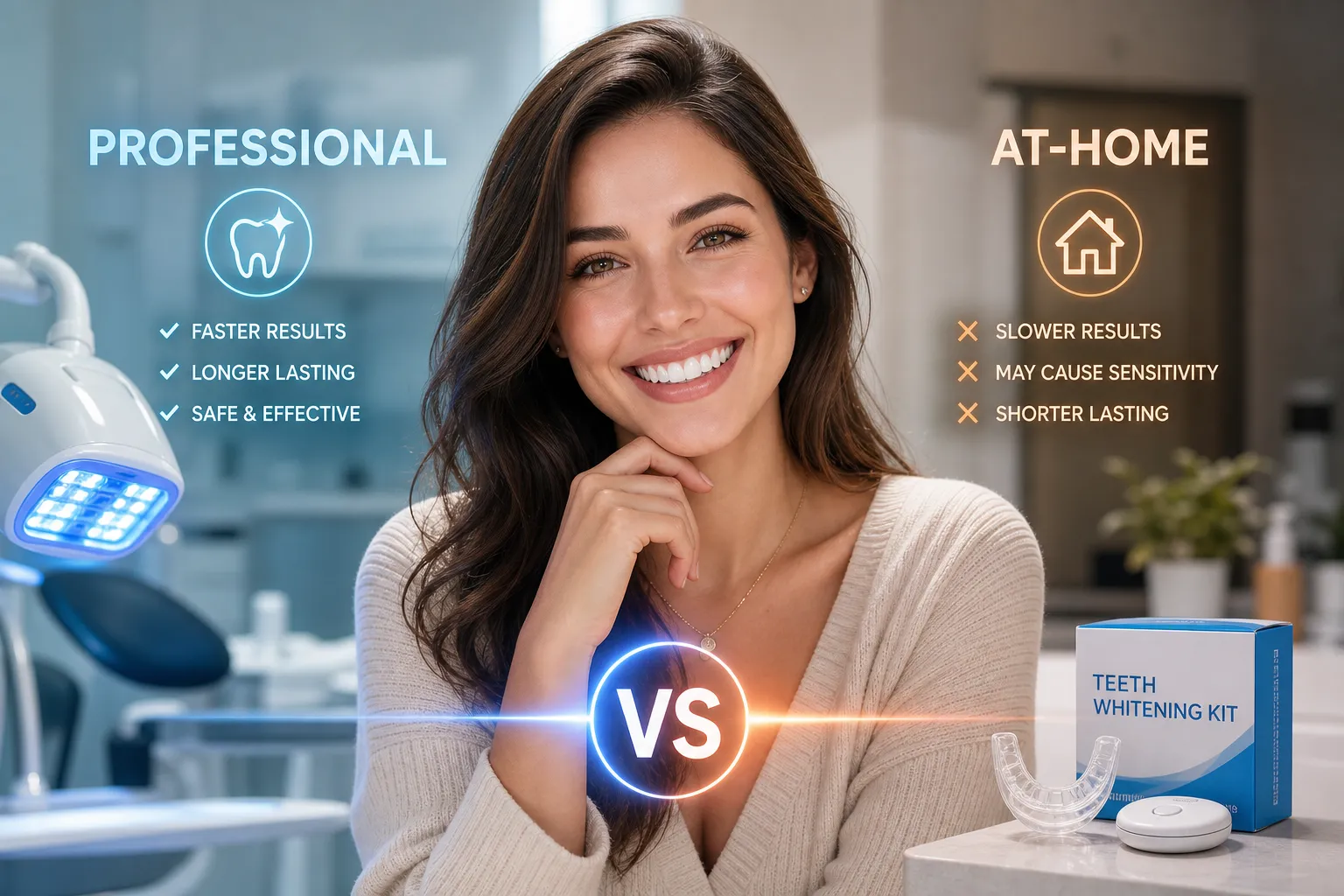
Professional Teeth Whitening vs. Home Kits: How Does Professional Teeth Whitening Compare to Over the Counter Home Kits?
You’re standing in the chemist aisle, whitening strip box in one hand and your phone in the other, looking up whether it’s really worth booking a dentist appointment. The kit is $40. The dentist visit is considerably more. The question feels obvious, until you try to answer it.
So, how does professional teeth whitening compare to over-the-counter home kits? It’s one of the most common questions the team at Sunbury Dental Group hears during smile consultations: “Can’t I just use the kit from the pharmacy?” The honest answer is: it depends on what you’re trying to achieve. OTC kits and professional whitening are genuinely different products operating at different strengths, with different results and different safety profiles. This article breaks down the real differences across effectiveness, cost, longevity, and suitability for sensitive teeth, so you can make a confident decision. Ultimately, understanding how does professional teeth whitening compare to over the counter home kits will help you choose the best option for your smile.
How does professional teeth whitening compare to over the counter home kits: a quick overview
Professional in-chair whitening and over-the-counter kits are not the same product at different price points. They use fundamentally different concentrations of active ingredients, and that gap drives everything else, from how many shades lighter your teeth become to how long those results actually hold.
How the two methods compare on whitening power
Why hydrogen peroxide concentration is the deciding factor
In-chair professional whitening uses 25, 40% hydrogen peroxide, applied directly to the teeth by a dentist with a protective gum barrier in place. Australian OTC products are legally capped at 6% hydrogen peroxide under the Poisons Standard, meaning the active ingredient is significantly more diluted before it even reaches your teeth. Dentist-issued take-home trays sit in the middle at 10, 22% carbamide peroxide, which is roughly equivalent to 3.3, 7.3% hydrogen peroxide, offering a supervised step up from anything you’d find at a chemist.
The higher concentration isn’t just a number. It determines how deeply the gel penetrates enamel to break down complex, embedded stains. Low-concentration OTC products primarily work on surface-level discolouration, which is why their results are modest and quick to reverse.
What the shade numbers actually mean for your smile
When considering which method is best for you, it’s important to ask how does professional teeth whitening compare to over the counter home kits in terms of safety and effectiveness? This question often arises during consultations, and the answers can be revealing.
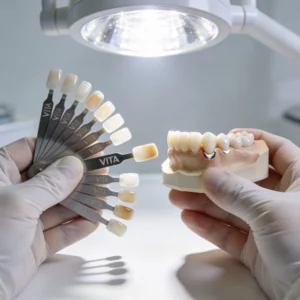
On the VITA dental shade scale used by dentists worldwide, in-chair whitening typically achieves 5, 8 shade improvements in a single 45, 90-minute appointment. OTC strips average 1, 3 shade improvements after two to four weeks of daily use. To put that in practical terms, professional whitening is roughly three to five times more effective per session than anything available off the shelf.
Whitening toothpastes and rinses deserve an honourable mention here, but not for the right reasons: clinical evidence shows they produce no meaningful bleaching effect, regardless of what the packaging claims.
Which option gives you results that actually last
Longevity is where the gap between professional whitening and home kits becomes most obvious. Many people who’ve tried OTC strips notice their teeth returning to a similar shade within one to three months, which leads them straight back to the chemist to buy more product.
Additionally, many patients wonder: how does professional teeth whitening compare to over the counter home kits regarding convenience? While OTC options are readily available, professional services offer personalized care.
Why over-the-counter results fade quickly
OTC results typically last only 1, 3 months before noticeable fading occurs. Because the lower peroxide concentration only addresses surface-level staining, the colour change is shallow and quick to reverse. Lifestyle factors like coffee, tea, red wine, and smoking accelerate fading further, and at a baseline improvement of just 1, 3 shades, there’s very little buffer before the result disappears entirely. Repeated use of OTC products to compensate for fading also increases sensitivity risk over time, without delivering the lasting improvement patients are chasing.
Why professionally whitened teeth hold their colour far longer
Professional bleaching penetrates deeper enamel layers, which means the colour change is more embedded and slower to reverse. While some studies report professional results persisting up to 2, 3 years with reasonable lifestyle habits and occasional maintenance, other clinical trials suggest earlier regression depending on the protocol and how diligently results are maintained. Combining an in-chair session with dentist-issued take-home trays for periodic touch-ups tends to extend results further still. This is a package Sunbury Dental Group offers as part of a tailored whitening plan, and for most patients, it delivers a strong outcome per dollar spent.
The real cost comparison: what you pay versus what you get
Upfront price comparisons often mislead people into thinking OTC kits are the smarter financial choice. The full picture looks quite different once you factor in how often each option needs to be repeated.
What each whitening option costs in Australia
Considering the cost, it’s essential to evaluate how does professional teeth whitening compare to over the counter home kits in terms of long-term value. Patients often find that investing in professional services saves money in the long run.
Here’s how the numbers typically break down across the different whitening options available in 2026:
- OTC strips and LED kits: $20, $200, with most whitening strips falling between $30 and $80.
- Dentist take-home custom trays: $250, $600 for the first set, including custom-fitted trays and professional-grade gel.
- In-chair professional whitening: $500, $1,500 per session, with regional Victoria clinics generally ranging between $600 and $900.
- Combined in-chair plus take-home packages: $900, $1,500, which many patients find offers a strong cost-per-result ratio.
Why total cost over time changes the maths
A patient buying OTC strips every four to six weeks to maintain their results can easily spend $300, $500 per year, based on typical strip pricing of $30, $80 per pack used roughly six to twelve times annually, with results still inferior to a single professional session. If in-chair results persist for two or more years with infrequent touch-ups, the annualised cost can work out lower than repeated OTC purchases for many patients. Professional whitening also removes the trial-and-error expense of buying multiple kit types that underdeliver before finding one that produces any visible change.
To summarize, understanding how does professional teeth whitening compare to over the counter home kits requires looking beyond the initial price and considering effectiveness and longevity.
Sensitive teeth and safety: which method is gentler on your mouth
When weighing your options, remember that how does professional teeth whitening compare to over the counter home kits can greatly influence your dental health and smile confidence.
The concern that stops many people from booking a dentist appointment is fear that professional whitening will hurt or damage their teeth. The data tells a more nuanced story.
Understanding the sensitivity rates for each method
Tooth sensitivity is common across all whitening methods. In-chair professional whitening produces sensitivity in 60, 75% of patients, typically peaking four to six hours post-treatment and resolving within 24, 48 hours. OTC strips produce sensitivity in 30, 40% of patients, with symptoms generally lasting one to two days. The higher incidence with in-chair treatment is directly linked to the higher peroxide concentration, but the critical difference is that it is short-lived and clinically managed.
Generic OTC trays that don’t fit the mouth properly are a separate issue. When gel spills onto the gums because the tray isn’t custom-fitted, the result is chemical gum irritation, the kind that custom professional trays are specifically designed to prevent.
Why supervised whitening is safer for people with pre-existing sensitivity
Before any in-chair whitening at a dental clinic, a dentist assesses gum health, existing restorations, and enamel condition. None of that happens when you open a box from the chemist. Patients with gum recession, thin enamel, or existing sensitivity can be prescribed lower-concentration take-home options or a modified in-chair protocol that reduces irritation without sacrificing results. Professional gum barriers protect soft tissue throughout treatment, a safeguard that’s completely absent from OTC kits.
For anyone with dental anxiety, existing restorations, or a history of sensitivity, going unsupervised with an OTC product carries more actual risk than a controlled, professionally managed treatment. The perception that “the dentist option must be harsher” is understandable, but it’s the opposite of what the clinical picture shows.
Choosing the right option for your situation
Not everyone has the same starting point or the same goal. The right whitening path depends on where your teeth are now, what you want to achieve, and how quickly you need to get there.
Who gets the most from in-chair professional whitening
Professional whitening delivers its best value for people with moderate-to-severe discolouration from years of coffee, tea, wine, or smoking. Anyone preparing for a significant event, a wedding, job interview, or school reunion, who needs meaningful results quickly will find it the more reliable path. Patients who’ve already tried OTC products and been disappointed are strong candidates too.
People with existing dental work like crowns or veneers also need a dentist to assess realistic expectations before whitening begins, not after. Restorations don’t respond to bleaching agents the same way natural enamel does, and that’s a conversation that matters upfront. At Sunbury Dental Group, every patient receives a full smile assessment before any whitening treatment, covering enamel condition, shade goals, and any existing restorations, so the approach is built around your specific mouth rather than a one-size-fits-all protocol.
When an OTC kit is a reasonable starting point
Ultimately, the question of how does professional teeth whitening compare to over the counter home kits boils down to your individual needs and goals.
An OTC kit makes sense for someone with mild surface staining, healthy teeth, no sensitivity, and realistic expectations for modest improvement. It also works well for a patient who has recently had professional whitening and wants a low-concentration product for occasional touch-ups between dental visits. The honest framing here is that OTC kits are a maintenance tool, not a whitening solution. If you want a genuinely noticeable change, the numbers point clearly to professional treatment.
Making the right call for your smile
When you consider how professional teeth whitening compares to over-the-counter home kits side by side, the evidence is consistent. Professional in-chair whitening delivers 3, 5 times more shade improvement in a single session, penetrates deeper into enamel for results that hold longer, and is performed in a controlled environment with safeguards that no chemist kit can replicate. OTC kits are accessible and affordable, but they are limited in what they can achieve and how long those results last.
Keep in mind that the answer to how does professional teeth whitening compare to over the counter home kits will vary for each person, but understanding the factors involved is key.
For anyone wanting a meaningful, lasting result, especially with sensitive teeth or existing dental work, supervised professional whitening is the clear choice. The upfront cost is higher, but the cost per month of maintained results often makes it the more economical decision over time.
If you’re in Sunbury or nearby suburbs including Diggers Rest, Riddells Creek, or Gisborne, the team at Sunbury Dental Group is happy to give you a personalised whitening recommendation before you commit to anything. A smile consultation takes the guesswork out of the decision entirely. A brighter smile is worth doing once, and doing it right.
In conclusion, as you consider the best path forward, keep asking yourself how does professional teeth whitening compare to over the counter home kits to ensure you make an informed choice.
FAQ
How does professional teeth whitening compare to over-the-counter home kits?
Professional in-chair whitening uses 25–40% hydrogen peroxide applied by a dentist, while Australian OTC kits are legally capped at 6% hydrogen peroxide. This concentration gap means professional whitening achieves 5–8 shades of improvement in one session, versus just 1–3 shades from OTC strips after weeks of daily use.
What hydrogen peroxide strength is used in professional whitening versus home kits?
In-chair professional whitening uses 25–40% hydrogen peroxide, dentist take-home trays use 10–22% carbamide peroxide (roughly 3.3–7.3% hydrogen peroxide equivalent), and Australian OTC products are capped at 6% hydrogen peroxide under the Poisons Standard.
How many shades whiter do teeth get with professional whitening vs OTC strips?
Professional in-chair whitening typically achieves 5–8 shade improvements on the VITA shade scale in a single 45–90 minute appointment, roughly three to five times more effective per session than OTC strips, which average just 1–3 shades after two to four weeks of daily use.
How long do professional whitening results last compared to home kits?
OTC results typically fade within 1–3 months because the lower peroxide concentration only whitens surface stains. Professional whitening penetrates deeper into enamel and can last 2–3 years with reasonable lifestyle habits and occasional maintenance.
How much does teeth whitening cost in Australia?
OTC strips and LED kits cost $20–$200, dentist take-home custom trays cost $250–$600, in-chair professional whitening costs $500–$1,500 per session (typically $600–$900 in regional Victoria), and combined in-chair plus take-home packages cost $900–$1,500.
Is professional teeth whitening actually cheaper long-term than home kits?
Yes, for many patients. Someone buying OTC strips every four to six weeks to maintain results can spend $300–$500 per year with inferior results, while a single professional session lasting two or more years often works out cheaper on an annualised basis.
Does professional teeth whitening cause more sensitivity than home kits?
In-chair professional whitening causes sensitivity in 60–75% of patients, higher than the 30–40% seen with OTC strips, because of the stronger peroxide concentration. However, professional sensitivity typically resolves within 24–48 hours and is clinically managed with gum barriers.
Are whitening toothpastes and rinses effective?
No. Clinical evidence shows whitening toothpastes and rinses produce no meaningful bleaching effect on tooth colour, regardless of marketing claims on the packaging.
Who should choose professional whitening over an OTC kit?
Professional whitening suits people with moderate-to-severe discolouration from coffee, tea, wine or smoking, those preparing for an event needing fast results, patients disappointed by OTC products, and anyone with crowns or veneers that need dentist assessment before whitening.
When is an OTC whitening kit a reasonable choice?
An OTC kit is reasonable for someone with mild surface staining, healthy teeth, no sensitivity, and realistic expectations for modest improvement, or as a low-concentration touch-up tool between professional dental visits.