
If you’ve caught yourself gently pulling your child’s thumb out of their mouth for the hundredth time this week, you’re definitely not alone. Thumb sucking is one of the most normal, most human habits a small child can have. It’s soothing, it’s familiar, and honestly, it’s kind of adorable when they’re two.
The trickier part comes when that habit sticks around longer than expected, and you start noticing their front teeth don’t quite meet anymore. Cue the Google search at 11pm, wondering if you’ve somehow caused permanent damage. Take a breath — we’re going to walk through exactly what’s happening, and what can genuinely be done about it.
What This Article Covers
We’re unpacking the real connection between thumb sucking and open bite, explaining how thumb sucking open bite orthodontics actually works in practice. You’ll learn what causes this specific bite pattern, when it tends to resolve on its own, and when professional open bite treatment children need becomes the smarter path. We’ll also cover the appliances used, realistic timelines, and how to gently support your child through the process of thumb sucking open bite orthodontics and how thumb sucking open bite orthodontics can change their smile.
Understanding thumb sucking open bite orthodontics is essential for parents noticing dental changes in their children.
In This Article, You’ll Discover:
How thumb sucking physically reshapes a growing bite over time
The age where sucking habits stop being “cute” and start being a concern
Whether an open bite can genuinely close on its own without treatment
The specific appliances used to correct open bite kids commonly need
What a two-phase orthodontic treatment plan typically looks like
Practical ways to help your child break the habit at home
What happens if the open bite isn’t treated at all

How Thumb Sucking Actually Creates an Open Bite
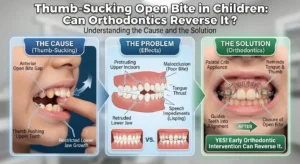
Here’s the mechanism, simplified. When a thumb sits between the upper and lower front teeth repeatedly over months or years, it applies gentle but constant pressure in exactly the wrong direction.
That pressure pushes the upper front teeth outward and can tip the lower front teeth inward, while also getting in the way of the back teeth fully coming together. Over time, this creates what’s called an anterior open bite — the front teeth simply don’t touch when your child bites down, even though the back teeth do.
It’s not just about crooked teeth either. Persistent sucking can influence how the jaw itself grows, sometimes affecting facial proportions if the habit continues well past the toddler years.
When Does Thumb Sucking Stop Being “Normal”?
Most kids naturally drop the habit somewhere between ages 2 and 4, often without any parental intervention at all. If it’s still going strong by age 5 or 6, that’s generally the point specialists start paying closer attention.
The honest truth is timing matters enormously here. The earlier a persistent habit gets addressed, the less impact it tends to have on permanent tooth development down the track.
Will the Open Bite Just Close on Its Own?
This is genuinely one of the more reassuring facts in all of this. Research suggests up to 80% of open bites resolve naturally once the sucking habit itself has actually stopped.
That’s a big number, and it means panic usually isn’t the right response to a mild open bite in a five-year-old who’s still sucking their thumb occasionally. What matters more is breaking the habit itself — the bite often follows the habit, not the other way around.
Where it gets more complicated is when the habit continues into the mixed dentition years, once permanent teeth start arriving. At that stage, natural correction becomes far less likely, and a proper assessment matters more.
How Orthodontic Open Bite Fix Options Actually Work
Learning about thumb sucking open bite orthodontics helps parents make informed choices regarding their child’s dental health.
If the habit has lingered and a genuine bite issue has developed, orthodontists have a genuinely effective toolkit here. None of it involves guesswork — these appliances specifically target the mechanics causing the problem.
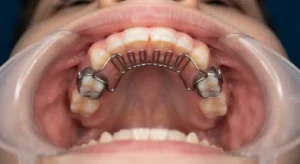
Palatal crib (tongue crib): A small fixed appliance bonded behind the front teeth that physically blocks the thumb-sucking motion and retrains tongue posture
Anterior bite plate: Prevents back teeth from touching fully, allowing them to naturally erupt further and close the front gap over time
Expansion plate with braces: Widens a narrow upper arch while braces gradually realign the front teeth, often used together in more established cases
Vertical chin cup: Occasionally used to influence how the lower face grows during active development
Bite blocks: Placed on the lower back molars to gently guide the front teeth back together, most effective before all adult teeth arrive
Most of these appliances work by making the habit physically uncomfortable or impossible to continue, which tends to break it far faster than willpower alone.
[INTERNAL LINK: anchor text “early orthodontic evaluation for kids in Sunbury” linking to an Orthodontic Referral or Kids Dentistry page]
What a Two-Phase Treatment Plan Often Looks Like
For more established open bites, treatment tends to unfold in two distinct stages rather than one long process.
Phase one (interceptive): Focuses on stopping the habit and guiding early jaw growth, often using a crib or expansion plate during the primary school years
Phase two (adolescent): If needed, traditional braces or clear aligners fine-tune the bite once most permanent teeth have arrived, typically during the teenage years
Full correction using combined approaches can take anywhere from around 12 to 15 months, though every child’s case genuinely differs.
Helping Your Child at Home
These strategies are crucial in addressing thumb sucking open bite orthodontics effectively.
Before appliances even enter the conversation, plenty of families make real progress with simple, gentle strategies at home.
Talk with your child about why the habit needs to stop, in an age-appropriate, non-shaming way
Use a reward or star chart to celebrate thumb-free stretches of time
Try a bandaid or soft cotton glove at bedtime as a gentle physical reminder
Identify triggers — tiredness, boredom, or anxiety often drive the habit more than comfort alone
Time a fresh start around a meaningful milestone, like starting school
If these approaches haven’t worked by the time your child’s in primary school and still sucking regularly, that’s a reasonable point to bring in professional support.

Positive reinforcement often works alongside professional support
Frequently Asked Questions
Parents should seek guidance on thumb sucking open bite orthodontics when their child is still sucking after age 5.
At what age should I worry about thumb sucking affecting my child’s teeth?
Most dentists start paying closer attention if the habit continues past age 5 or 6, particularly once permanent teeth begin arriving. Before that age, it’s usually considered a normal part of early development.
Can an open bite from thumb sucking fix itself without any treatment?
Yes, in many cases — research shows up to 80% of open bites close naturally once the sucking habit stops on its own. The key factor is breaking the habit itself, which often allows the bite to correct without further intervention.
Does my child need braces if they have an open bite from thumb sucking?
Not necessarily straight away. Many cases respond well to simpler interceptive appliances first, with braces only needed later if the bite hasn’t fully corrected once permanent teeth arrive.
How long do orthodontic appliances need to stay in for a thumb-sucking habit?
Habit-breaking appliances are typically left in place for around 4 to 6 months after the habit has visibly stopped, to make sure it doesn’t return. More complex bite corrections involving expansion or braces can take considerably longer.
Is it my fault if my child developed an open bite from thumb sucking?
Not at all — thumb sucking is an entirely normal, instinctive soothing behaviour in young children. What matters now is addressing it calmly and, if needed, getting the right professional support rather than placing blame.
Bringing It All Together
Thumb sucking is a normal habit, and in many children, any resulting open bite closes naturally once the habit stops — no drama required. For the cases that don’t resolve on their own, orthodontic options like cribs, bite plates, and staged treatment plans offer a genuinely proven path back to a properly closing bite, particularly through thumb sucking open bite orthodontics.
Consider how thumb sucking open bite orthodontics can impact your child’s long-term dental health.
If you’ve noticed your child’s front teeth aren’t meeting properly, our Dentist Sunbury team can take a look and talk you through whether a specialist referral makes sense for their specific situation.