
Introduction
You’ve brushed twice, rinsed with mouthwash, even chewed a piece of gum, and that odd metallic tang is still sitting on your tongue. It’s a weird sensation, isn’t it? Almost like you’ve been sucking on a coin.
Understanding the various metallic taste in mouth causes can provide insight into potential health issues.
Here’s the thing: metallic taste in mouth causes are more varied than most people expect, and quite a few of them trace straight back to what’s happening with your teeth and gums. Some causes are harmless and temporary. Others, like a lingering gum infection taste, are your body’s way of flagging something that genuinely needs attention. We’re going to walk through exactly what’s likely going on and when it’s time to stop guessing and get it checked.
Let’s dive deeper into the metallic taste in mouth causes that might be affecting you.
Overview
This guide breaks down the most common dental and general health reasons behind a persistent metallic taste, with a particular focus on the oral causes that dentists see most often. We’ll cover how gum disease and tooth decay directly change how your mouth tastes, what a ruptured abscess feels and tastes like, and which non-dental factors might be contributing too. By the end, you’ll know exactly what to watch for and whether a trip to the dentist is the right next step.
Awareness of metallic taste in mouth causes can help you address any underlying concerns.
In This Article, You’ll Discover:
Why bleeding gums can leave a metallic taste behind, even when you can’t see blood
These dental issues are common metallic taste in mouth causes that require attention.
How gum disease and periodontitis directly cause that lingering metal flavour
Gum disease is one of the primary metallic taste in mouth causes that you should be aware of.
What it means if the taste appears suddenly alongside pain relief
The connection between tooth decay symptoms and a bad taste in your mouth
Exploring the metallic taste in mouth causes helps clarify the connection between dental health and taste.
Non-dental causes worth ruling out, from medications to nutrient deficiencies
Simple things you can try at home while you wait for an appointment
Addressing the metallic taste in mouth causes can lead to better oral hygiene practices.
When a metallic taste means you need to see a dentist urgently
Why Does a Metallic Taste Happen in the First Place?
Many people wonder what specific metallic taste in mouth causes they might experience.
Taste and smell work together in ways most of us never think about, until something throws them off. A metallic taste often comes down to one simple culprit: blood. Blood carries iron, and iron has a genuinely distinct metallic flavour, so even a tiny amount mixing with your saliva can coat your taste buds and linger there.
That’s exactly why so many bad taste mouth dental cause situations trace back to bleeding gums rather than anything more exotic. Your gums don’t need to be visibly bleeding for this to happen either — plenty of people have gums that bleed just slightly during brushing without ever noticing a drop.
Understanding the link between blood and metallic taste in mouth causes is crucial for diagnosis.
Gum Infection Taste: The Most Common Dental Culprit
If there’s one condition responsible for more metallic-taste complaints than any other, it’s gum disease. Gingivitis, the earliest stage, inflames your gums enough that they bleed easily, releasing iron into your mouth with every brush or bite.
Identifying gum disease as one of the metallic taste in mouth causes is essential for treatment.
How Gum Disease Progresses to Cause a Stronger Taste
Left untreated, gingivitis can progress into periodontitis, and that’s where the taste tends to get noticeably worse. Periodontitis creates deep pockets between your teeth and gums where bacteria and infection settle in, and this combination intensifies both the smell and the taste in your mouth.
Recognizing the severity of metallic taste in mouth causes can help prevent further complications.
Here’s a quick way to spot the pattern:
Gingivitis — mild gum inflammation, occasional bleeding, a faint metallic hint
It’s important to monitor your symptoms related to metallic taste in mouth causes.
Early periodontitis — more frequent bleeding, a stronger and more persistent taste
Advanced periodontitis — deep pockets, ongoing infection, a taste that barely fades even after rinsing
Advanced gum disease is one of the serious metallic taste in mouth causes that needs immediate attention.
Dry mouth makes all of this worse too. Saliva normally washes blood, bacteria, and food particles away, so when your mouth is dry, that metallic taste has nothing flushing it out and simply lingers longer.
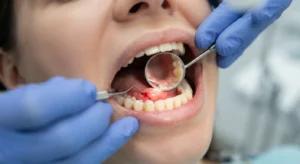
Awareness of the potential metallic taste in mouth causes can enhance your dental visits.
Tooth Decay Symptoms That Come With a Bad Taste
Preventing issues from metallic taste in mouth causes starts with good dental hygiene.
Gum disease isn’t the only dental issue behind this. Tooth decay itself, once it progresses far enough, produces its own distinct taste problem. As bacteria break down tooth structure, they release byproducts that genuinely taste unpleasant, and this often shows up alongside other classic tooth decay symptoms like sensitivity to hot or cold and visible dark spots.
This is where things get more serious. A dental abscess is a pocket of infection filled with pus, and if that abscess ruptures, the sudden release creates a distinctly foul, salty, or metallic taste that’s hard to mistake for anything else. Oddly enough, people sometimes feel a wave of pain relief right when this happens, because the pressure that was building has finally released.
A dental abscess is one of the more alarming metallic taste in mouth causes you should be aware of.
Don’t let that relief fool you, though. A ruptured abscess still means active infection, and it needs treatment regardless of how the pain feels in the moment. According to Healthdirect Australia, a tooth abscess simply won’t resolve on its own and requires proper dental treatment to clear the infection completely.[healthdirect.gov]
Severe, throbbing pain that worsens over time
Identifying the signs related to metallic taste in mouth causes can prevent emergencies.
Sensitivity to hot and cold that lingers longer than usual
Swelling in the face, cheek, or gum area
Keeping track of the symptoms related to metallic taste in mouth causes is important for health.
A pimple-like bump on the gum near the affected tooth
Fever or swollen glands under the jaw
Fever can also be a symptom linked to metallic taste in mouth causes that needs attention.

Ruling out metallic taste in mouth causes can help you focus on your overall health.
Non-Dental Causes Worth Ruling Out
Not every metallic taste points back to your teeth. A handful of other factors show up often enough that they’re worth mentioning honestly.
Many medications can contribute to metallic taste in mouth causes, so be aware of side effects.
Medications — blood pressure medications, certain antibiotics, and some prescriptions get partly absorbed and released into saliva, altering taste[health.clevelandclinic]
Supplements — multivitamins or supplements containing zinc, iron, or copper are common triggers[southtowndentalcare]
Supplements can also be linked to metallic taste in mouth causes; discuss with your doctor.
Nutrient deficiencies — a significant zinc or vitamin B12 deficiency can genuinely change how things taste[crest]
Sinus issues — colds and sinus infections can dull or distort taste temporarily
Understanding sinus issues is vital as they can contribute to metallic taste in mouth causes.
Pregnancy hormones — many pregnant women report a metallic taste, particularly in early pregnancy
If you’ve recently started a new medication or supplement around the time the taste appeared, that timing is worth mentioning to whoever you see next, whether that’s your dentist or your GP.
Keep track of any changes that may point to metallic taste in mouth causes for your next appointment.
What You Can Try at Home in the Meantime
While you wait for your appointment, a few small habits genuinely help take the edge off:
While waiting for your appointment, reflecting on metallic taste in mouth causes can be helpful.
Rinse with a warm water and baking soda solution to help neutralise the taste
Stay well hydrated, since dry mouth makes everything linger longer
Stay vigilant about metallic taste in mouth causes while maintaining hydration.
Swap metal cutlery and water bottles for glass or plastic where possible
Keep up gentle, consistent brushing and flossing, even if gums feel tender
Maintaining good oral hygiene can alleviate some metallic taste in mouth causes.
Avoid smoking, which tends to make the metallic taste noticeably worse
These won’t fix an underlying infection, but they can make day-to-day life a bit more comfortable while you get things properly checked.
Being aware of metallic taste in mouth causes can lead to better daily habits.
When Should You See a Dentist?
Most causes of a mild, occasional metallic taste aren’t emergencies. But a few signs mean you shouldn’t wait around:
Seeking help for metallic taste in mouth causes is crucial for your well-being.
The taste persists for more than a week despite good oral hygiene
It’s accompanied by visible gum swelling, bleeding, or a bad smell
Discussing metallic taste in mouth causes with your dentist can clarify your symptoms.
You notice a bump or pimple on your gum near a specific tooth
There’s facial swelling, fever, or pain that’s getting worse, not better
Recognizing the signs of metallic taste in mouth causes can prompt timely action.
Pain suddenly eases alongside a strong burst of unpleasant taste
Any of these combinations point toward an active infection that genuinely needs professional treatment rather than home remedies.
Don’t ignore any indications of metallic taste in mouth causes during your dental visit.
Frequently Asked Questions
Why do I have a metallic taste in my mouth that won’t go away?
A persistent metallic taste is most often caused by bleeding gums from gingivitis or periodontitis, since blood contains iron and leaves a distinct metallic flavour. If it’s lasted more than a week, it’s worth getting your gums checked rather than waiting it out.
Can gum disease really cause a metallic taste?
Yes, gum disease is one of the most common dental causes of a metallic taste, because inflamed gums bleed easily and that blood mixes with saliva. The taste tends to get stronger as gum disease progresses from gingivitis to periodontitis.
Is a metallic taste a sign of a tooth infection?
It can be, particularly if the taste is sudden, foul, and salty, or follows a burst of pain relief, which often signals a ruptured abscess. This still requires dental treatment even if the pain feels better afterward.
Can medications cause a metallic taste in your mouth?
Yes, certain blood pressure medications, antibiotics, and supplements containing zinc, iron, or copper are known to cause a temporary metallic taste. If the timing lines up with a new medication, it’s worth mentioning to your doctor or dentist.
What should I do if the metallic taste comes with tooth pain?
Book a dental appointment as soon as possible, since tooth pain combined with a metallic taste often points to decay or infection that needs treatment. Don’t wait for the pain to go away on its own, as it usually signals the problem is progressing.
Final Thoughts
A metallic taste that lingers is rarely random — it’s usually your gums or teeth signalling that something needs attention, often linked to common metallic taste in mouth causes. The good news is that most of these causes are very treatable once properly diagnosed. If that metallic taste has stuck around longer than a week, book your appointment at Sunbury Dental Group today and let’s find out exactly what’s behind it.
This article is general information only and does not replace individualised advice from a registered dental or medical practitioner. A persistent metallic taste can occasionally indicate non-dental medical conditions, so consult your GP if dental causes are ruled out. Sunbury Dental Group complies with AHPRA advertising guidelines and Australian Consumer Law; no outcome, result, or diagnosis is guaranteed without an in-person clinical assessment.