
You’ve had your implant for years, it’s felt rock solid the whole time, and now suddenly there’s a wobble that wasn’t there before. Naturally, your brain jumps straight to worst-case scenarios. Take a breath — a loose dental implant years later is genuinely worth investigating promptly, but it’s rarely as catastrophic as it feels in the moment.
We’re Sunbury Dental Group, and patients from Sunbury, Diggers Rest, Bulla, and the wider Hume region come to us with exactly this concern more often than you’d expect. Let’s walk through what’s actually happening when an old implant starts feeling loose, what the genuine implant failure symptoms look like, and what happens next.
Overview: What This Article Covers Loose Dental Implant Years Later
We’re going to explain the difference between a loose crown and a genuinely loose implant post, because they’re not the same problem and they don’t carry the same urgency. You’ll learn the most common failing dental implant signs, why looseness years later has different causes than looseness in the first few months, and what actually happens during assessment and treatment. We’ll also cover practical steps to protect your implant going forward.
In This Article, You’ll Discover…
Why a loose implant years later has different causes than one that loosens early
The crucial difference between a loose crown and a genuinely loose implant post
The most common failing dental implant signs to watch for
What peri-implantitis is and why it’s the leading cause of late-stage looseness
How screw loosening and grinding contribute to this problem
What actually happens during assessment and treatment
Practical steps that protect your implant for the long haul
Loose Crown or Loose Implant? The Distinction That Changes Everything
Here’s the first thing we want to clear up, because it genuinely changes how worried you should be. What feels like “my implant is loose” is very often not the implant post itself moving in the bone — it’s the crown or the abutment connecting to it.
This distinction matters enormously. A loose crown or abutment is a mechanical issue, usually fixable in a single visit. A loose implant post, on the other hand, points to something happening at the bone level, which is a more involved problem.
Why This Happens So Often
Abutment screw loosening is actually the most common technical complication in implant dentistry, accounting for up to 33 percent of all post-implant prosthetic issues. One long-term study found screw loosening occurred in as many as 59.6 percent of single implant crowns within 15 years, while other research reports a somewhat lower incidence of 5 to 12 percent between one and seven years. Either way, it’s genuinely common enough that your dentist has likely seen it many times before.
[INTERNAL LINK: suggest anchor text “dental implants in Sunbury” linking to /services/dental-implants]
Implant Failure Symptoms: What Actually Points to a Deeper Problem
If it’s not just a loose screw, here’s what genuine implant failure symptoms tend to look like.
Signs Worth Taking Seriously
The implant post itself moves, not just the visible crown on top
Persistent pain or discomfort at the implant site that’s new or worsening
Swelling, redness, or bleeding gums around the implant
A bad taste or odour, often signalling active infection beneath the gum line
Visible gum recession exposing more of the implant than before
Difficulty chewing on that side, or the bite feeling noticeably different
If several of these show up together, particularly pain and swelling alongside the looseness, that’s a stronger signal something at the bone level needs attention rather than a simple mechanical fix.
Failing Dental Implant Signs: Why It Happens Years Later Specifically
This is genuinely the most useful part of the conversation, because looseness that shows up years after placement has quite different causes from looseness in the first few months.
The Leading Cause: Peri-Implantitis
Across nearly every clinical source on this topic, one cause comes up again and again as the number one reason for late-stage implant looseness: peri-implantitis. This is an infection of the gum and bone tissue surrounding the implant, functioning much like gum disease does around a natural tooth. Left unaddressed, it gradually eats away at the bone anchoring your implant, which is exactly why the implant eventually starts to feel unstable.
Risk factors that make peri-implantitis more likely include smoking, uncontrolled diabetes, thin gum tissue, and inconsistent oral hygiene. None of these guarantee it’ll happen, but they do meaningfully raise the odds.
Bruxism and Bite Force Over Time
Chronic teeth grinding or clenching, often happening unconsciously during sleep, places sustained, repetitive force on the implant and surrounding bone. Over years, that pressure can gradually weaken the bone-implant connection, particularly if a protective night guard hasn’t been part of the routine.
Bone Loss That Creeps Up Quietly
Bone loss around an implant doesn’t always come with obvious pain, which is exactly why it’s described as “sneaky” in clinical literature. As surrounding bone gradually shrinks, whether from ageing, disease, or mechanical stress, the implant’s support base weakens even though nothing might feel wrong until the looseness itself shows up.
Other Contributing Factors
Retained dental cement left under the gum from the original crown placement, causing chronic low-grade inflammation
Incompatible or poorly fitted implant components creating uneven stress
Underlying health conditions like osteoporosis or osteomalacia affecting bone strength generally
Certain medications that impact bone density or healing over time
Accidental trauma to the mouth, even relatively minor knocks

Peri-implantitis is the leading cause of implants loosening years after successful placement.
Implant Complication: What Happens Once You Get It Checked
If you’ve noticed looseness, here’s genuinely what the assessment and treatment pathway tends to look like.
The Assessment Process
Your dentist will first determine whether it’s the crown, abutment, or the implant post itself that’s moving, since that distinction drives the entire treatment plan. X-rays help assess bone levels around the implant, and a periodontal-style probing check looks for signs of infection or pocket depth changes. This isn’t something to try diagnosing yourself at home — the difference between a five-minute screw tightening and a more involved bone-level intervention isn’t something you can tell just by wiggling the tooth with your tongue.
Treatment Depends on the Actual Cause
Loose screw or crown: Often resolved by retightening or re-cementing in a single appointmentPeri-implantitis: Treated with deep cleaning around the implant, possibly antimicrobial therapy, and sometimes surgical intervention for more advanced cases
Bruxism-related strain: Managed with a custom night guard to protect the implant from ongoing excessive force
Significant bone loss: May require bone grafting, and in more severe cases, implant removal and replacement once the site has healed
Retained cement inflammation: Addressed by removing the retained material and treating the resulting inflammation
[INTERNAL LINK: suggest anchor text “book an urgent implant check” linking to /patient/book-an-appointment/]
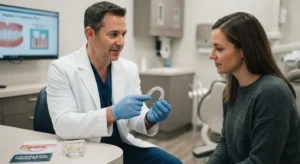
A custom night guard can protect an ageing implant from the slow damage caused by grinding.
Why Prompt Action Genuinely Matters Here
We won’t sugarcoat this part: leaving a loose implant unaddressed rarely resolves itself, and the underlying cause — whether infection or mechanical strain — tends to progress rather than improve with time. Dental implants overall maintain a strong success rate, generally cited around 95 percent, and catching a developing problem early is a huge part of why that number stays that high. The earlier peri-implantitis or bone loss is caught, the more treatment options remain genuinely on the table.
A Local Note for Sunbury Families
If you’ve had an implant for years and something suddenly feels off, please don’t wait it out hoping it settles down on its own. We see plenty of Sunbury and Bulla patients who put off getting a loose implant checked for months, only to find a straightforward fix had turned into something more involved simply because of the delay. Getting it looked at early is almost always the easier, less costly path.
Questions Worth Asking at Your Assessment
Is it the crown, abutment, or the implant post itself that’s actually loose?
Are there any signs of infection or bone loss on my X-rays?
Would a night guard help protect my implant if grinding is a factor?
What’s the realistic treatment timeline if peri-implantitis is confirmed?
What can I do at home to reduce my risk of this happening again?
Frequently Asked Questions
Is it normal for a dental implant to feel loose years after placement?
No, a genuinely loose implant is not considered normal and should always be assessed promptly, though it’s often the crown or abutment rather than the implant post itself. Either way, it’s worth having checked rather than assumed.
What is the most common cause of a dental implant becoming loose over time?
Peri-implantitis, an infection affecting the gum and bone around the implant, is the leading cause of late-stage implant looseness across most clinical research. Screw loosening in the crown or abutment is also extremely common but is a separate, generally simpler issue.
Can a loose dental implant be fixed without replacing it?
Often, yes — if the issue is a loose screw or crown, it can typically be resolved in a single appointment. If bone loss or infection has affected the implant itself, treatment may involve grafting or, in more severe cases, replacement.
Does teeth grinding cause dental implants to loosen?
Yes, chronic grinding or clenching places repeated, excessive force on the implant, which can gradually weaken its connection to the bone over years. A custom night guard significantly reduces this risk.
How urgent is it to see a dentist if my implant feels loose?
Fairly urgent — the underlying cause, whether infection or mechanical, generally doesn’t improve on its own and tends to progress the longer it’s left. Prompt assessment gives you the widest range of treatment options.
Can smoking cause a dental implant to fail years after placement?
Yes, smoking is a well-documented risk factor for late implant failure, largely because it reduces blood flow and increases susceptibility to infection around the implant. It’s one of the more modifiable risk factors worth addressing if you’re a smoker.
Bringing It All Together
A loose dental implant years later usually comes down to one of a handful of well-understood causes, most commonly a loose crown or screw, peri-implantitis, or grinding-related strain on the bone. None of these are things to panic over, but all of them respond far better to prompt attention than to waiting and hoping it settles.
If your implant has started feeling different lately, don’t sit on it wondering. Book your appointment at Sunbury Dental Group today for a thorough assessment: https://sunburydentalgroup.com.au/patient/book-an-appointment/