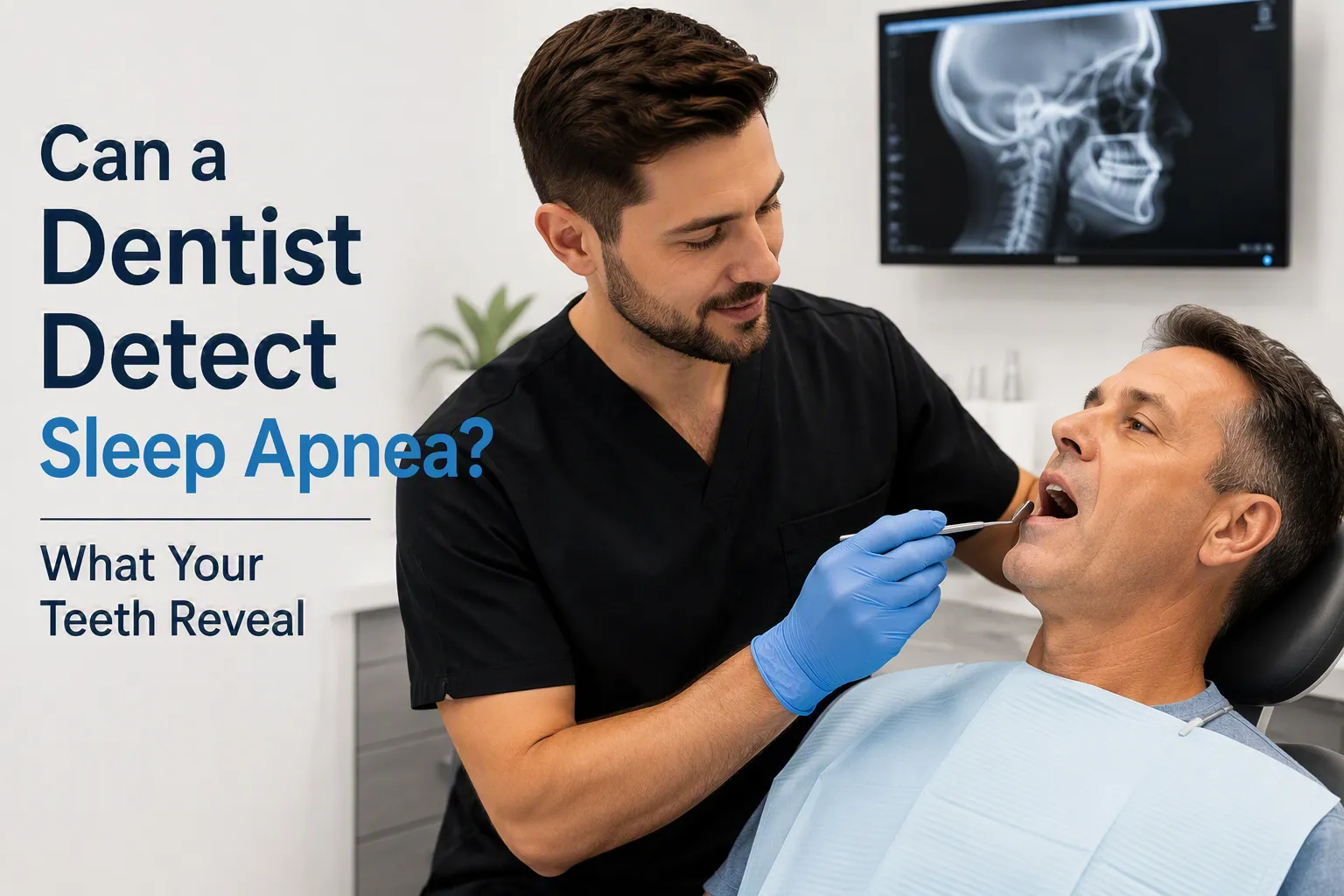
Can a Dentist Detect Sleep Apnea? What Your Teeth Reveal
You brush, you floss, you show up for your six-month check-up. Fair enough — you’re doing the right things. But here’s something that might surprise you: the person looking in your mouth twice a year could spot signs of a serious sleep disorder long before you ever mention feeling tired.
Additionally, a dentist can detect sleep apnea by examining various indicators in your mouth.
That’s not a stretch. It’s actually becoming a bigger part of what modern dentistry looks for, and for good reason.
If you’ve ever woken up with a sore jaw, a partner complaining about your snoring, or a dentist raising an eyebrow at worn-down teeth, this article is for you. We’re going to walk through exactly how a dentist can detect sleep apnea signs, what your teeth and mouth reveal about your breathing at night, and what families around Sunbury can do about it. Remember, a skilled dentist can detect sleep apnea signs by noticing these signs early and addressing them promptly.
When you visit your dentist, remember that they can detect sleep apnea through careful observation.
Overview
Your dentist can help detect sleep apnea early, so ensure you mention your concerns during your regular check-ups. A dentist detect sleep apnea by observing the signs in your mouth.
It’s important to note how a dentist detect sleep apnea during your regular check-ups.
How Can a Dentist Detect Sleep Apnea?
Understanding how a dentist detect sleep apnea can empower you to seek help sooner rather than later.
Your dentist’s ability to detect sleep apnea is crucial for your overall health.
This article explains how dentists screen for obstructive sleep apnea (OSA) by examining physical signs inside your mouth, like worn enamel, a scalloped tongue, or a narrow airway. We’ll cover the specific sleep apnea signs teeth show, why snoring and clenching are connected, and what dental sleep medicine actually involves. You’ll also get a clear picture of when to ask your GP or a sleep specialist for a formal diagnosis, and how a Sunbury dentist fits into that bigger picture of care.
In This Article, You’ll Discover…
Why dentists are often the first health professional to notice sleep apnea red flags
The specific sleep apnea signs teeth and gums can show, from grinding damage to scalloping
How snoring, teeth grinding (bruxism), and sleep apnea are all connected
What dental sleep medicine involves, including oral appliances as a treatment option
Who’s most at risk in Sunbury and the surrounding suburbs, and why local lifestyle factors matter
When a dental observation should lead you to a sleep study or GP referral
If you’re experiencing symptoms, it’s crucial to consult your dentist, as they can detect sleep apnea and guide you toward further evaluation.
Asking your dentist about how they can detect sleep apnea can lead to significant health benefits.
Practical next steps if you recognise these signs in yourself or your kids
Why Your Dentist Notices Things You Don’t
Think about it for a second. You see your GP once a year, maybe. You see a dentist twice a year, and they’re staring straight into your mouth with a bright light for a good ten minutes each time.
That’s a lot of opportunity to notice change.
Dentists are trained to look past cavities. They’re watching how your jaw sits, how your teeth wear down over time, and what your tongue and soft tissue look like. Many of these details tie directly back to how well — or how poorly — you’re breathing at night.
Research backs this up. A 2023 overview in the dental literature confirmed that dentists are well-positioned to screen for obstructive sleep apnea because of the physical changes it causes in the mouth and airway. It’s not guesswork. It’s pattern recognition built on genuine anatomy.
The Airway-Mouth Connection
Here’s the simple version: your airway and your mouth are neighbours. When your airway narrows during sleep — which is what happens in obstructive sleep apnea — your body compensates in ways that show up right there in your teeth, jaw, and tongue.
A narrow palate, a receding jaw, a large tongue relative to the mouth — these aren’t just cosmetic details. They can physically reduce airway space and increase the odds of nighttime breathing interruptions.
Sleep Apnea Signs Teeth and Mouths Reveal
Let’s get specific, because “signs” is a vague word until you know what to actually look for.
1. Worn, Flattened, or Chipped Teeth
If you clench or grind your teeth at night — a condition called bruxism — your dentist will usually spot it fast. Flattened biting edges, tiny chips, or teeth that look shorter than they used to are classic clues.
Grinding and sleep apnea travel together more often than people realise. Some researchers believe grinding is actually your body’s way of trying to reopen a blocked airway during sleep. It’s almost like an unconscious survival reflex.
2. A Scalloped Tongue
This one surprises most patients. If the edges of your tongue show a wavy, scalloped pattern — like the imprint of your teeth pressed into the sides — it often means your tongue is too large for your mouth or is being pushed against your teeth repeatedly at night.
A scalloped tongue is one of the more specific physical markers dentists look for during an oral exam.
3. A Small or Recessed Jaw
A jaw that sits further back than average narrows the space behind your tongue. Less space back there means a higher chance of airway collapse during deep sleep.
Dentists assess jaw position as a routine part of orthodontic and general exams anyway, so this observation often happens without you even realising it’s relevant to sleep.
4. Dry Mouth and Increased Decay
Mouth breathing at night — a common companion to sleep apnea — dries out your saliva’s natural protective effect. Less saliva means more decay, more gum irritation, and a higher risk of cavities showing up between visits.
If your dentist comments that you’re getting cavities faster than expected despite good hygiene, that’s worth a second conversation.
5. A Narrow, High-Arched Palate
Some people are simply born with a narrower roof of the mouth. This shape can reduce nasal airway space too, contributing to snoring and breathing difficulty during sleep.
6. Enlarged Tonsils or a Long Soft Palate
While this sits more toward the throat than the teeth, dentists often get a clear view of the back of the mouth during routine exams and can flag anything that looks unusually crowded.
[INTERNAL LINK: anchor text “learn more about our general dentistry check-ups” linking to /services-dentist-sunbury/general-dentistry/]
How Snoring Fits Into the Picture
Snoring gets treated like a joke in a lot of households. Someone snores, their partner elbows them, everyone laughs about it the next morning. But loud, chronic snoring is actually one of the most common and reliable signs of obstructive sleep apnea.
It happens when the soft tissue at the back of your throat vibrates because your airway is partially blocked. Occasional snoring after a big night out? Not a big deal. Snoring most nights, paired with gasping, choking sounds, or pauses in breathing that your partner notices? That’s worth flagging.
Quick Self-Check: Common Sleep Apnea Warning Signs
Keep in mind that your dentist can detect sleep apnea signs that you may not notice.
Loud snoring most nights of the week
Waking up gasping or choking
Morning headaches that fade during the day
Dry mouth or sore throat upon waking
Excessive daytime tiredness despite a full night in bed
A partner reporting pauses in your breathing while asleep
Difficulty concentrating or irritability during the day
If three or more of these sound familiar, it’s genuinely worth raising with a health professional — whether that’s your dentist, your GP, or both.
Dental Sleep Medicine: What It Actually Involves
“Dental sleep medicine” sounds fancy, but it’s a fairly practical field. It’s the part of dentistry focused on identifying and helping manage sleep-related breathing problems, working alongside sleep physicians rather than replacing them.
Many patients ask, can a dentist detect sleep apnea? The answer is yes; they can detect sleep apnea signs through careful observation of your teeth and jaw alignment during exams. It’s important for patients to understand that a dentist detect sleep apnea effectively during routine visits.
Asking your dentist how they detect sleep apnea can provide clarity on your symptoms.
If you snore loudly or notice signs of sleep apnea, remember that your dentist can detect sleep apnea while examining your mouth and teeth during routine visits.
Dentists are trained to look for physical clues that can help them detect sleep apnea signs, such as worn teeth or jaw alignment issues. Knowing that a dentist can detect sleep apnea early can motivate patients to seek help sooner rather than later.
Here’s what that usually looks like in practice:
Screening during routine exams — noticing physical signs like the ones covered above
Asking the right questions — snoring frequency, daytime fatigue, morning headaches
Referral pathways — connecting patients to a GP or sleep specialist for formal testing
Oral appliance therapy — for patients already diagnosed with mild-to-moderate OSA who can’t tolerate a CPAP machine
It’s worth being clear here: a dentist doesn’t diagnose sleep apnea on their own. A formal diagnosis requires a sleep study, usually organised through your GP or a sleep physician. What a dentist can do is notice the physical clues early and help point you toward the right next step.
Understanding how a dentist detect sleep apnea can empower you to take action.
Oral Appliances: A Dental Treatment Option
For patients who’ve already been diagnosed with mild-to-moderate obstructive sleep apnea, a custom-made oral appliance can genuinely help.
These devices work by gently holding your lower jaw slightly forward while you sleep, which opens up more space behind your tongue and reduces airway collapse. They’re not a fix for everyone, and they’re generally recommended for people who can’t tolerate a CPAP machine, or as directed by a sleep physician.
Individual results vary depending on the severity of the condition and each person’s anatomy, so any decision about oral appliance therapy should follow a proper diagnosis and a conversation with your treating dentist and sleep physician together.
Why This Matters More in Sunbury Than You’d Think
Sunbury and the surrounding growth corridor — think Bulla, Sydenham, Melton, Mickleham, Gladstone Park — have seen a lot of new families move in over the past decade. New homes, longer commutes into Melbourne, shift work at the airport precinct nearby, and busy family schedules all add up to less consistent sleep for a lot of local households.
Add in Australia’s broader obesity and cardiovascular risk trends, and you’ve got a community where undiagnosed sleep apnea is genuinely common — not rare.
A lot of local parents come in for their kids’ check-ups and mention, almost as an aside, “oh, he snores really loudly, is that normal?” Sometimes it’s nothing. Sometimes it’s enlarged tonsils affecting a child’s breathing and even their growth. Either way, it’s a conversation worth having with your family dentist, not something to just shrug off.
When to See a Sleep Specialist Instead
Your dentist plays a supporting role here — not the leading one. If you’re showing multiple signs of sleep apnea, the appropriate next step is usually:
A conversation with your GP about your symptoms
A referral for a sleep study (either in a lab or via a home sleep test)
Formal diagnosis and, if needed, a treatment plan involving CPAP, lifestyle changes, or in some cases, an oral appliance coordinated with your dentist
Please don’t self-diagnose based on this article alone. Sleep apnea is a medical condition, and only a qualified sleep physician or your GP can confirm a diagnosis. What you can do right now is pay attention to the signs and start the conversation.
[
A Word on Kids and Sleep Apnea
It’s not just adults. Children with enlarged tonsils, chronic mouth breathing, or a narrow dental arch can experience sleep apnea too, and it sometimes shows up as behavioural issues or trouble concentrating at school rather than obvious tiredness.
If your child snores regularly, breathes through their mouth during the day, or seems unusually cranky despite a full night’s sleep, it’s worth mentioning at their next dental visit.
What Happens at a Dental Check-Up If Sleep Apnea Signs Are Found
If your dentist notices something during a routine exam, here’s roughly what that conversation looks like:
It’s essential to remember that your dentist can detect sleep apnea signs effectively.
They’ll ask about your sleep — snoring, fatigue, morning headaches
They’ll examine your jaw position, tongue, and any tooth wear patterns
They’ll explain what they’ve noticed in plain language, not jargon
They’ll suggest you follow up with your GP or a sleep specialist for formal assessment
If you’re already diagnosed and struggling with CPAP, they may discuss oral appliance therapy as an option
No pressure, no scare tactics. Just an honest heads-up so you can make an informed decision about your health.
Frequently Asked Questions
Can my dentist help if I suspect I have sleep apnea?
Your dentist can detect sleep apnea signs and recommend next steps, such as a referral to a specialist for further evaluation.
Can a dentist detect sleep apnea? Yes! Many patients are surprised to learn that their dentist can detect sleep apnea signs during routine exams.
During your check-up, don’t hesitate to ask how your dentist can detect sleep apnea.
If you suspect you have sleep apnea, bring it up during your next check-up. A dentist can help detect sleep apnea and recommend appropriate follow-up actions.
It’s essential to inform your dentist if you suspect sleep apnea, as they can detect sleep apnea and recommend appropriate follow-up actions.
Can a dentist really tell if I have sleep apnea?
A dentist can spot physical warning signs — like worn teeth, a scalloped tongue, or a narrow jaw — that are commonly associated with sleep apnea. They can’t formally diagnose it, but they can point you toward a GP or sleep specialist for proper testing.
When discussing the signs of sleep apnea, remember that your dentist can detect sleep apnea through careful examination.
Moreover, it’s crucial to understand that if you have symptoms, your dentist can detect sleep apnea signs during your next visit.
Moreover, if you have symptoms, your dentist can detect sleep apnea signs during your next visit and recommend further steps.
What should I tell my dentist about sleep apnea?
Inform your dentist about any symptoms or concerns regarding sleep apnea, such as snoring or daytime fatigue, as they can help detect sleep apnea early.
What does grinding your teeth have to do with sleep apnea?
Teeth grinding, or bruxism, often happens alongside sleep apnea because your body may be trying to reopen a blocked airway during sleep. If your dentist notices significant tooth wear, it’s a reasonable prompt to ask about your sleep quality too.
Is snoring always a sign of sleep apnea?
Not always ��� occasional light snoring can be harmless. But loud, frequent snoring accompanied by gasping, choking sounds, or noticeable pauses in breathing is a common red flag for obstructive sleep apnea and worth discussing with a health professional.
Can a mouthguard fix sleep apnea?
An over-the-counter night guard is designed for grinding, not sleep apnea, and may not address the underlying airway issue. A custom oral appliance, fitted after a formal diagnosis, works differently by repositioning the jaw to improve airway space.
If you find yourself wondering, can a dentist detect sleep apnea? Yes, they can! Regular visits help ensure that your dentist can detect sleep apnea signs before they become more serious.
If you’re wondering if your dentist can detect sleep apnea, rest assured they are trained to look for signs of the condition.
Should I see a dentist or a GP first if I suspect sleep apnea?
Either is a reasonable starting point. Your GP can arrange a sleep study for formal diagnosis, while your dentist can flag physical signs during a routine check-up and refer you onward if needed.
Being proactive and mentioning symptoms can empower your dentist to detect sleep apnea early, allowing for timely interventions.
Being proactive and mentioning symptoms can empower your dentist to detect sleep apnea early during your appointments.
Can children have sleep apnea too?
Yes. Enlarged tonsils, chronic mouth breathing, or dental arch issues can cause sleep apnea in kids, sometimes showing up as concentration or behavioural issues rather than obvious tiredness.
Recognize that your dentist can detect sleep apnea signs and guide you accordingly.
It’s vital to recognize that a dentist can detect sleep apnea signs and help you find the right treatment options.
Always remember, your dentist can detect sleep apnea signs if you raise your concerns.
This is especially important if your child shows signs of sleep apnea, as your dentist can help detect sleep apnea even in younger patients.
The Bottom Line
Your mouth tells a story your tongue can’t. Worn teeth, a scalloped tongue, or a jaw that sits a bit further back than usual — these aren’t just dental quirks. They can be genuine clues about how well you’re breathing while you sleep.
Remember, if you suspect sleep apnea, your dentist can detect sleep apnea and provide guidance.
A dentist can’t diagnose sleep apnea on their own, but they’re often the first person to notice something’s off — sometimes years before a formal diagnosis happens elsewhere. That early flag matters. It’s the difference between catching a problem while it’s manageable and letting it quietly affect your heart health, your energy, and your quality of life for years.
By being proactive, you can ensure your dentist can detect sleep apnea signs early, leading to better health outcomes.
Your dentist can detect sleep apnea, leading to timely interventions and improved health outcomes.
So, during your next visit, don’t hesitate to mention concerns about how your dentist can detect sleep apnea.
If any of this sounds familiar — snoring, morning headaches, tired teeth, a tired you — don’t just brush it off at your next check-up. Mention it.
This discussion is crucial because your dentist can detect sleep apnea, which could lead to improved health outcomes.
Ultimately, your dentist can detect sleep apnea, enhancing your understanding of the condition.
Don’t hesitate to mention any concerns about sleep apnea during your dental visit. Your dentist can help detect sleep apnea and guide you towards necessary evaluations and treatments.
Finally, don’t forget that a dentist can detect sleep apnea during your dental check-up, so be sure to ask about it.
Regular check-ups can ensure your dentist detect sleep apnea and its symptoms.
Your dentist can detect sleep apnea signs and help ensure you get the treatment you need.
By addressing concerns about sleep apnea, you ensure your dentist can detect sleep apnea and guide you to the necessary evaluations.
Book your appointment at Sunbury Dental Group today:
Make sure to ask your dentist how they can help detect sleep apnea during your visits.
Book your appointment at Sunbury Dental Group today:
Let us help you address any concerns regarding sleep apnea — a dentist can help detect sleep apnea signs during your next visit.
This means that during your appointment, you should mention if you’re concerned that your dentist can detect sleep apnea.
CTA Button Text: “Book Your Check-Up Now”
It’s important to recognize that a dentist can detect sleep apnea, which can lead to significant health improvements.
If you suspect that you or a loved one may have sleep apnea, please remember: only a dentist can help detect sleep apnea during your dental check-up.
The next time you visit, don’t forget to ask your dentist how they can help detect sleep apnea signs and what steps to take next.
During your next visit, make sure to ask how your dentist can detect sleep apnea effectively.