Best Permanent Tooth Replacement Options Explained
A missing tooth has a way of taking over your thinking. You know something needs to be done, but the moment you start researching your options, you’re confronted with terms like implant-supported bridge, fixed denture, and osseointegration, and suddenly the problem feels bigger than the gap in your smile. Modern dentistry has made permanent tooth replacement more predictable and more accessible than at any previous point in its history, with clinical outcomes to back that up.
Permanent tooth replacement has evolved over the years to provide patients with more reliable options.
Three main solutions fall under the permanent umbrella: single dental implants, implant-supported bridges, and fixed implant-supported full-arch restorations. Each works differently, suits a different clinical situation, and comes with its own cost and recovery timeline. At Sunbury Dental Group, restorative consultations are designed to help patients work through exactly this decision without pressure or confusion. This guide gives you the groundwork you need before you walk into that appointment.
Considerations for permanent tooth replacement include your lifestyle and how each option impacts daily activities.
Permanent tooth replacement: what it means in practice
Understanding permanent tooth replacement will help you make informed decisions about your dental health.
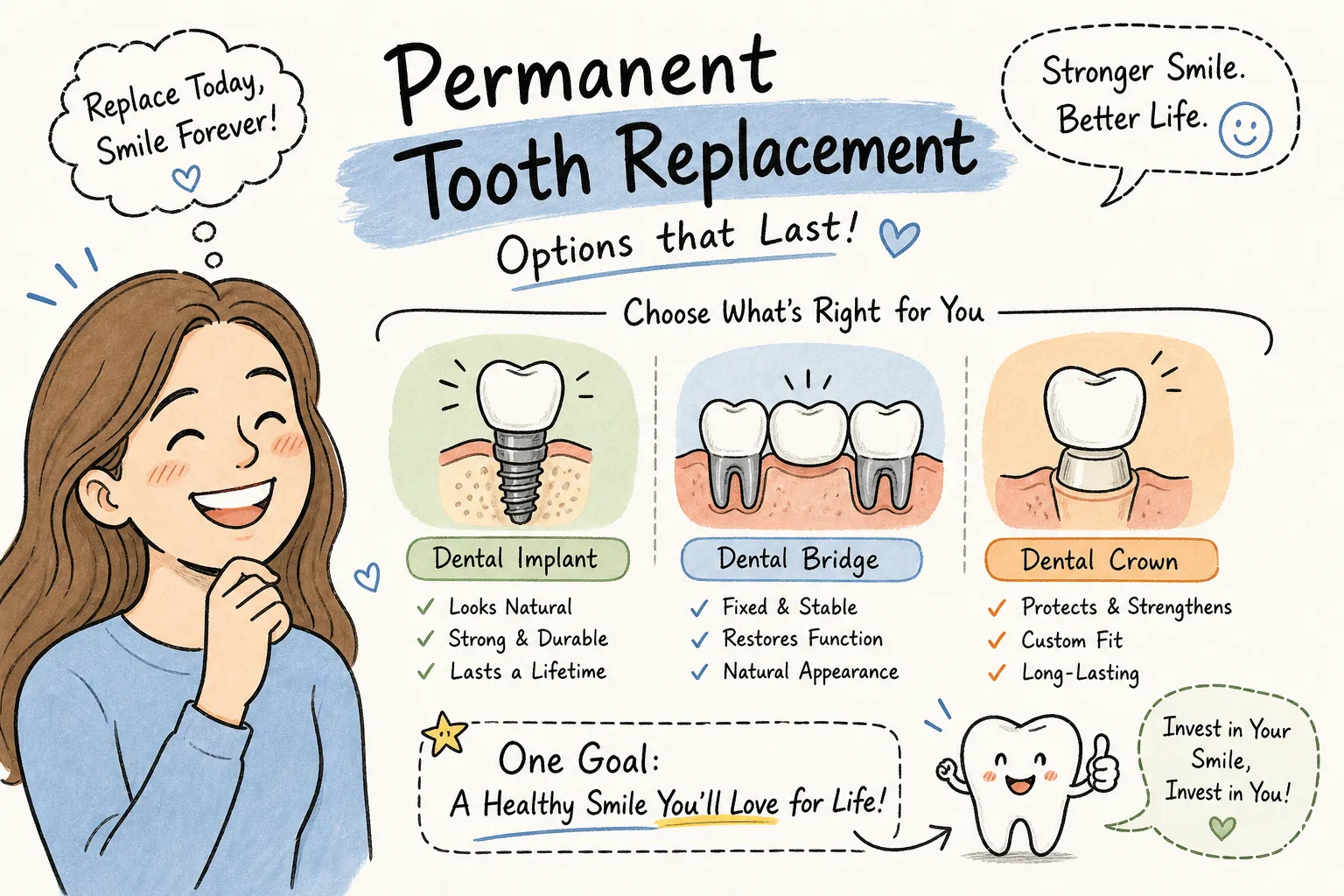
In dentistry, permanent means fixed in place. Unlike traditional removable dentures, which you take out at night and store in a glass, a fixed tooth replacement is either surgically secured into the jawbone or cemented onto prepared teeth. It stays in your mouth the way a natural tooth does. That distinction shapes everything: how the restoration feels, how it functions, and how it affects your long-term oral health.
The three main permanent options each work differently. A single dental implant involves a titanium post surgically placed into the jawbone, which acts as an artificial root; a custom crown sits on top. An implant-supported bridge uses two or more implants to anchor a bridge that spans a gap of several adjacent missing teeth. A fixed implant-supported full-arch restoration, sometimes called All-on-4 or All-on-X, uses multiple implants to permanently anchor a full-arch prosthesis replacing most or all of the teeth in one jaw.
Choosing the right permanent tooth replacement is essential for both function and aesthetics.
One source of confusion worth clearing up early: the word “dentures” makes people assume removable. Fixed implant-supported full-arch restorations are not removable by the patient. They are screwed or cemented onto implants and function like natural teeth. Traditional removable dentures are a separate category entirely: the non-permanent baseline against which all fixed options are compared.
How the three options compare where it matters most
Bone health: the factor most people overlook
Each type of permanent tooth replacement offers unique benefits that can enhance your quality of life.
When a tooth is lost, the jawbone beneath it begins to shrink. Without a root structure to stimulate it, the bone has no signal to maintain its volume. Over years, this bone loss changes the shape of your face and jaw in ways that no crown or bridge can reverse. Only implant-based solutions (single implants and implant-supported restorations) actually preserve bone by transferring chewing forces into the jaw the way a natural root does.
A traditional tooth-supported bridge fills the visual gap but does nothing to stop bone resorption beneath the pontic (the false tooth in the middle). That’s not a reason to avoid bridges entirely, but it is a clinically significant difference that affects long-term outcomes. Preserving facial structure and jaw volume matters for most patients, and this distinction carries real weight when choosing between permanent tooth replacement options.
Discussing the advantages of permanent tooth replacement with your dentist can clarify your options.
Bite force, stability, and everyday function
A single dental implant restores close to 100 percent of natural bite force in well-suited candidates, which means you eat, speak, and function without thinking about your tooth. Fixed implant-supported full-arch restorations restore roughly 50 to 65 percent of natural bite force, still far superior to removable options, and enough to eat most foods comfortably. Traditional bridges distribute force across neighbouring teeth, which works functionally but places long-term stress on the adjacent teeth that are supporting the structure.
Permanent tooth replacement options provide stability that traditional solutions cannot match.
Aesthetics and how each option looks
All three permanent options can deliver a natural-looking result using zirconia or porcelain. Single implants are the gold standard for matching a natural tooth’s translucency and texture, because they emerge from the gum just like a real tooth root. Bridges and full-arch fixed restorations can also achieve excellent aesthetics; the result depends on the number of teeth being replaced, the materials used, and the skill of the ceramicist. Appearance matters, but it’s one factor among several, not the deciding one.
Investing in permanent tooth replacement can significantly improve your oral health and self-esteem.
Permanent tooth replacement costs in Australia
Realistic price ranges for 2026
Cost is one of the first questions patients ask, and it deserves a straight answer. A single dental implant (including the implant post, abutment, and crown) typically costs $3,000 to $7,000 nationally, with the average sitting around $5,500. Melbourne CBD and inner-city Sydney practices tend to sit toward the upper end; regional Victoria clinics generally quote toward the lower end, with a realistic range of $4,800 to $6,800 for the Sunbury area.
Evaluating the costs associated with permanent tooth replacement is crucial during the decision-making process.
A traditional tooth-supported bridge runs $1,500 to $4,500, with no surgical component required. An implant-supported bridge replacing two to three teeth using two implants costs $6,000 to $15,000. A fixed full-arch implant restoration ranges from $20,000 to $40,000 per arch. These figures reflect 2026 Australian market data from published dental fee surveys and professional body guidelines; exact quotes will vary by clinic, implant system, and individual treatment needs.
It’s important to weigh the long-term benefits of permanent tooth replacement against the immediate costs.
What pushes the cost up
Additional procedures add meaningfully to the total. Bone grafting, sinus lifts, or guided bone regeneration can add $4,500 to $8,000 per site to an implant case. Premium implant systems and all-ceramic materials also increase costs compared to standard options. Private health insurance may cover 30 to 50 percent of eligible costs, but annual limits often cap the benefit well below what a single implant costs. Some practices, including Sunbury Dental Group, offer flexible payment plans that allow patients to spread the investment across manageable instalments rather than paying the full amount upfront, it’s worth confirming what’s available at your initial consultation.
Explore financing options available for permanent tooth replacement to ease the financial burden.
Are you a good candidate for a permanent restoration?
What makes someone suitable for dental implants
Implants require adequate jawbone density (at least 10 mm height and 5 mm width), healthy gums with no active periodontal disease, and completed jaw growth, typically from age 18 for women and 21 for men. There is no upper age limit provided your general health is stable. Well-controlled diabetes (HbA1c under 8 percent) does not rule someone out, but uncontrolled diabetes significantly impairs healing and is a contraindication. Smoking is one of the strongest risk factors for implant failure; stopping at least four weeks before surgery and eight weeks after surgery improves outcomes considerably.
Your dentist can guide you in determining your suitability for permanent tooth replacement based on your unique needs.
When a bridge or fixed denture may be the better fit
Patients who have insufficient bone for implants but prefer not to undergo grafting may be better suited to a tooth-supported bridge in the short term. Those missing multiple adjacent teeth or a full arch are often stronger candidates for an implant-supported full-arch restoration rather than individual implants. Bisphosphonate medications used for osteoporosis require specialist consultation before any implant surgery, as these medications affect bone healing. A restorative consultation is the only reliable way to know which path applies to your specific bone volume, jaw anatomy, and health profile, no article can substitute for that clinical assessment.
For some, permanent tooth replacement may provide a more effective solution than traditional methods.
Timeline for permanent tooth replacement: what the process actually looks like
The dental implant journey from consult to crown
For a standard implant case without grafting, the full process takes three to nine months. Consultation, imaging, and treatment planning take one to two weeks. The surgical procedure itself takes 30 to 60 minutes; most patients return to work within one to two days and resume a normal diet within about six weeks. The longest phase is osseointegration: the bone fusing around the titanium post. This typically takes three to four months in the lower jaw and four to six months in the upper jaw, where the bone is softer. Abutment placement and crown fabrication then add approximately three to five weeks at the end of the process.
Each step in the process of permanent tooth replacement is vital for achieving optimal results.
How bridges and fixed full-arch restorations compare on timing
A traditional tooth-supported bridge is significantly faster, involving two to three appointments over two to four weeks with no surgical healing period. Implant-supported bridges follow the same timeline as single implants, since they still require surgery and osseointegration. Fixed full-arch solutions can take six to fifteen months total when bone grafting is needed. For patients who need a tooth replaced quickly while a longer implant plan is developed, a bridge can serve as a well-functioning interim solution; this is a practical conversation worth having during your initial consultation.
With fixed solutions like permanent tooth replacement, patients often enjoy quicker recovery times.
Questions to bring to your restorative consultation
The questions that reveal whether a treatment plan is right for you
Before committing to any permanent dental restoration, go to your appointment armed with specific questions. A good treatment plan should be able to answer all of them clearly.
Asking the right questions about permanent tooth replacement will lead to informed choices.
- Do I have sufficient bone for implants, or will I need grafting, and what does that add to the cost and timeline?
- What are the realistic long-term outcomes for my specific case?
- What is included in the quoted price, and what potential add-ons might increase it?
- How many appointments will I need, and what does recovery look like for me personally?
- What happens to the neighbouring teeth under each option?
- How long has this practice been placing implants, and what implant system do you use?
Finding the right clinic for this kind of decision
Permanent tooth replacement is not a decision to rush, and it is worth choosing a practice that takes time to explain your options without steering you toward the most expensive path. At Sunbury Dental Group, the team offers restorative consultations specifically for patients weighing their options. With digital X-ray and advanced imaging technology on-site, transparent treatment planning, and no need to travel into Melbourne, it is a practical and genuinely welcoming starting point for anyone in Sunbury and surrounding suburbs, including Diggers Rest, Riddells Creek, and Gisborne, who wants a clear picture of the best path forward.
Knowledge about permanent tooth replacement is a powerful tool in making the right decisions for your oral health.
Making the right choice for your situation
To summarise the three options clearly: single dental implants are best for one or a few missing teeth where long-term bone preservation is the priority. Implant-supported bridges suit multi-tooth gaps where fewer implants are preferable. Fixed implant-supported full-arch restorations are the most comprehensive solution for those replacing most or all teeth in a jaw. Each option requires a different investment of time and money, and candidacy varies meaningfully from person to person.
Long-term clinical data place implant success rates at 95 to 97 percent at ten years when placed in appropriate candidates, among the strongest outcomes in restorative dentistry, though reported figures do vary by study design, patient selection, and implant system. That doesn’t make implants the right choice for every patient in every situation, but it does make them worth taking seriously as a long-term investment in your oral health and quality of life.
Long-term benefits of permanent tooth replacement often outweigh initial concerns about costs and procedures.
Online research gets you this far. A consultation gets you the rest. If you want personalised advice on permanent tooth replacement for your situation, book a restorative consultation at Sunbury Dental Group and take the first concrete step toward a solution that will actually last.
By understanding your options, you can take the next step towards permanent tooth replacement and regain your confidence.
FAQ :-
What are the main permanent tooth replacement options?
The three main permanent options are single dental implants, implant-supported bridges, and fixed implant-supported full-arch restorations (All-on-4/All-on-X). Each uses titanium implants surgically anchored in the jawbone, unlike removable dentures which come out at night.
How much does a single dental implant cost in Australia?
A single dental implant, including the post, abutment, and crown, typically costs $3,000 to $7,000 nationally, averaging around $5,500. In the Sunbury area, a realistic range is $4,800 to $6,800, generally lower than Melbourne CBD pricing.
What is the cost difference between a bridge and an implant-supported bridge?
A traditional tooth-supported bridge costs $1,500 to $4,500 with no surgery required, while an implant-supported bridge replacing two to three teeth using two implants costs $6,000 to $15,000. The higher cost reflects the surgical implants and their bone-preserving benefit.
How much does a full-arch fixed implant restoration cost?
A fixed full-arch implant restoration (All-on-4/All-on-X) ranges from $20,000 to $40,000 per arch. Additional bone grafting or sinus lifts can add $4,500 to $8,000 per site to this total.
Do dental implants stop bone loss after a missing tooth?
Yes. Only implant-based solutions transfer chewing forces into the jawbone like a natural tooth root, preserving bone volume. A traditional bridge fills the visual gap but does not stop bone resorption beneath the false tooth.
How much bite force do implants versus full-arch restorations restore?
A single dental implant restores close to 100 percent of natural bite force in well-suited candidates. Fixed full-arch restorations restore roughly 50 to 65 percent of natural bite force, still far superior to removable dentures.
How long does the dental implant process take from start to finish?
A standard implant case without grafting takes three to nine months. Consultation and planning take one to two weeks, surgery takes 30 to 60 minutes, and osseointegration (bone fusing to the implant) takes three to four months in the lower jaw and four to six months in the upper jaw.
Are bridges faster than dental implants?
Yes. A traditional tooth-supported bridge takes just two to three appointments over two to four weeks with no surgical healing period, compared to three to nine months for a single implant.
Who is a good candidate for dental implants?
Good candidates need at least 10mm bone height and 5mm width, healthy gums with no active periodontal disease, and completed jaw growth (from age 18 for women, 21 for men). Uncontrolled diabetes and active smoking significantly reduce implant success and are key risk factors to address first.
What is the long-term success rate of dental implants?
Long-term clinical data place implant success rates at 95 to 97 percent at ten years when placed in appropriate candidates, among the strongest outcomes in restorative dentistry. Success rates vary by study design, patient selection, and implant system used.