If you’re wondering how to get Whiter Teeth Without Damaging Your Enamell, you’re asking exactly the right question. A brighter smile is one of the most common requests at our clinic, and almost every conversation starts the same way: “I want whiter teeth, but I don’t want to damage them.” That concern is completely reasonable. The whitening market is crowded with strips, pastes, charcoal powders, and social media hacks, and many products lack consumer-facing clinical evidence or clear instructions about what they’re actually doing to your enamel while they work.
One of the best ways to achieve Whiter Teeth Without Damaging Your Enamel is to understand the different methods available. Ensuring you select products that are specifically designed to achieve Whiter Teeth Without Damaging Your Enamel is crucial for long-term dental health.
The good news is that safe, effective whitening is absolutely achievable. The distinction between treatments that work and treatments that quietly cause harm comes down to a few well-researched factors: the concentration of the active ingredient, how long it stays on your teeth, whether the delivery method suits your mouth, and what you do in the days after treatment. This article walks you through exactly what the clinical evidence shows, which home remedies hold up and which ones don’t, and how to build a whitening routine that protects your enamel for the long term.
Incorporating tips on achieving Whiter Teeth Without Damaging Your Enamel can help readers make informed decisions about their whitening options.
What Whitening Actually Does to Your Enamel
Whitening products work through chemistry, not magic. Hydrogen peroxide and carbamide peroxide penetrate the enamel surface and oxidise chromogen molecules, the pigmented compounds sitting inside the tooth structure. This is not a surface-level process. The bleaching agent moves through the enamel and into the dentin layer beneath, which is why whitening works at all, and why using the wrong product or concentration creates real problems.
For anyone seeking Whiter Teeth Without Damaging Your Enamel, it’s essential to consult with a dental professional who can recommend safe whitening methods.
The degree of impact on enamel depends on three variables: concentration, duration, and frequency of exposure. Low concentrations applied correctly and infrequently cause minimal structural disruption. High concentrations used too often, or for too long, begin to stress the enamel in ways that compound over time. Understanding this relationship is the foundation of any sensible whitening decision.
There are two types of signals worth knowing. Transient sensitivity during or shortly after whitening is common and typically reflects temporary changes in the enamel surface, often resolving within a few days. Persistent sensitivity lasting more than a week after treatment ends, and visible translucency at the edges of your front teeth, are different matters entirely. These are early signs of structural enamel thinning, and enamel does not regenerate the way other body tissues do. Once it’s gone, it’s gone. That distinction matters before you pick up any whitening product.
Recognizing how to achieve Whiter Teeth Without Damaging Your Enamel is critical for those considering various whitening products.
How to Get Whiter Teeth Without Damaging Your Enamel: Safe Peroxide Concentrations
In Australia, over-the-counter whitening products are legally capped at 6% hydrogen peroxide, or 18% carbamide peroxide, under the Therapeutic Goods Administration’s Poisons Standard. This limit has been in place since May 2013, as set out in the SUSMP (Standard for the Uniform Scheduling of Medicines and Poisons). Anything above 6% hydrogen peroxide is classified as a Schedule 6 substance and restricted to registered dental practitioners. This isn’t a conservative overreach; it reflects genuine clinical uncertainty about long-term enamel safety when higher concentrations are used without professional oversight.
Choosing a safe concentration is key to obtaining Whiter Teeth Without Damaging Your Enamel, especially for at-home treatments.
For context, the United States caps unsupervised over-the-counter use at 3.5% hydrogen peroxide, and the European Union is far more restrictive at 0.1% for consumer products without supervision. Australia sits in the middle, but the principle across all three frameworks is the same: concentration and supervision are inseparable when it comes to enamel-safe whitening.
Professional in-chair whitening uses 30 to 40% hydrogen peroxide, which sounds alarming until you understand the clinical environment surrounding it. Soft tissue is isolated before the gel is applied, the gel is applied in precisely timed intervals, and fluoride is applied immediately after to begin remineralisation. The concentration alone doesn’t determine risk; the controlled environment and trained clinician do. This is why in-chair whitening, despite using far higher concentrations than any over-the-counter kit, carries a strong safety record when performed by a registered dentist.
Professional treatments are typically the safest way to achieve Whiter Teeth Without Damaging Your Enamel due to the controlled environment.
Carbamide peroxide releases its active agent more slowly than hydrogen peroxide, making it better suited to at-home trays. A useful reference point: 10% carbamide peroxide releases approximately 3.6% hydrogen peroxide. This slower release is more forgiving in unsupervised settings, but it still requires the right concentration and correct exposure time to avoid unnecessary enamel stress.

Home Whitening Methods Ranked by Evidence and Enamel Safety
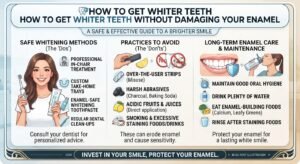
To maintain Whiter Teeth Without Damaging Your Enamel, consider using alternatives like baking soda sparingly.
Baking soda is the only home remedy with solid peer-reviewed support for whitening. Multiple clinical studies confirm that sodium bicarbonate dentifrices effectively remove extrinsic stains, and the ADA considers it safe for enamel due to its low abrasive potential. Used once or twice a week, it’s a reasonable maintenance option for surface stain removal. There is one important exception: mixing baking soda with lemon juice or apple cider vinegar creates an acidic reaction that accelerates enamel erosion significantly. These combinations should be avoided entirely.
Oil pulling has no peer-reviewed evidence confirming any whitening effect. It may offer some benefit for gum health, but it does not change tooth colour. Fruit-based remedies are more concerning. Lemon juice is highly acidic, and its apparent “whitening” effect is actually the early stage of enamel erosion, not stain removal. Strawberry pastes show very mild results in laboratory settings that don’t translate meaningfully to clinical outcomes. These are not safe whitening options, regardless of how often they appear on social media.
Whitening toothpastes deserve their own discussion. Many carry high RDA (Relative Dentin Abrasivity) values, which increase surface roughness and worsen erosive wear over time. For anyone with sensitive or already-thinning enamel, look for a toothpaste with an RDA of 70 or below and check the product label carefully. Some formulations combine pyrophosphate and hydrated silica, two ingredients associated with higher abrasivity, and several popular whitening toothpastes contain both. If in doubt, ask your dentist before committing to a product.
Monitoring the safety of your products is essential for ensuring you achieve Whiter Teeth Without Damaging Your Enamel.
At-Home Whitening Without Damaging Enamel: Tray Fit and Product Choice
Tray fit is one of the most underestimated factors in whitening outcomes. Poorly fitting trays cause gel to leak onto the gums and create uneven peroxide exposure across the tooth surface, leading to patchy results, gum irritation, and unnecessary sensitivity. Clinical observations consistently show that custom-fitted tray users experience a lower incidence of localised sensitivity compared to strip users, attributed to uniform gel distribution and precise soft tissue protection. Custom trays, made from an exact dental mould, distribute whitening gel evenly and keep it well clear of gum tissue. The fit isn’t a cosmetic detail; it directly affects both the result and the enamel safety of the treatment.
Maintaining a good tray fit is vital to ensuring you can achieve Whiter Teeth Without Damaging Your Enamel effectively.
For anyone pursuing whitening without damaging enamel at home, the concentration of your chosen product matters as much as the delivery method. Low-concentration carbamide peroxide gels used in well-fitted custom trays represent the safest at-home approach, provided you follow the recommended exposure times and allow adequate recovery periods between applications.
Why Professionally Supervised Whitening Is a Fundamentally Different Experience
Understanding the process behind achieving Whiter Teeth Without Damaging Your Enamel can enhance patient comfort and results.
At Sunbury Dental Group, whitening never begins without a clinical assessment first. Dr Nita Kumari evaluates enamel thickness, existing restorations, gum condition, and baseline sensitivity before recommending any whitening pathway. This step is what separates a treatment plan from a gamble. Over-the-counter kits assume you’re a perfect candidate. A dentist confirms whether you actually are, and if you’re not, adjusts the approach accordingly.
A supervised in-chair session takes this further. Soft tissue is isolated before any gel is applied, the high-concentration agent is timed precisely by the treating clinician, and fluoride treatment begins immediately after to support remineralisation. Every variable is managed by a trained professional. For patients wanting the fastest, most predictable results without compromising enamel integrity, dental association guidance and comparative clinical data consistently support supervised in-chair bleaching as producing greater predictability and speed than over-the-counter alternatives.
For optimal results, following a professional’s guidance on achieving Whiter Teeth Without Damaging Your Enamel is crucial.
Sunbury Dental Group also offers custom take-home tray whitening for patients who prefer to manage the process at home with professional oversight built in. The trays are fabricated from an exact mould of your teeth, the gel concentration is selected for your specific enamel condition, and you have direct access to Dr Nita Kumari’s team throughout the process.
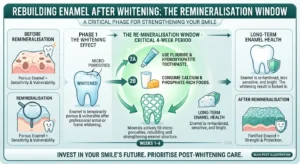
Rebuilding Enamel After Whitening: the Remineralisation Window
Using fluoride products is part of the aftercare that helps you keep Whiter Teeth Without Damaging Your Enamel long-term.
Fluoride remains the most clinically validated option for remineralising enamel after whitening. Standard fluoride toothpaste at 1,000 to 1,450 ppm has consistent trial support for rebuilding the early enamel lesions that peroxide can create during treatment. Using a fluoride toothpaste for at least two to four weeks after any whitening treatment helps restore mineral density to the treated surface, this is standard aftercare in professionally supervised settings, not optional.
Nano-hydroxyapatite (nHA) toothpaste is gaining clinical attention as a remineralising agent, and the evidence is genuinely promising. In-vitro and in-situ studies show it performs comparably to fluoride for rebuilding enamel lesions, and a 2024 clinical study published in the Journal of Dentistry found it effective against erosive enamel damage. There are currently no whitening-specific clinical trials testing nHA post-bleaching, so it’s best treated as a complementary option rather than a direct replacement for fluoride. It’s a sound choice for patients avoiding fluoride, and combining nHA with fluoride may enhance remineralisation further. Discuss it with your dentist before substituting it entirely.
Discussing options for maintaining Whiter Teeth Without Damaging Your Enamel with your dentist can provide valuable insights.
The first 48 hours after whitening are the most critical period for enamel recovery. During this window, the enamel pores are more open and the surface is temporarily more vulnerable. Avoid acidic foods and drinks, including citrus, vinegar-based dressings, and carbonated drinks. Avoid highly pigmented foods such as coffee, red wine, and tomato-based sauces. Keep temperatures moderate to avoid spiking sensitivity. Use a low-RDA remineralising toothpaste and do not re-whiten during this period regardless of which product or method you used.
A Safe Long-Term Whitening Routine That Preserves Your Results
To sustain your results and ensure Whiter Teeth Without Damaging Your Enamel is achieved, regular check-ups are recommended.
The Australian Dental Association does not support the frequent maintenance schedules that many over-the-counter whitening brands promote, such as weekly or fortnightly top-ups. There is no clinical data supporting the long-term safety of ongoing high-frequency whitening use. For most patients, a professionally supervised whitening session once or twice a year is sufficient, consistent with the generally recommended interval of six to twelve months between professional treatments. Low-concentration maintenance products can be used selectively in between, but not routinely.
For at-home kits using lower concentrations, a minimum of three to six months between full courses is the accepted standard. Using products containing fluoride or calcium phosphate between sessions actively supports enamel recovery and strengthens the surface against further exposure.
Utilizing recovery aids can significantly help in achieving Whiter Teeth Without Damaging Your Enamel post-treatment.
Four signals tell you to stop any whitening product and book a dental appointment: persistent sensitivity lasting more than a week after treatment ends; visible translucency at the edges of your front teeth; white spots or uneven patches appearing on the enamel surface; and gum irritation or recession. These are not minor side effects to push through. They are early clinical signs of enamel compromise that require professional assessment before any further whitening is attempted.
Getting It Right from the Start
It’s vital to learn how to obtain Whiter Teeth Without Damaging Your Enamel for effective long-term care.
Knowing how to get Whiter Teeth Without Damaging Your Enamel isn’t just about choosing the right product, it’s about understanding the full picture before you start.
For anyone in Sunbury or the surrounding suburbs considering a brighter smile, Sunbury Dental Group offers professional whitening consultations focused on Whiter Teeth Without Damaging Your Enamel, with enamel protection built into every step of the process.
Book your whitening consultation at Sunbury Dental Group by calling the clinic or using the online booking form. Getting this right from the start means your enamel stays intact for everything that comes after.
Frequently Asked Questions
Is peroxide safe for tooth enamel?
Peroxide is safe for enamel when used at appropriate concentrations, for the correct duration, and with adequate recovery time between treatments. The risk comes from overuse, excessively high concentrations used without supervision, or poorly fitting delivery trays that concentrate the gel in unintended areas. Under professional supervision, peroxide-based whitening has a well-established safety record.
How often can I whiten my teeth without damaging enamel?
For professionally supervised in-chair whitening, the generally recommended interval is six to twelve months between sessions. For at-home kits using lower concentrations, a minimum of three to six months between full courses is the accepted standard. Frequent or continuous whitening beyond these intervals is not supported by clinical data and increases enamel risk.
What is the safest way to whiten teeth at home?
The safest at-home approach is a low-concentration carbamide peroxide gel used in a custom-fitted tray provided by your dentist, combined with a fluoride or nano-hydroxyapatite toothpaste for remineralisation support. Avoid acidic home remedies such as lemon juice or apple cider vinegar, and choose whitening toothpastes with an RDA value of 70 or below.
What concentration of hydrogen peroxide is safe for whitening?
In Australia, over-the-counter products are capped at 6% hydrogen peroxide under the TGA’s Poisons Standard. For professional in-chair treatment, concentrations of 30 to 40% are used safely because the clinical environment, including soft tissue isolation, timed application, and post-treatment fluoride, controls the exposure. It is the management of the process, not the concentration alone, that determines safety.
Can whitening toothpaste damage enamel?
Some whitening toothpastes carry high RDA (Relative Dentin Abrasivity) values that can increase surface roughness and worsen erosive wear over time, particularly for those with already-thinning enamel. Look for products with an RDA of 70 or below, and check labels for combinations of pyrophosphate and hydrated silica, which are associated with higher abrasivity.
How long does sensitivity last after teeth whitening?
Transient sensitivity during or shortly after whitening is common and typically resolves within a few days. Sensitivity lasting more than a week after treatment ends warrants a dental review, as it may indicate enamel stress or an underlying condition that needs assessment before further whitening is attempted.
What should I do after whitening to protect my enamel?
The first 48 hours after whitening are the most important for enamel recovery. Avoid acidic and pigmented foods and drinks, keep temperatures moderate, and use a remineralising toothpaste, either fluoride at 1,000 to 1,450 ppm or nano-hydroxyapatite, for at least two to four weeks. Do not re-whiten during this window.
Is professional whitening worth it compared to over-the-counter kits?
Professional whitening offers a pre-treatment clinical assessment, custom-fitted trays or properly managed in-chair application, and post-treatment remineralisation care, none of which are included in over-the-counter kits. Comparative clinical data supports supervised whitening as producing more predictable results. For patients with existing sensitivity, thin enamel, or dental restorations, professional assessment is particularly important before any whitening product is used.
Understanding how to achieve Whiter Teeth Without Damaging Your Enamel is essential for making informed choices about dental care.
Note:- This article is general information only and does not replace personalised advice from a registered dental practitioner. Individual results and experiences vary between patients. Sunbury Dental Group complies with AHPRA advertising guidelines and does not include patient testimonials or guaranteed outcomes in this content. For specific concerns about your child’s dental health, please book a consultation with our team.