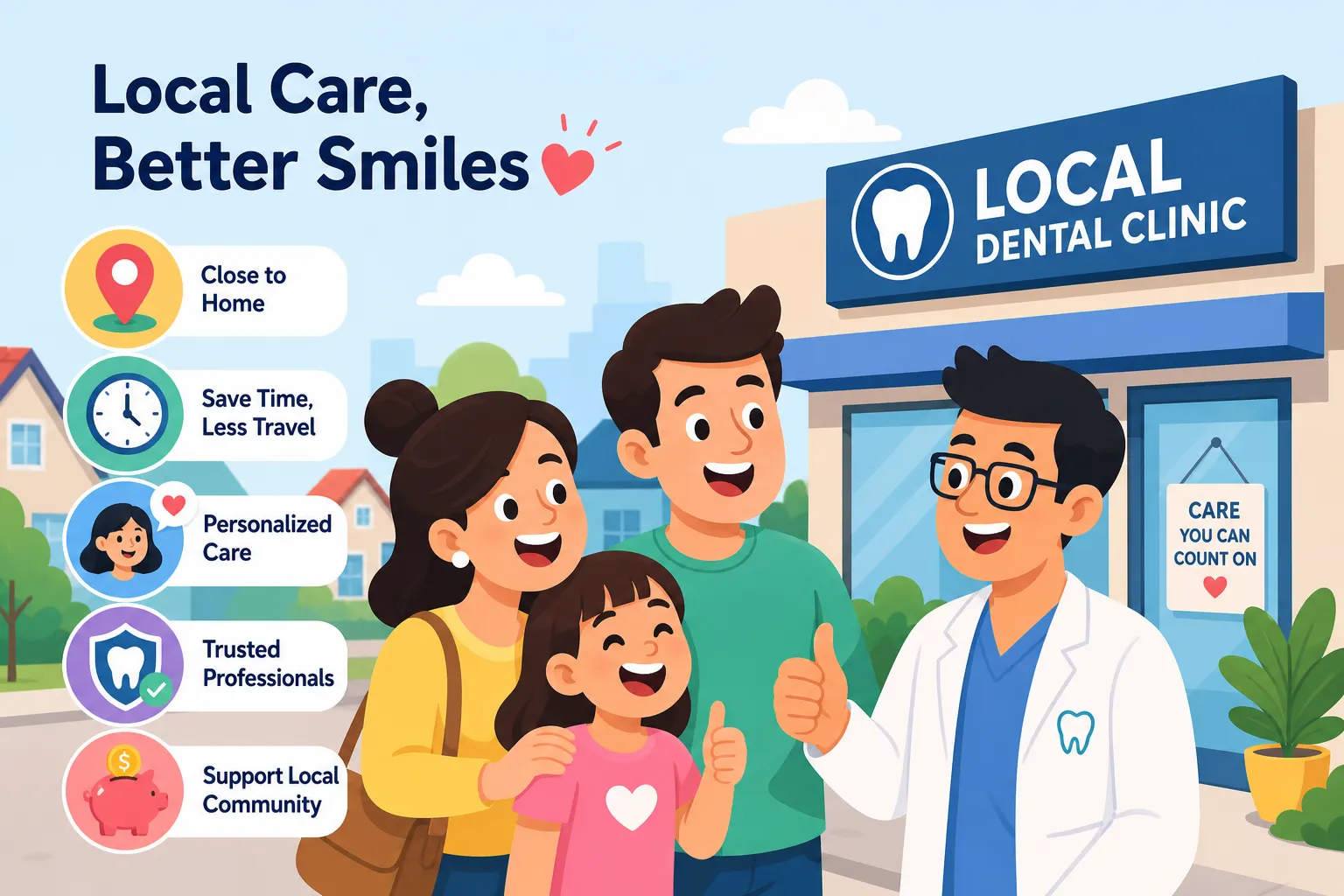
It happens more often than you’d think. Someone in Sunbury drives straight past a fully equipped local dental clinic, books an appointment at a corporate chain in the Melbourne CBD, and assumes the extra commute is worth it because bigger must mean better. It’s an understandable instinct, but it’s one that doesn’t hold up under scrutiny.
Choosing a local dental clinic provides advantages that corporate chains often lack.
A locally owned dental practice offers something a large corporate chain structurally cannot deliver: a long-term relationship with a dentist who knows your name, understands your dental history, and is genuinely invested in the community you both live in. At Sunbury Dental Group on Evans Street, that’s exactly the model, full-service care, an AHPRA-registered dentist in Dr Nita Kumari, and a practice that serves Sunbury and the surrounding suburbs of Diggers Rest, Riddells Creek, Gisborne, Bulla, and Lancefield. No city drive required.
At a local dental clinic, the focus is on individual patient relationships, ensuring the highest quality of care.
Here are five reasons why choosing a local dental clinic close to home is one of the smartest decisions you can make for your long-term oral health.
Supporting your local dental clinic means contributing to the community’s overall health and well-being.
1. Your dentist actually knows your full history
Continuity of care is one of those phrases that sounds clinical but means something very practical: when you see the same dentist at every recall appointment, they build a complete picture of your oral health over time. They notice subtle changes, track problem areas, and catch things early that a rotating locum or a new face at a corporate chain would simply miss. This matters most for patients managing ongoing issues like gum disease, bruxism (teeth grinding), or multi-stage restorative work.
A local dental clinic can adapt to the unique needs of your family and personal dental history.
At large corporate chains, staff turnover is high. Workforce data from the Australian dental sector indicates that roughly one in three associate dentists changes employers within a single year. That means patients frequently sit down in front of a dentist who has never met them before, has no familiarity with their clinical context, and is relying entirely on whatever notes exist in a system. That’s not a great foundation for personalised care.
Why treatment history is your dentist’s most valuable tool
Returning to the same local dental clinic fosters trust and open communication about your dental needs.
A dentist who has treated you for years can spot a meaningful change in your gum health or bone density from a single digital X-ray comparison. That kind of pattern recognition only happens when one clinician follows your care consistently over time. It reduces the risk of misdiagnosis, supports more conservative treatment decisions, and leads to genuinely better long-term outcomes.
Clinical evidence supports this pattern. Patients with continuity of dental care tend to show reduced rates of caries and periodontal disease, earlier detection of emerging problems, and significantly higher treatment satisfaction. Your history isn’t just paperwork, it’s your dentist’s most important diagnostic tool.
When choosing a local dental clinic, the continuity of care can lead to better overall health outcomes.
The real cost of starting over with a new dentist every visit
Starting from scratch at each visit means repeating your medical history, redoing baseline X-rays, and re-explaining previous treatments. More than an inconvenience, it creates gaps in clinical reasoning that can lead to unnecessary or duplicated procedures. The dentist treating you for the first time has no way to know whether a particular finding is stable and longstanding, or new and concerning. That distinction changes everything about the recommended course of action.
Every visit to a local dental clinic ensures you won’t have to repeat your history.
2. Local clinics are accountable to the community they serve
A locally owned dental practice can’t easily hide behind a brand name when something goes wrong. Their reputation lives in the suburb, on Google reviews, in conversations between neighbours, and at the school gate. That kind of accountability tends to drive a higher standard of care. Community trust is built slowly through consistent quality and genuine follow-through, and it is difficult for a large chain to replicate authentically.
Accountability at a local dental clinic fosters higher standards in patient care.
Platforms like Google Reviews and Healthengine mean that honest, suburb-specific feedback is available before a patient even picks up the phone. When you see a high volume of detailed, recent reviews from people in your own area naming specific treatments and specific staff members, that’s a meaningful trust signal. It tells you the practice is doing the basics consistently well.
Why word-of-mouth still drives patient decisions in local suburbs
Choosing a local dental clinic often means that you receive care from professionals who know the community.
A recommendation from a neighbour in Sunbury carries far more weight than a glossy advertisement from a national chain. The person vouching for the clinic has experienced the care first-hand, and in a tight-knit community, they have a social stake in that recommendation that a marketing campaign simply doesn’t carry. Independent clinics depend on these referrals. A dissatisfied patient in a small suburb can affect an entire referral network, which means that dependency tends to keep standards high in a way that a centralised corporate structure rarely replicates.
What trust signals actually mean when choosing a local dental clinic near you
You can verify trust signals for a local dental clinic through your neighbors’ experiences and reviews.
When assessing a local dental clinic, look for AHPRA registration of the treating dentist, named clinicians on the website (not just a brand logo), a genuine response rate to online reviews, and transparent pricing. A community-focused practice makes these details easy to find. By contrast, some practices, including some larger chains, don’t prominently display individual clinician credentials, which can make it harder to assess where accountability actually sits.
3. Why a local dental clinic makes routine care and emergencies easier
Many families prefer a local dental clinic due to the convenience it offers in emergencies.
Convenience is chronically underrated when people are choosing a dental practice. A clinic that’s ten minutes from home changes how consistently you show up for preventive care. Families with young children, busy working adults, and patients without reliable transport benefit most from a genuinely local dental clinic, because the friction of getting there is simply lower. Fewer barriers means more regular visits, and more regular visits means fewer complex, and expensive, interventions later.
Then there’s the emergency scenario. When you crack a tooth on a Saturday morning or develop acute pain overnight, the last thing you want is a 45-minute drive to the nearest available dentist in the city. A local practice that knows you, already holds your records, and can see you same-day makes a stressful situation significantly more manageable.
Your local dental clinic will prioritize your needs during urgent situations.
How distance affects how often people actually go to the dentist
Australian Institute of Health and Welfare data consistently shows that patients who live further from their dental practice defer appointments more often. This distance decay effect compounds over time. A missed six-month check-up becomes a missed year, then two; the next appointment then involves treating problems that preventive care would have caught early. It’s worth noting that motivation and transport availability also play a role, but all else being equal, proximity is a genuine enabler of consistent care. Choosing a practice close to home removes that friction from the start.
Regular visits to a local dental clinic are more manageable and likely when located nearby.
Emergency dental access in your own neighbourhood
Local independent practices often offer same-day emergency slots for existing patients. Because the dentist already has your records, triage is faster and more targeted. Common emergency presentations, broken or chipped teeth, acute toothache, lost fillings, soft tissue injuries, are handled with full clinical context rather than a cold start. That matters when you’re in pain and need clear answers quickly.
Emergency care at a local dental clinic ensures that the staff is familiar with your history.
4. Local doesn’t mean basic, full-service care right in your neighbourhood
This is where the corporate-chain assumption gets dismantled most directly. Many people believe they need to travel to Melbourne for anything beyond a check-up and clean. In reality, many local clinics now offer services that previously required a trip to the city, and Sunbury Dental Group is a clear example of exactly that.
Patients often find they can access extensive services at their local dental clinic without travel.
From Evans Street in Sunbury, patients can access Invisalign clear aligner orthodontics, porcelain veneers, dental implants, crowns and bridges, professional teeth whitening, gum disease management, fissure sealants, custom mouthguards, digital X-rays, and emergency dentistry, all under one roof, without leaving the community.
The full range of treatments available at a quality local dental clinic
Every local dental clinic should provide a comprehensive range of treatments tailored to local needs.
General and preventive care forms the foundation: check-ups, scale and cleans, diagnostic imaging, fluoride treatments, and fissure sealants for children. Restorative treatments cover fillings, root canal therapy, crowns, bridges, and dental implants for patients dealing with damage or tooth loss. Cosmetic services include teeth whitening, porcelain veneers, and full smile consultations for patients wanting to improve their appearance with a clear, personalised plan. Patients get accurate diagnosis on-site with modern digital X-ray technology, no off-site referrals and no extra waiting.
Why a locally owned clinic can be more responsive to your specific needs
Personalized care is more likely at your local dental clinic where the focus is on individual needs.
Independent clinics often have clinical flexibility that larger corporate chains struggle to match. A local dentist can adjust a treatment plan mid-course, offer more detailed explanations without a strict per-appointment time limit, and tailor cosmetic outcomes to the individual rather than applying a standardised protocol. For patients researching veneers, implants, or Invisalign, that flexibility makes a real difference to the final result. You’re getting a plan built around your face, your goals, and your budget, not a templated approach designed for volume.

5. Transparent pricing and personalised treatment planning make a real difference
Transparent pricing at a local dental clinic helps you understand your treatment options fully.
One of the most common frustrations with large dental chains is unexpected costs and treatment plans that feel rushed or upselling-driven. Independent local clinics tend to operate with transparent pricing, clearly explaining each item number, what’s covered by private health insurance, and what the out-of-pocket cost will be before any work begins. In Australia, a check-up and scale and clean typically ranges from $150 to $350, a dental crown from $1,200 to $2,800, and an emergency visit from $200 to $600 or more depending on the treatment required. A transparent practice tells you this upfront.
A locally owned practice has a strong incentive to keep patients informed and comfortable with costs, because one bad experience travels fast in a tight-knit community. That accountability shapes the way treatment is presented and discussed, and it benefits the patient directly. Flexible payment options add another access point, particularly for families or patients facing higher-cost restorative or cosmetic work.
At a local dental clinic, you’ll often find flexible payment options that suit your budget.
What transparent treatment planning actually looks like at the chair
A patient-centred treatment consultation looks like this: the dentist walks through their clinical findings, explains the available options (not just the single recommended path), outlines the costs clearly against each option, and gives you the time to ask questions before committing to anything. You leave the appointment knowing exactly what’s happening in your mouth, why it matters, and what it will cost. That’s the standard at a well-run independent clinic, and it’s the experience you should expect when you stay local.
During consultations at a local dental clinic, you’ll feel prioritized and informed about your dental needs.
How flexible payment options make local dental care more accessible
Locally owned clinics often work with health fund partners and offer payment plan options to reduce the financial barrier to care. This is particularly relevant for restorative treatments and cosmetic procedures, where costs are higher and patients benefit from spreading payments over time. A volume-driven corporate chain focuses on throughput; a community practice focuses on keeping care accessible for the people it actually knows. That difference in motivation shows up in how financial conversations are handled.
A local dental clinic often collaborates with health funds to provide more accessible care.
Finding a local dental clinic, the smarter choice is closer than you think
Choosing a local dental clinic close to home isn’t a compromise. It’s a smarter, more sustainable approach to oral health. The relationship you build with a local dentist, the proximity for both routine and emergency care, the full-service clinical capabilities, and the transparent and community-accountable approach all compound over time into genuinely better outcomes. None of that requires a commute to the city.
Finding a reliable local dental clinic can lead to better long-term oral health outcomes.
If you’re in Sunbury or the surrounding suburbs, Diggers Rest, Riddells Creek, Gisborne, Bulla, or Lancefield, and you’re looking for a dental practice that delivers on all of this, Sunbury Dental Group is currently welcoming new patients. Dr Nita Kumari and the team at 5/92 Evans Street offer the full range of general, cosmetic, restorative, and emergency dental services with transparent pricing and a genuine commitment to patient-centred care.
Make the choice for your family’s dental needs by selecting a local dental clinic that cares.
Book online or call the clinic directly to discuss your needs and take the first step toward dental care that’s built around you, not around volume.
FAQ Section: 5 Reasons to Choose a Local Dental Clinic Near You
Q1: What’s the main advantage of choosing a local dental clinic over a corporate dental chain?
The main advantage is continuity of care — seeing the same dentist over time allows them to track your oral health history, notice subtle changes, and catch issues early. This is particularly valuable for patients managing ongoing concerns like gum disease or bruxism, where a consistent clinical picture supports better-informed treatment decisions.
Q2: Does a local dental clinic offer the same range of treatments as a city or corporate chain?
Yes, many local clinics now provide a full range of services once thought to require a trip to the city, including general and preventive care, cosmetic treatments such as teeth whitening and veneers, restorative work like crowns and dental implants, orthodontic options such as Invisalign, and emergency dentistry, all delivered in one location.
Q3: How does a local dental clinic handle dental emergencies?
A local practice that already holds your dental records can generally offer faster, more targeted triage for emergencies such as a broken tooth, lost filling, or acute toothache, since the treating dentist has your clinical history on hand rather than starting from scratch. Same-day emergency appointments for existing patients are often more readily available at a local clinic than at a distant provider.
Q4: How can I check whether a local dental clinic is trustworthy before booking?
Look for clear AHPRA registration details for the treating dentist, named clinicians listed on the website rather than just a brand logo, visible responses to patient reviews, and transparent pricing information published upfront. These are practical, verifiable trust signals you can check before your first visit.
Q5: Is treatment pricing at a local dental clinic transparent?
A well-run local clinic should walk you through each item number, explain what may be covered by private health insurance, and outline the likely out-of-pocket cost before any treatment begins. As a general guide, a check-up and scale and clean in Australia typically ranges from $150 to $350, though individual pricing varies by provider and clinical need.
Q6: Does living closer to my dentist actually affect how often I go for check-ups?
Research on dental attendance patterns suggests that patients who live further from their practice tend to defer appointments more often, and missed check-ups can compound over time into more complex issues. Choosing a practice closer to home may help reduce this kind of appointment-avoidance friction, though individual habits and circumstances also play a role.
Q7: Are payment plans available for larger dental treatments at a local clinic?
Many independently owned local clinics offer flexible payment options to help make restorative or cosmetic treatment more accessible, particularly for higher-cost procedures. It’s best to ask your clinic directly about what payment plan options may be available for your specific treatment.