Choosing the Right Whitening Treatment: A Simple Guide
If you’re wondering how to choose the right whitening treatment for your smile, you’re not alone. The answer isn’t as straightforward as the pharmacy aisle makes it look. Walk down the oral care section at your local chemist, and you’ll find shelves stacked with strips, pens, LED kits, whitening toothpastes, and trays. Every single one promises a brighter, whiter smile. Open Google, and the contradictions start. One article tells you in-chair treatment is the only real option. Another insists strips are just as good. A third warns you off peroxide entirely. It’s genuinely confusing. If you’ve already tried something that didn’t work, the frustration is real.
In this guide, we will break down the options available to you and help clarify the confusion.
When considering how to choose the right whitening treatment for your smile, it’s essential to weigh your options carefully.
At Sunbury Dental Group, we often discuss whitening treatments with patients from Sunbury, Diggers Rest, Riddells Creek, and surrounding suburbs. Many come in having spent money on OTC products that barely moved the needle. They want to know why. The answer is almost always the same: The product wasn’t matched to the type of staining or the condition of their teeth.
This guide walks you through everything you need to know: what’s causing your discolouration, which treatment options actually suit your situation, how to factor in sensitivity and existing dental work, and what you’ll realistically spend. By the end, you’ll have a clear sense of which direction to take, and why.
This guide walks you through everything you need to know, including what’s causing your discolouration. You’ll learn which treatment options suit your situation, how to factor in sensitivity and existing dental work, and what you’ll realistically spend.
This guide will also help you understand how to choose the right whitening treatment for your smile.
Why the type of stain matters before anything else
The single biggest predictor of whitening success is not the product you choose, it’s whether the type of staining you have is something whitening can actually address. Most people don’t realise there’s a meaningful clinical difference between surface stains and stains that originate inside the tooth itself.
Extrinsic staining: the kind whitening handles well
Extrinsic staining sits on the outer surface of the enamel. It accumulates in the thin protein film that coats your teeth. Coffee, tea, red wine, tobacco, and built-up plaque are the main culprits. Because these pigments are external, they respond well to both professional cleaning and peroxide-based bleaching agents. Whitening treatments are specifically designed to target this type of staining. When you see before-and-after images that look genuinely dramatic, extrinsic staining is typically what’s being corrected. Both professional teeth whitening and over-the-counter options can address it. However, the speed and depth of results vary significantly between them.
Intrinsic staining: when it goes deeper than the surface
Intrinsic staining originates within the tooth structure itself, inside the enamel or the dentin beneath it. The causes include fluorosis, tetracycline antibiotics taken early in life, trauma to a developing tooth, and the natural thinning of enamel that comes with age. These stains can’t be scrubbed or polished away because they’re not on the surface at all.
It’s crucial to understand these differences to make an informed decision.
Standard whitening can lighten intrinsic stains to a degree. However, results for moderate to severe cases are often underwhelming. Clinical research indicates that tetracycline-stained teeth respond to bleaching at roughly 75% efficacy compared to approximately 95% for teeth without that history. The characteristic banding pattern rarely disappears entirely. If previous whitening attempts haven’t produced results, intrinsic staining is the most likely explanation. For severe cases, options like dental bonding, porcelain veneers, or crowns are typically needed to achieve a genuinely uniform result.
How to choose the right whitening treatment for your smile: three paths explained
Understanding how to choose the right whitening treatment for your smile can make a difference in your confidence.
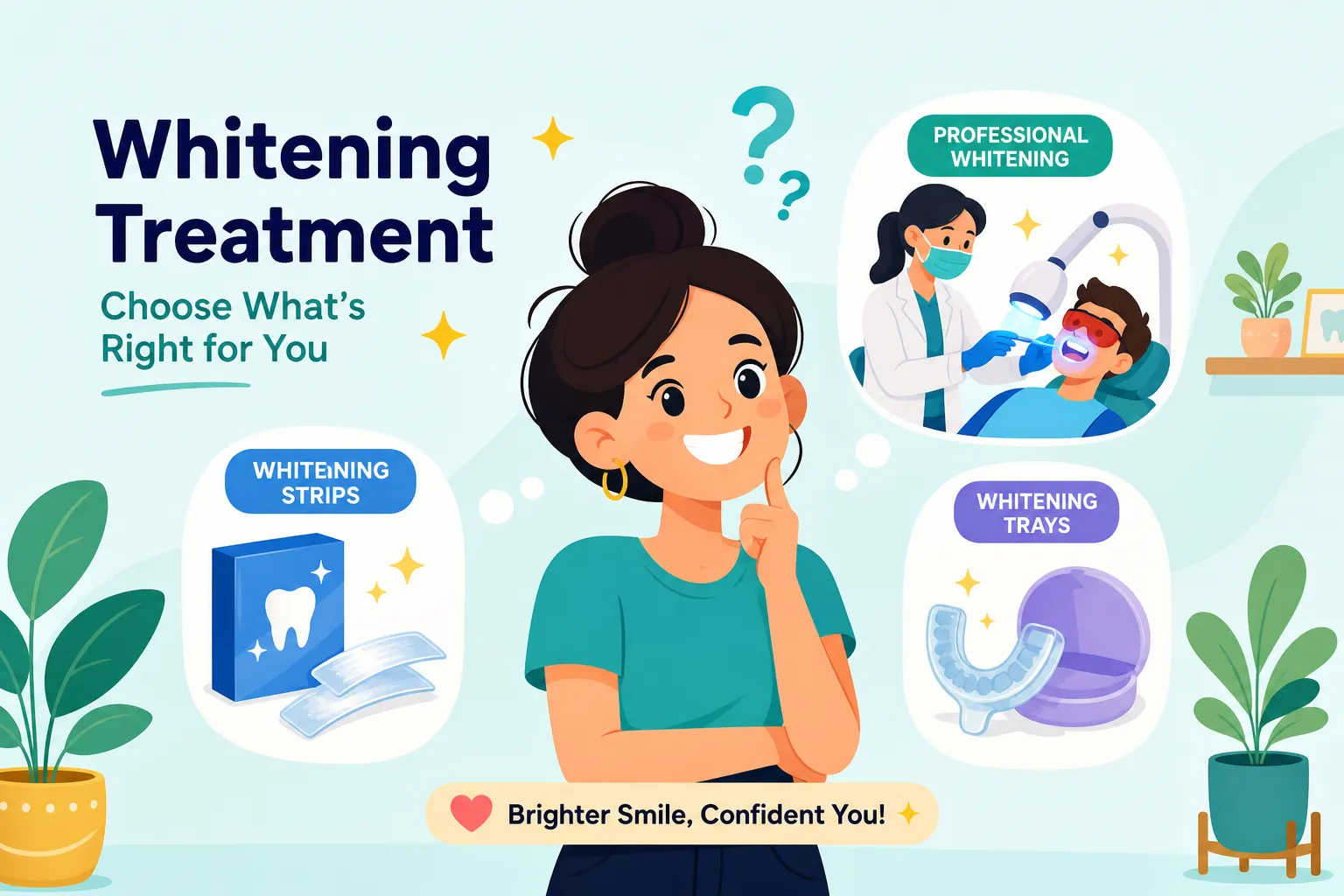
Once you have a sense of your stain type, the next step is understanding the three core whitening methods available to you, what each one actually does and who each one is realistically suited to.
In-chair professional whitening
In-chair whitening is performed entirely at your dental clinic. Your dentist applies a high-concentration peroxide gel directly to your teeth, with a protective barrier in place to shield your gums throughout the procedure. The gel works quickly, and results are visible within a single session. This makes it the right choice when timeline is the priority, preparing for a wedding, a job interview, or any event with a fixed date. It delivers the most dramatic shade shift of any whitening method and is the safest way to use high-strength bleaching agents, precisely because a trained clinician manages the entire process.
One important note: studies comparing light-activated and non-light protocols consistently show that LED or laser activation used during some in-chair sessions does not actually improve the whitening outcome or reduce sensitivity. This is worth knowing, given the marketing claims routinely attached to LED and laser add-ons.
Custom Take-Home Whitening Trays
Custom take-home trays begin with your dentist taking a precise impression of your teeth. That impression is used to fabricate a tray that fits your teeth exactly, a snug fit keeps the professional-strength gel in contact with your enamel and away from your gum tissue. You fill the tray with gel and wear it for two to four hours daily, or overnight, over several weeks. Results are comparable to in-chair whitening over time, and colour stability with custom trays tends to be excellent, with comparative studies showing a lower rate of discolouration returning than with in-chair treatment alone. This is the most appropriate path for patients who prefer a gradual, controlled process or who want clinical-grade results at a more accessible price point.
Knowing how to choose the right whitening treatment for your smile is crucial to achieving the desired results. This guide will help you understand effectively how to choose the right whitening treatment for your smile.
Over-the-counter strips, pens and paint-on gels
OTC products are available from pharmacies without a prescription and use lower concentrations of hydrogen peroxide. Under Australian regulations, OTC whitening products are capped at 6% hydrogen peroxide (or equivalent), compared to the significantly higher concentrations used in professional settings. Strips typically adhere to the front surface of teeth for 30 minutes twice daily and can shift colour by one to two shades over about 14 days. They’re convenient and the most affordable entry point, but coverage is less consistent than a custom-fitted tray, and results fade faster, often requiring monthly maintenance. If you’re searching for whitening strips in Australia, OTC products are best suited to patients with mild extrinsic staining who want light touch-up maintenance rather than a meaningful transformation.
For those who want to know how to choose the right whitening treatment for your smile, OTC options may be suitable.
Sensitivity, gum health, and existing restorations
Two concerns come up in almost every whitening conversation: “Will it hurt?” and “What happens to my crown?” Both are worth addressing directly.
Choosing the right whitening treatment for your smile by sensitivity and stain type
Whitening sensitivity is genuinely common. The peroxide temporarily opens the dentinal tubules, allowing temperature and pressure changes to reach the nerve more easily. This sensation is temporary, but it can be uncomfortable. For patients with sensitive teeth or gum recession, a custom take-home tray with a low-concentration carbamide peroxide gel (10 to 16%) is the safest starting point. Carbamide peroxide releases hydrogen peroxide slowly, reducing the intensity of sensitivity compared to faster-acting formulas.
Understanding how to choose the right whitening treatment for your smile is essential, especially if you have sensitivity concerns. Pre-treatment research supports using a desensitising toothpaste containing potassium nitrate for two weeks before starting treatment. Doing so makes a measurable difference to sensitivity levels.
Pre-treatment research supports using a desensitising toothpaste containing potassium nitrate for two weeks before starting treatment. Doing so makes a measurable difference to sensitivity levels. Many professional whitening gels also include potassium nitrate and fluoride in the formula, which further reduces discomfort during the process. If you have gum recession, always have a dentist assess your baseline before starting any peroxide-based treatment, regardless of whether it’s professional or OTC.
Crowns, veneers, and fillings: what whitening can and can’t do
Bleaching agents work exclusively on natural tooth enamel. They have no effect whatsoever on porcelain veneers, crowns, composite fillings or caps. If you whiten the natural teeth surrounding a crown or veneer, you can create a visible colour mismatch, the restored tooth appearing darker than the teeth around it. Whitening toothpaste is safe for maintaining the cleanliness of existing restorations without altering their shade.
If you have significant restorations in the visible smile zone and want a uniformly brighter result, speak to your dentist before starting any whitening. This isn’t optional; it’s essential for planning around what’s already in your mouth.
Cost and timeline: what to realistically budget and expect
Australian whitening prices in 2026 vary by treatment type, clinic location, and whether you’re in a metro CBD or a suburban and regional area like Sunbury. The ranges below reflect current market data and will vary by clinic.
OTC products (strips, pens, LED kits) range from $20 to $150 at pharmacies, making them the lowest-cost entry point. Custom take-home trays from a dentist typically cost $250 to $600, including the trays and an initial supply of professional-strength gel, with top-up gel syringes available for $30 to $80 as needed. In-chair professional teeth whitening at a dental clinic sits in the $500 to $1,500 range nationally, with suburban Victoria practices in areas like Sunbury generally priced toward the lower end of that range, around $500 to $900 per session. Combined in-chair plus take-home packages range from $770 to $1,500 depending on the clinic.
On the timeline: in-chair whitening delivers visible results the same day. Outcomes last six to twelve months depending on your diet and oral hygiene. Custom take-home trays show noticeable change within a few days and reach peak results over two to three weeks, with strong colour stability. OTC products take the longest, ten to sixteen days for noticeable change, and fade the fastest. This makes regular maintenance necessary to hold whatever result you’ve achieved.
To choose the right whitening treatment for your smile, you should consider four factors: stain type, sensitivity level, budget, and timeline. Working through them in order gives you a clear answer without any guesswork.
The four factors that should guide your decision are stain type, sensitivity level, budget, and timeline. Working through them in order gives you a clear answer without any guesswork.
To successfully navigate how to choose the right whitening treatment for your smile, prioritize your needs.
Matching treatment to sensitivity and stain type
If you have sensitive teeth or gum recession, start with a custom take-home tray using a low-concentration gel. An OTC strip is not the right starting point here, the lack of a precise fit means gel contact with gum tissue is inconsistent and potentially irritating. If your staining is extrinsic and genuinely mild (one to two shades from where you want to be), a well-reviewed OTC strip used consistently is a reasonable first attempt. If previous whitening attempts haven’t produced results, intrinsic staining is the most likely explanation, and a professional assessment is the only reliable way to determine what treatment is actually appropriate for your teeth.
In evaluating how to choose the right whitening treatment for your smile, consider the factors we’ve discussed.
Matching treatment to budget and timeline
Working with a tight budget and mild staining: OTC strips are a reasonable starting point, but set realistic expectations. One to two shades is the ceiling. With a mid-range budget and a few weeks to work with, custom take-home trays from a dentist deliver professional-grade results at a more accessible price point than in-chair treatment. The colour tends to hold better over time. If you have an upcoming event or want the fastest possible result, in-chair whitening is the only method that delivers a significant shade shift in a single appointment. If you have crowns or veneers anywhere in your smile zone, speak to a dentist first, regardless of your budget or how quickly you want results.
Ultimately, knowing how to choose the right whitening treatment for your smile can save you time and money. The key is understanding your stain type, being honest about your sensitivity, knowing your budget, and being clear on your timeline.
Why a smile consultation is the most reliable first step
Self-assessment guides like this one are genuinely useful for narrowing your options. But they can’t confirm your stain type, evaluate the condition of your enamel and gums, or account for existing restorations. That’s what a clinical assessment is for. A dentist can use a tooth shade guide to establish your current shade objectively, identify whether your staining is extrinsic or intrinsic, and factor in any restorations before recommending a specific approach. This is the difference between spending money on the right treatment first and cycling through products that don’t match your situation.
Finding out how to choose the right whitening treatment for your smile is a step toward achieving your ideal look.
At Sunbury Dental Group, a smile consultation includes a full assessment of your current shade, an honest conversation about what whitening can and can’t realistically achieve for your specific teeth, and a transparent breakdown of costs for whichever path makes sense. The approach prioritises comfort, particularly valuable for patients who have experienced sensitivity issues in the past or who feel anxious about dental procedures. If you’d like to learn more about professional teeth whitening in Sunbury, our team is happy to walk you through your options without pressure.
The bottom line on choosing your whitening path
Knowing how to choose the right whitening treatment for your smile comes down to understanding your stain type, being honest about your sensitivity, knowing your budget, and being clear on your timeline.
By understanding how to choose the right whitening treatment for your smile, you can enhance your overall dental health.
By understanding how to choose the right whitening treatment for your smile, you can enhance your overall dental health. The best whitening decision you can make is an informed one. If you’re still not sure how to choose the right whitening treatment for your smile, a consultation at Sunbury Dental Group takes the guesswork out of the process.
If you’re still not sure how to choose the right whitening treatment for your smile, a consultation at Sunbury Dental Group takes the guesswork out of the process. It ensures your first whitening step is the right one. Book online or call our Evans Street clinic to arrange your smile consultation today.
If you’re uncertain about how to choose the right whitening treatment for your smile, consulting a professional can help.
It’s clear that knowing how to choose the right whitening treatment for your smile is vital for anyone considering whitening.